


Clinical guide
AUDIT Alcohol Screening Test: Questions, Scoring, and Interpretation
The WHO AUDIT uses 10 questions to screen for hazardous drinking, dependence symptoms, and alcohol-related harm; learn its scoring and limits.
By Paul James Roeser·Reviewed by Noelle Mathew, LCSW, LCADC, CASAC-M·Last reviewed August 25, 2026·5 min read
Published ·Updated
The Alcohol Use Disorders Identification Test (AUDIT) is a 10-question World Health Organization screen for hazardous drinking, dependence symptoms, and alcohol-related harm. It produces a risk score; it does not diagnose alcohol use disorder or determine treatment placement by itself.
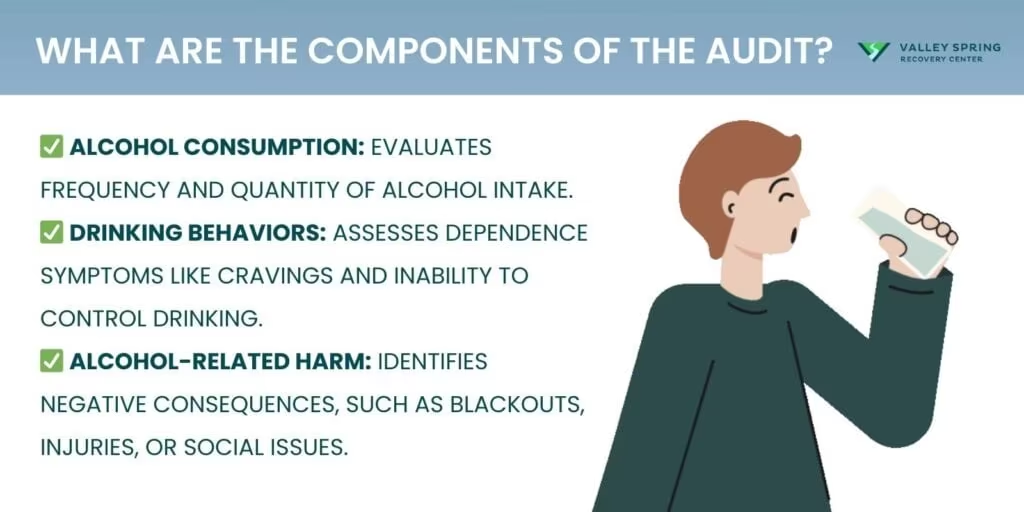
AUDIT asks about the past 12 months. Questions 1 through 3 address consumption, questions 4 through 6 address dependence symptoms, and questions 7 through 10 address alcohol-related harm.
Each response receives a tool-specific value. The full score ranges from 0 to 40, and interpretation depends on the instrument version, setting, population, and follow-up assessment.
What Is the Alcohol Use Disorders Identification Test?
AUDIT is a structured alcohol questionnaire developed by the World Health Organization for early identification of risky and harmful drinking. A person can complete it independently or with a trained professional, but the result still requires clinical context when concern is present.
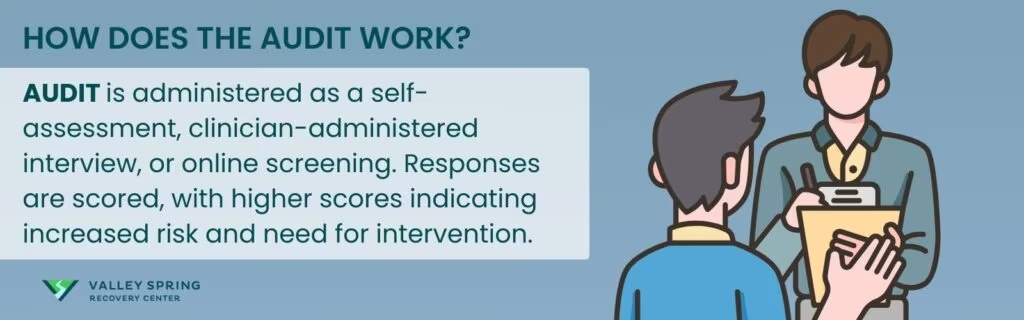
AUDIT differs from a diagnostic interview because it does not establish every symptom, duration requirement, impairment domain, medical explanation, or co-occurring condition needed for diagnosis.
What Are the 10 AUDIT Questions?
The 10 AUDIT questions cover consumption, control, dependence, consequences, injury, and concern from others. The questions summarize the standard areas while preserving the instrument's three-part structure.
- How often do you have a drink containing alcohol?
- How many drinks do you have on a typical drinking day?
- How often do you have six or more drinks on one occasion?
- How often have you been unable to stop drinking once you started?
- How often has drinking caused you to fail to do what was normally expected?
- How often have you needed a morning drink after heavy drinking?
- How often have you felt guilt or remorse after drinking?
- How often have you been unable to remember what happened because of drinking?
- Have you or someone else been injured because of your drinking?
- Has a relative, friend, doctor, or other health worker expressed concern or suggested that you cut down?
What Is the Difference Between AUDIT and AUDIT-C?
AUDIT-C is the three-question consumption subset of the full AUDIT. AUDIT-C asks about drinking frequency, typical quantity, and high-volume occasions, while full AUDIT adds dependence symptoms and alcohol-related consequences.
AUDIT-C is useful when a short adult screen is needed. A positive AUDIT-C result may lead to the full AUDIT, brief intervention, or a broader assessment rather than an automatic diagnosis.
The alcohol screening comparison places AUDIT and AUDIT-C beside CAGE, MAST, and breathalyzer testing so the instruments are not treated as interchangeable.
How Is AUDIT Scored?
AUDIT scoring adds the values assigned to its 10 responses. Each item contributes 0 to 4 points, and the complete score ranges from 0 to 40.
Question 9 and question 10 use response choices that are not identical to the frequency items, so scoring must follow the official form rather than an improvised point system.
What Do AUDIT Score Ranges Mean?
AUDIT score ranges indicate increasing alcohol-related risk, not DSM-5-TR severity. The commonly used WHO interpretation groups scores into four bands:
- 0 to 7: lower-risk pattern in the population and setting studied; clinical context still matters.
- 8 to 15: hazardous or harmful use that generally calls for feedback, brief intervention, or further assessment.
- 16 to 19: higher-risk use that generally calls for continued assessment and focused intervention.
- 20 to 40: a pattern associated with a higher likelihood of alcohol dependence and a need for diagnostic evaluation.
A cutoff is a decision rule, not a diagnosis. Age, pregnancy, setting, culture, language, medical risk, and the reason for screening can change how a clinician responds to the same score.
What Does a High AUDIT Score Mean?
A high AUDIT score means the reported pattern contains more consumption, dependence, or harm signals than a lower score. It supports a closer assessment of withdrawal, injuries, impaired control, health effects, and the person's goals.
A high score does not prove alcohol use disorder. The clinical assessment process reviews current diagnostic criteria and level-of-care factors after screening.
Where Is AUDIT Used?
AUDIT is used in primary care, hospitals, behavioral-health settings, research, and public-health screening. The same questionnaire can support different workflows, so administration, privacy, referral options, and follow-up should match the setting.
AUDIT can support brief intervention and treatment referral, but it should not be used as a stand-alone measure of treatment progress or withdrawal severity.
What Are the Validation Limits of AUDIT?
AUDIT validation results vary by language, population, setting, cutoff, and outcome. Sensitivity and specificity from one study do not provide a universal accuracy percentage for every person or use.
AUDIT also depends on self-report. Memory, stigma, fear of consequences, intoxication, literacy, and the quality of the administration can affect responses.
How Does AUDIT Compare With Other Alcohol Screens?
AUDIT is broader than CAGE and more behavior-focused than MAST in its standard past-year reference period. CAGE is shorter and lifetime-based. MAST is longer and focuses on lifetime alcohol-related problems. A breathalyzer provides a biological measurement rather than a questionnaire score.
These tools should be selected for the question being asked. A clinician may combine results, but one score should not be translated into another instrument's scale.
What Should You Do After Taking AUDIT?
After AUDIT, review the result with a qualified professional when the score is elevated or drinking is causing harm. Follow-up should include safety, withdrawal risk, medical conditions, mental health, other substances, and the person's preferred next step.
Anyone with severe withdrawal symptoms, confusion, seizures, hallucinations, or immediate danger needs urgent medical help rather than an online score interpretation.
Sources & References4ShowHide
- World Health Organization. AUDIT: The Alcohol Use Disorders Identification Test: Guidelines for Use in Primary Care — Original WHO guidance for administration, questions, scoring, and interpretation.
- Saunders JB, Aasland OG, Babor TF, de la Fuente JR, Grant M. Development of the Alcohol Use Disorders Identification Test (AUDIT). Addiction, 1993 (PubMed) — Original development and validation study of the 10-item AUDIT.
- National Institute on Alcohol Abuse and Alcoholism. Screen and Assess: Use Quick, Effective Methods — Current U.S. clinical guidance on AUDIT-C, single-question screening, and follow-up.
- U.S. Preventive Services Task Force. Unhealthy Alcohol Use in Adolescents and Adults: Screening — Recommends screening adults and pregnant persons and providing brief behavioral counseling when indicated.