


Clinical guide
7-OH Ban: DEA Scheduling Status and State Laws (October 2026)
The FDA recommended scheduling 7-OH in 2025 and many states ban it. See the DEA scheduling status, which states ban 7-OH, and what changes for users.
By Lisa Siclari·Reviewed by Stephen LaTourette, Pharm.D., RPh, CADC Intern·11 min read
Published ·Updated
The 7-OH ban is a set of federal and state actions to control 7-hydroxymitragynine (7-OH), a kratom alkaloid with opioid-like effects that is sold in concentrated tablets, gummies, drink mixes and shots. As of October 14, 2026, 7-OH is not a federally controlled substance. The DEA proposed a temporary Schedule I order in July 2026, did not issue it, and on October 14, 2026 replaced that proposal with a new notice and a revised threshold.
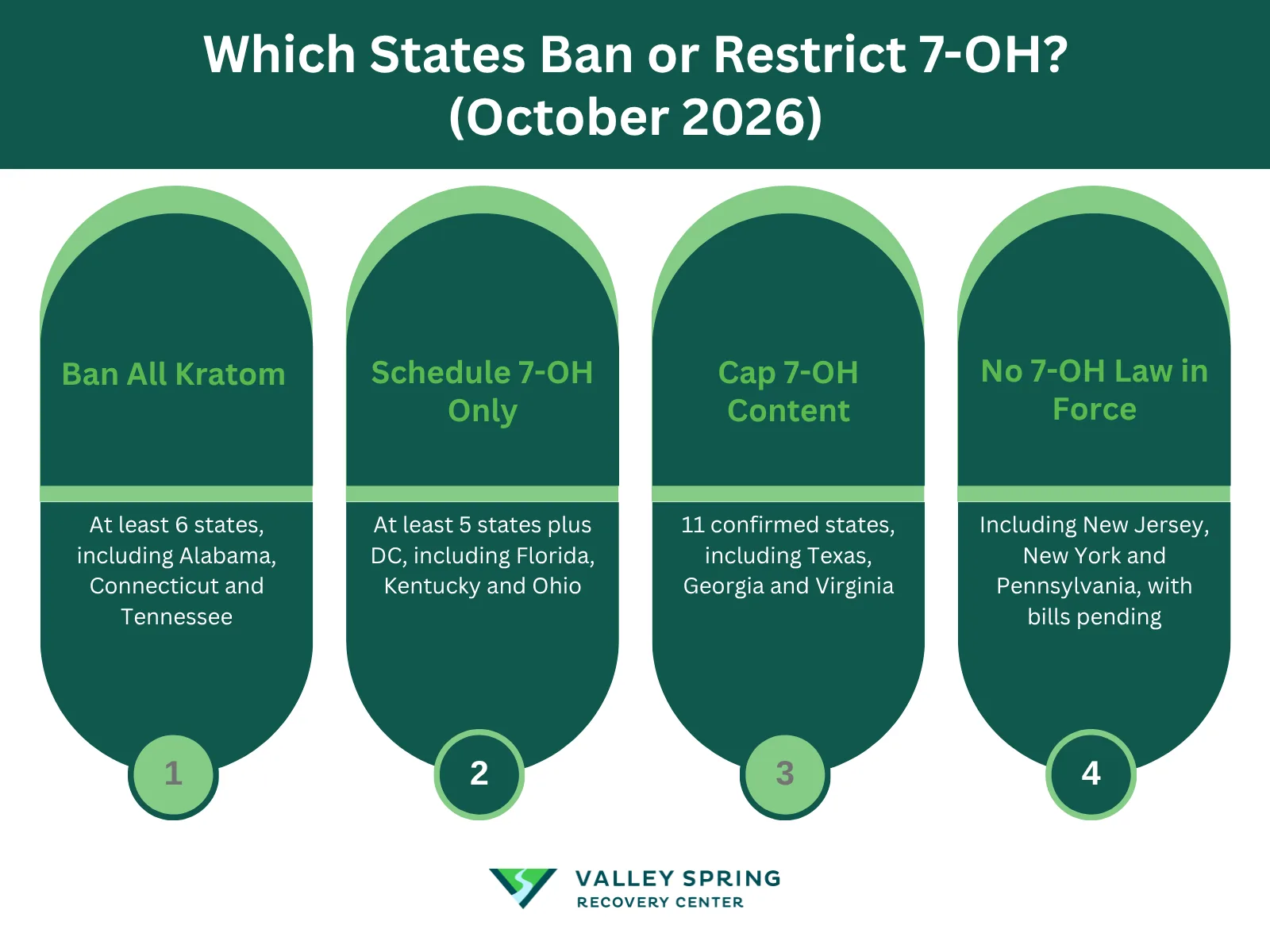
The new DEA notice allows a temporary order to be published on or after November 13, 2026. State law is already stricter in many places: at least 6 states ban kratom outright, and at least 5 states plus the District of Columbia schedule 7-OH itself.
This tracker separates what is in force from what is proposed, gives the effective date for each state law, and records the source for every entry.
Is 7-OH Banned in the United States?
No, 7-OH is not banned under federal drug law as of October 14, 2026, but federal agencies already treat 7-OH products as illegal to sell as supplements or food. The Department of Justice (DOJ) confirmed on October 9, 2026 that the DEA "had not issued a temporary scheduling order for 7-OH." Federal scheduling and federal food-and-drug law are separate questions, and 7-OH products are restricted under the second while the first is pending. 7-OH (7-hydroxymitragynine) differs from kratom leaf in potency, effects and risks.
When Will the Federal 7-OH Ban Start?
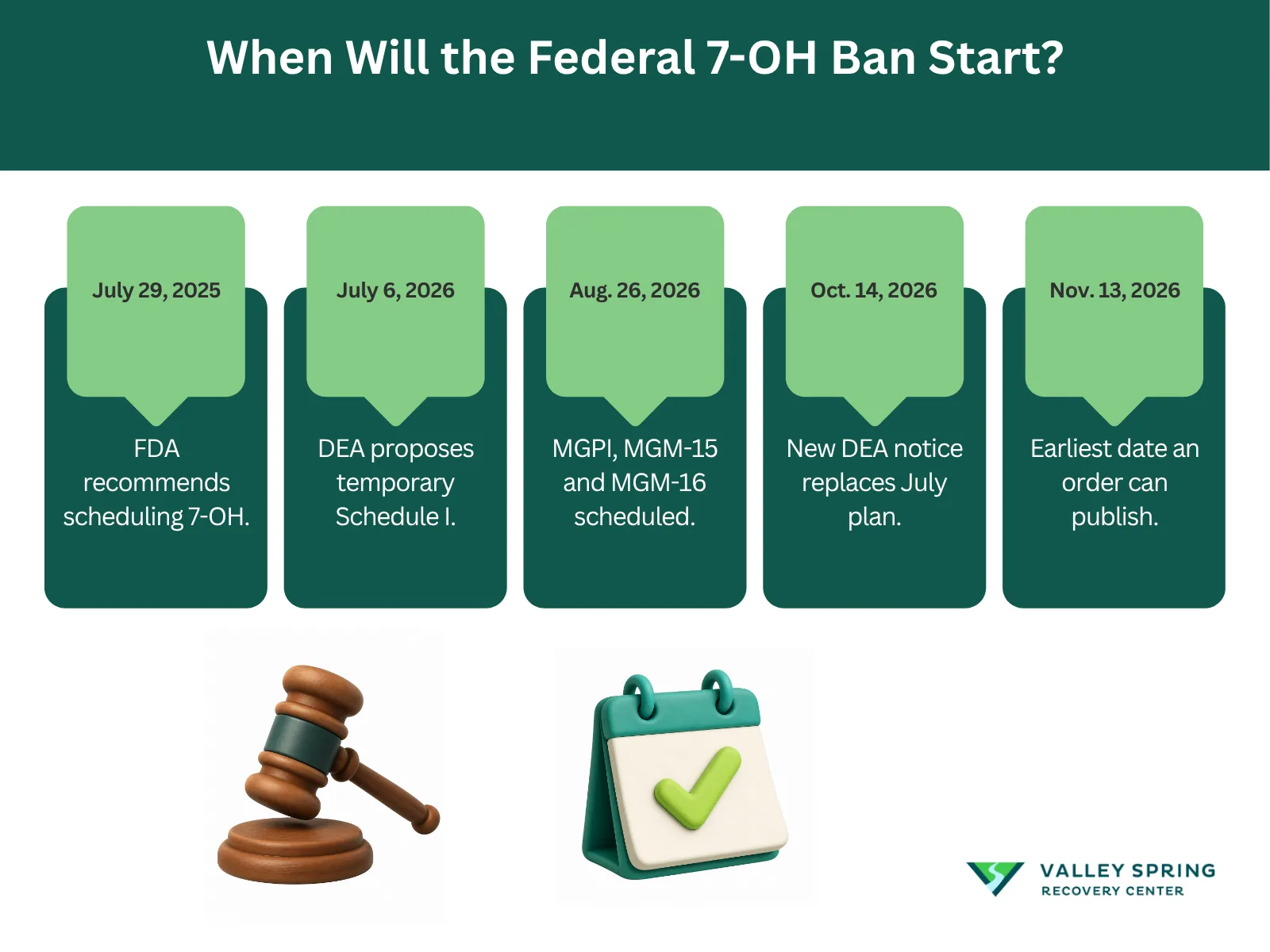
The federal 7-OH ban can start on or after November 13, 2026, 30 days after the DEA's October 14, 2026 notice of intent. The DEA's July 2026 notice gave an earlier "on or after August 5, 2026" date, and no order followed, so November 13 is a floor, not a promise. The federal timeline has 7 steps so far:
| Date | Action |
|---|---|
| July 29, 2025 | The FDA announced it recommended scheduling certain 7-OH products under the Controlled Substances Act, after warning letters to 7 companies. |
| December 2, 2025 | The DOJ seized about 73,000 units of 7-OH products from 3 Kansas City-area warehouses. |
| July 6, 2026 | The DEA published a notice of intent to place 7-OH above a threshold in temporary Schedule I (Federal Register document 2026-13580). |
| August 26, 2026 | The DEA placed MGPI, MGM-15 and MGM-16 in temporary Schedule I until August 26, 2028. 7-OH was not included. |
| October 9, 2026 | The DOJ announced the DEA would restart 7-OH scheduling with a revised threshold recommended by the Department of Health and Human Services (HHS). |
| October 14, 2026 | The DEA published a new notice of intent for 7-OH and MGPI (Federal Register document 2026-20943) and withdrew the July notice. |
| On or after November 13, 2026 | Earliest date the DEA can publish the temporary Schedule I order for 7-OH. |
A temporary scheduling order lasts 2 years and can be extended by 1 year while the DEA pursues permanent scheduling, according to the July 2026 notice. No permanent scheduling rule for 7-OH has been proposed in the Federal Register as of October 14, 2026.
What Would the DEA's 7-OH Threshold Cover?
The DEA's 7-OH threshold covers concentrated and enhanced 7-OH products, not ordinary kratom leaf. The October 14, 2026 notice places 7-OH and MGPI in Schedule I when a product meets any of 3 tests, alone or combined:
- Solids: more than 1 mg of 7-OH or MGPI per gram, in powders, capsules or other solid forms.
- Liquids: more than 1 mg of 7-OH or MGPI per milliliter.
- Ratio: less than 100 parts mitragynine for each part 7-OH or MGPI by mass.
The ratio test targets products whose 7-OH has been boosted relative to the mitragynine that dominates natural leaf. The notice states that neither HHS nor the DEA has found 7-OH safe at levels below the threshold. The withdrawn July 2026 proposal used a different test, more than 0.05% 7-OH or more than 1 mg per article, and that test no longer applies.
Which 7-OH-Related Substances Are Already Federally Controlled?
Three 7-OH-related substances, mitragynine pseudoindoxyl (MGPI), MGM-15 and MGM-16, are already in federal Schedule I. The DEA's temporary order took effect on August 26, 2026 and runs until August 26, 2028. MGPI appears in some concentrated kratom products, and MGM-15 and MGM-16 are synthetic derivatives. The DEA published a companion notice on October 14, 2026 reissuing MGM-15 and MGM-16 unchanged.
Is Selling 7-OH Already Illegal Under Federal Law?
Yes, selling 7-OH as a dietary supplement or food is already illegal under the Federal Food, Drug, and Cosmetic Act, separate from drug scheduling. The FDA sent warning letters in 2025 to 7 companies marketing 7-OH tablets, gummies, drink mixes and shots. In the December 2, 2025 seizure, Assistant Attorney General Brett Shumate stated that "products containing 7-OH are illegal under federal law." The FDA has not approved 7-OH to treat any condition.
Which States Ban or Restrict 7-OH?
States regulate 7-OH in 4 different ways: banning all kratom, scheduling 7-OH itself, capping 7-OH content, or setting age and food rules only. The DEA notice states that federal scheduling "does not preempt more restrictive state law," so a state ban stays in force regardless of the federal outcome. The tables list laws confirmed on state government sources as of October 13, 2026.
States That Ban All Kratom, Including 7-OH
| State | What the law does | Effective |
|---|---|---|
| Alabama | Mitragynine and hydroxymitragynine are Schedule I (Ala. Code § 20-2-23); Attorney General cease-and-desist order enforces it statewide. | In force; order March 25, 2026 |
| Arkansas | Mitragynine and 7-OH listed in Schedule I by rule. | In force since 2015–2016 |
| California | Department of Public Health: foods, supplements and drugs containing kratom or 7-OH are illegal to make or sell for consumption. | October 24, 2025 |
| Connecticut | 7-OH and Mitragyna speciosa (leaf, stem, extracts) are Schedule I (Public Act 25-101). | April 2, 2026 |
| Massachusetts | Emergency temporary Schedule 1: kratom plant, mitragynine, 7-OH, MGPI, MGM-15, MGM-16. | August 28, 2026, for 1 year |
| Tennessee | "Matthew Davenport's Law": kratom criminalized; possession a Class A misdemeanor, sale a Class C felony. | July 1, 2026 |
Kentucky's ban on all kratom sales takes effect July 1, 2027. Louisiana, Wisconsin and Indiana are widely reported to ban kratom, but their statute pages could not be reached to confirm the current text on October 13, 2026.
States That Schedule 7-OH but Not Kratom Leaf
| State | What the law does | Effective |
|---|---|---|
| District of Columbia | 7-OH in Schedule I by regulation; no threshold. | In force since 2018 |
| Florida | Emergency rule: 7-OH Schedule I above 1 mg/g or 1 mg/mL or under a 100:1 mitragynine ratio; MGM-15 and MGM-16 outright. | August 18, 2026 |
| Kansas | 7-OH added to Schedule I opiates (HB 2365); mitragynine not listed. | 2026 |
| Kentucky | 7-OH Schedule I above 400 parts per million dry weight; kratom sales limited to adults 21+. | March 12, 2026 |
| North Dakota | Schedule I for kratom above 0.05% 7-OH and processed products above 0.05% or 1 mg per item; pure leaf licensed for adults 21+. | September 4, 2026 |
| Ohio | Emergency Schedule I for mitragynine-related compounds including 7-OH; natural kratom leaf excluded. | December 12, 2025 |
States That Cap 7-OH Content
| State | 7-OH limit | Minimum age | Effective |
|---|---|---|---|
| Arizona | ≤2% of alkaloids; no synthetics | 18 | In force |
| Georgia | ≤0.5 mg/g and ≤1 mg per serving; no enhancement | 21 | January 1, 2025 |
| Maryland | ≤2% of alkaloids; synthetic 7-OH banned | 21 | October 1, 2024 |
| Mississippi | ≤1% of alkaloids and ≤0.5 mg per container | 21 | July 1, 2025 |
| Oklahoma | ≤1% of alkaloids; no synthesized alkaloids | 18 | November 1, 2025 |
| Rhode Island | ≤0.5 mg/g and ≤1 mg per serving; licensed sale | 21 | April 1, 2026 |
| South Carolina | Fully synthetic 7-OH banned; 7-OH on label | 21 | July 11, 2025 |
| South Dakota | ≤2% of alkaloids; synthetic 7-OH banned | 21 | 2025 |
| Texas | ≤2% of alkaloids; synthetic 7-OH banned | 18 | September 1, 2023 |
| Virginia | 7-OH above 1% of alkaloids or 1 mg per serving banned | 21 | July 1, 2026 |
| Wyoming | ≤2% of alkaloids; synthesized 7-OH banned | 21 | July 1, 2026 |
Colorado, Utah, Nebraska and Oregon also regulate kratom product content or registration. Minnesota and Delaware set a minimum age of 21 for kratom sales without a 7-OH cap.
States With No 7-OH Law in Force
New Jersey, New York, Pennsylvania, North Carolina, Michigan, Missouri, Iowa, Nevada, Washington and Illinois had no state law on 7-OH itself in force as of October 13, 2026, though bills are pending in several of them. Michigan's rules adopt federal schedules by reference, so a federal 7-OH order could apply there without a new state law. West Virginia's 7-OH rule was amended in August 2026, and its current limit could not be confirmed.
Is 7-OH Legal in New Jersey?
7-OH is not banned by New Jersey law as of October 14, 2026, but 3 related compounds are. The New Jersey Attorney General announced that MGPI, MGM-15 and MGM-16 became controlled dangerous substances in New Jersey on September 25, 2026, following the federal order, and that natural kratom remains legal. New Jersey adopts a federal scheduling unless the Director of the Division of Consumer Affairs objects, which is how those 3 compounds became controlled.
Two New Jersey bills would classify 7-OH as a Schedule I drug. Senate Bill S301 cleared the Senate Health, Human Services and Senior Citizens Committee on March 16, 2026 and sits in the Senate Budget and Appropriations Committee. Its Assembly companion, A5359, was introduced on September 10, 2026. Both bills would amend NJ kratom law.
Is 7-OH Legal in New York?
7-OH is legal to sell in New York as of October 14, 2026, but a sales ban has passed the legislature. Senate Bill S8925A would prohibit selling products with 7-OH above 2% of total alkaloids or 1 mg per serving. The bill passed the Senate 61-0 on June 2, 2026 and the Assembly on June 5, 2026, and it has not been signed into law. New York's under-21 kratom sales ban and kratom warning-label law were signed on December 22, 2025. Both measures are now part of NY kratom law.
What Does a 7-OH Ban Mean for People Who Use 7-OH?
A 7-OH ban means daily users can lose their supply suddenly, which can start opioid-type withdrawal. 7-OH acts on mu-opioid receptors, and the FDA describes physical dependence and withdrawal after regular use. A store closing or a product leaving the shelf can stop daily use overnight.
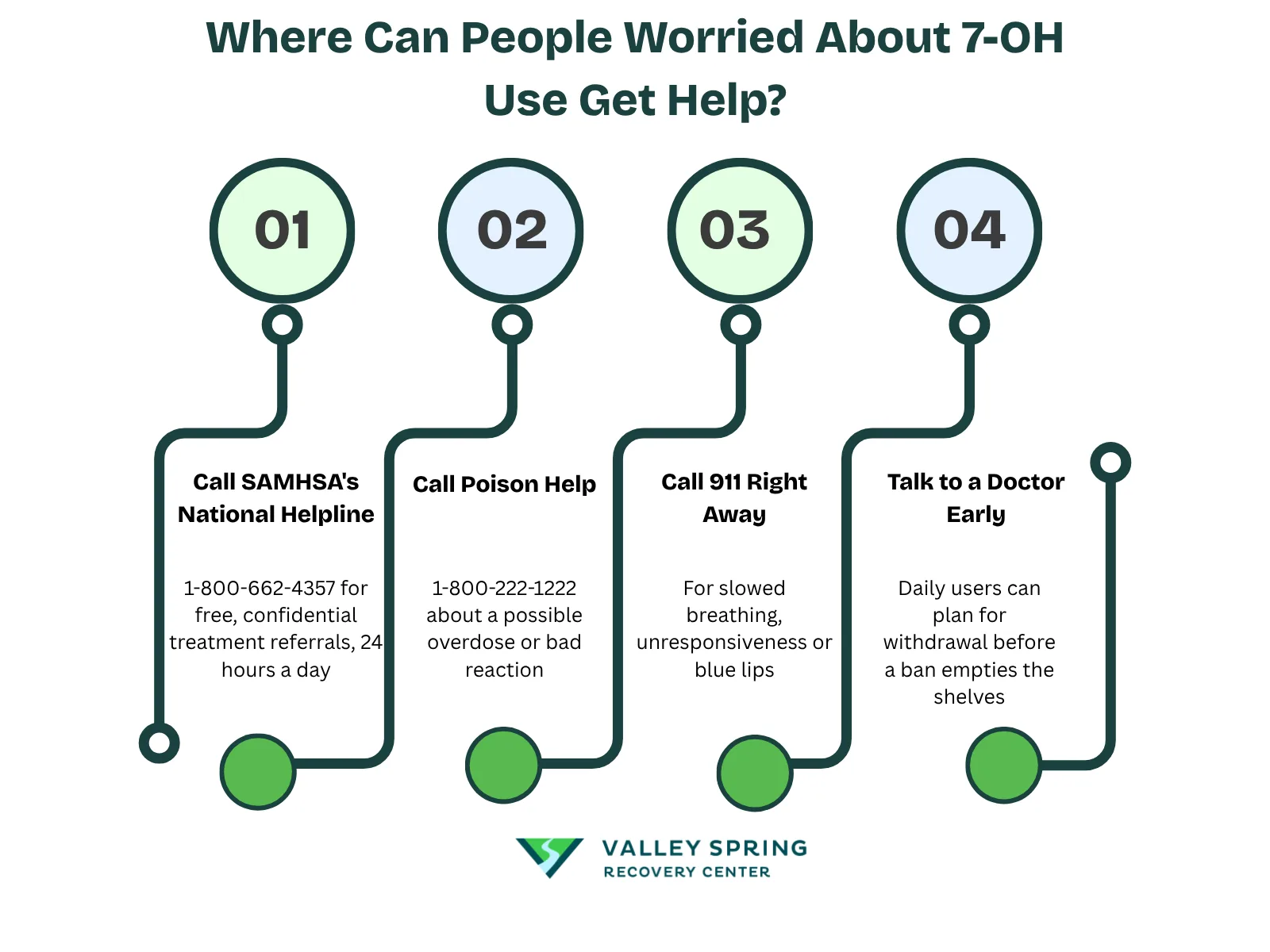
There are 3 sources of help for people worried about 7-OH use:
- Call SAMHSA's National Helpline at 1-800-662-4357 for free, confidential treatment referrals, 24 hours a day.
- Call Poison Help at 1-800-222-1222 about a possible overdose or bad reaction to a 7-OH product.
- Call 911 for slowed breathing, unresponsiveness or blue lips.
How Can You Check Whether a 7-OH Law Has Changed?
Check 3 primary sources to confirm the current 7-OH law, because news and retailer pages often repeat outdated dates:
- Search the Federal Register for DEA docket DEA-1570 to see whether a 7-OH temporary order has been published.
- Read the state legislature's bill page for the latest action on a pending bill, such as New Jersey's S301.
- Follow the state attorney general, health department or pharmacy board, which announce emergency scheduling orders.
Frequently Asked Questions About the 7-OH Ban
Is 7-OH illegal now?
7-OH is not federally scheduled as of October 14, 2026, but selling it as a supplement or food is illegal under federal law. Several states, including Alabama, Connecticut, Florida and Ohio, already ban or schedule 7-OH.
When will the DEA ban 7-OH?
The DEA can publish a temporary Schedule I order for 7-OH on or after November 13, 2026. That date is the earliest possible start; an earlier August 2026 date passed without an order.
Is the 7-OH ban the same as a kratom ban?
No, the federal 7-OH proposal targets concentrated products, not kratom leaf. Some states, such as Alabama, Connecticut and Tennessee, ban all kratom, while others schedule only 7-OH or cap its content.
Does the federal 7-OH ban cover kratom leaf?
No, ordinary kratom leaf falls below the proposed threshold of 1 mg of 7-OH per gram. HHS and the DEA state that falling below the threshold is not a finding that a product is safe.
What states is 7-OH legal in?
Under state law, 7-OH products remain legal for adults in states without a 7-OH ban, such as New Jersey, New York and Pennsylvania, as of October 2026. States like Texas allow sales only below a 7-OH content cap.
What happens if you are caught with 7-OH?
The penalty depends on the state. In Tennessee, kratom possession is a Class A misdemeanor. Federal controlled-substance penalties apply to 7-OH only after a Schedule I order is published.
Is 7-OH an opioid?
7-OH is an opioid-receptor agonist that activates mu-opioid receptors, though it is not derived from opium. The FDA has stated that 7-OH can be more potent than morphine.
Sources & References21ShowHide
- Drug Enforcement Administration (2026, October 14). Schedules of Controlled Substances: Temporary Placement of 7-Hydroxymitragynine and Mitragynine Pseudoindoxyl Above a Specified Threshold in Schedule I. Federal Register document 2026-20943.
- Drug Enforcement Administration (2026, July 6). Schedules of Controlled Substances: Temporary Placement of 7-Hydroxymitragynine Above a Specified Threshold in Schedule I. 91 FR 40917.
- Drug Enforcement Administration (2026, August 26). Temporary placement of mitragynine pseudoindoxyl, MGM-15 and MGM-16 in Schedule I. 91 FR 54948.
- U.S. Department of Justice (2026, October 9). Department of Justice Announces Updates to Emergency Scheduling Actions for 7-OH and Related Opioid Substances.
- U.S. Department of Justice (2025, December 2). Justice Department Seizes Unlawful 7-OH Products from Three Warehouses.
- U.S. Food and Drug Administration (2025, July 29). FDA Takes Steps to Restrict 7-OH Opioid Products Threatening American Consumers.
- U.S. Food and Drug Administration (2026). Hiding in Plain Sight: 7-OH Products.
- New Jersey Office of the Attorney General (2026, September 25). Public alert: three types of synthetic kratom to be listed as controlled dangerous substances in New Jersey.
- New Jersey Legislature. Bill history for S301 and A5359 (2026–2027 session).
- New York State Senate. Senate Bill S8925A (2025–2026).
- Office of the Governor of New York (2025, December 22). Governor Hochul signs two pieces of landmark legislation on kratom.
- Alabama Attorney General (2026). Statewide cease-and-desist order targeting illegal kratom products.
- Connecticut Department of Consumer Protection. Kratom update.
- Tennessee Secretary of State. Public Chapter 950 (2026).
- Massachusetts Department of Public Health. Kratom.
- California Department of Public Health. News release NR25-016.
- Florida Administrative Register. Emergency Rule 2ER26-2.
- Kentucky Legislature. 902 KAR 55:015 and HB 757 (2026).
- North Dakota Legislative Assembly. HB 1628 (2026 special session).
- Office of the Governor of Ohio. Executive Order 2025-08D.
- State statutes and legislature records for Arizona, Georgia, Maryland, Mississippi, Oklahoma, Rhode Island, South Carolina, South Dakota, Texas, Virginia, Wyoming, Kansas, Arkansas and the District of Columbia, as listed in the state tables (accessed October 13, 2026).