


Clinical guide
Kratom Withdrawal: Symptoms, Timeline and Detox
Kratom withdrawal starts 12 to 48 hours after the last dose with aches, insomnia and restless legs. See the timeline, how detox works and when to get care.
By Lisa Siclari·Reviewed by Stephen LaTourette, Pharm.D., RPh, CADC Intern·11 min read
Published ·Updated
Kratom withdrawal is the set of physical and emotional symptoms that appear when a person who uses kratom regularly stops or sharply cuts down. Kratom (Mitragyna speciosa) is a Southeast Asian tree whose leaves contain mitragynine and 7-hydroxymitragynine (7-OH), alkaloids that act on the same mu-opioid receptors as opioid pain medications.
Kratom withdrawal symptoms typically emerge 12 to 24 hours after the last dose and resemble mild opioid withdrawal, according to psychiatrist Cornel Stanciu, MD, speaking at the American Psychiatric Association's 2022 annual meeting. Withdrawal from plain leaf kratom is usually mild to moderate. Withdrawal from concentrated 7-OH products is faster and more severe.
Kratom use is common enough that withdrawal is a practical concern. About 0.6% of Americans aged 12 and older, roughly 1.7 million people, used kratom in the past year, according to the National Institute on Drug Abuse (NIDA), citing 2021 survey data. No medication is approved by the U.S. Food and Drug Administration (FDA) to treat kratom withdrawal.
What Is Kratom Withdrawal?
Kratom withdrawal is the rebound reaction that follows when the brain's opioid receptors lose a regular supply of kratom alkaloids. Mitragynine and 7-OH activate mu-opioid receptors, and daily use leads the body to adapt to their presence. Stopping produces withdrawal symptoms until that adaptation reverses. Readers new to the plant can start with what kratom is, its effects and its risks.
Kratom withdrawal is a sign of physical dependence, which is not the same as addiction. Physical dependence describes the body's adaptation to a substance. Kratom use disorder, the clinical term for kratom addiction, adds a pattern of impaired control, craving and continued use despite harm. NIDA notes that the DSM-5 has no specific diagnosis for kratom use, so clinicians apply the general criteria for other substance use disorders.
What Are the Symptoms of Kratom Withdrawal?
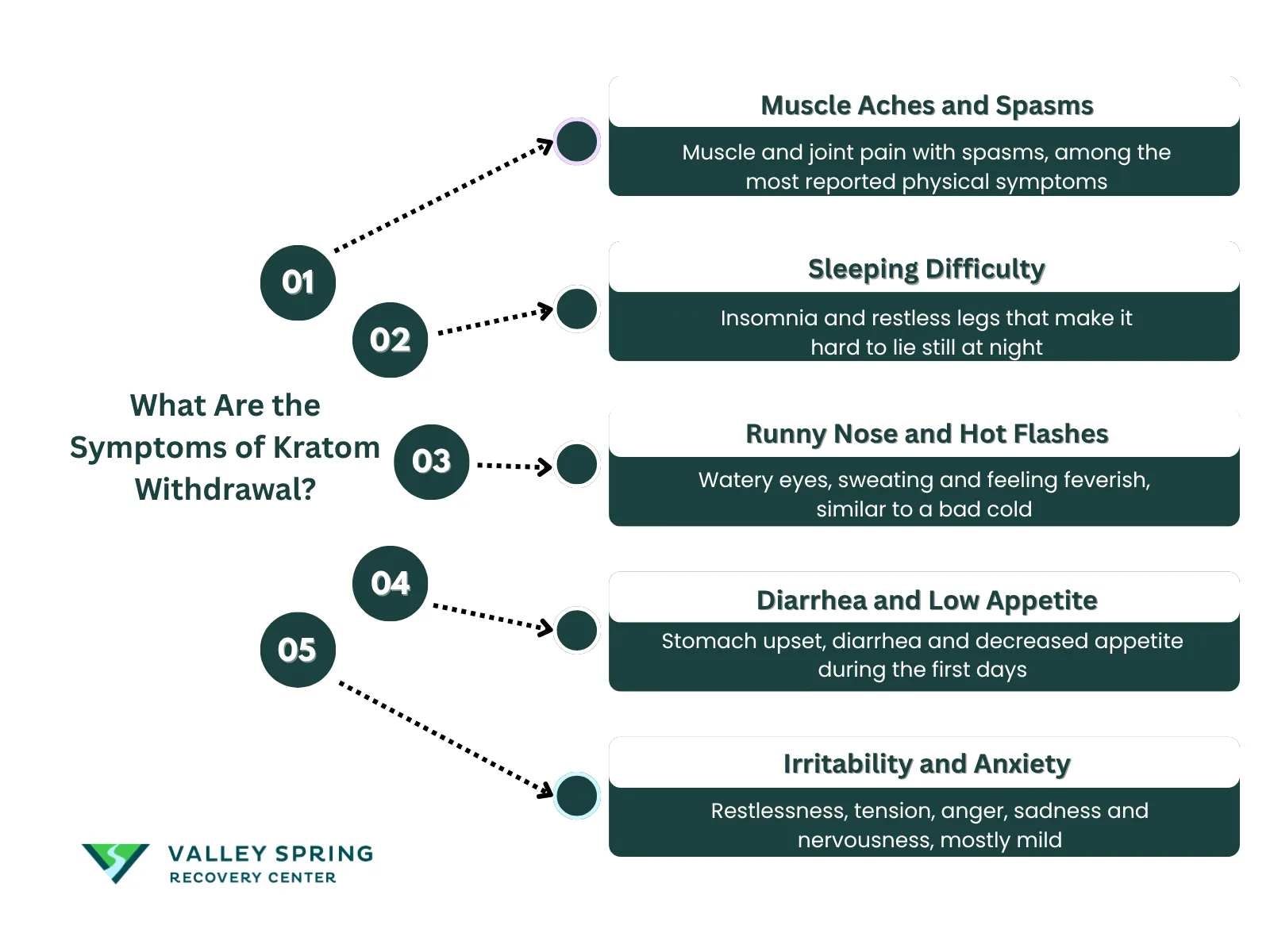
The symptoms of kratom withdrawal are muscle aches and spasms, trouble sleeping, restless legs, runny nose and watery eyes, hot flashes, diarrhea, low appetite, irritability, anxiety and low mood. Singh, Müller and Vicknasingam's 2014 study of 293 regular kratom users in Malaysia, published in Drug and Alcohol Dependence, grouped the symptoms into physical and psychological types.
Physical Symptoms of Kratom Withdrawal
Singh and colleagues (2014) recorded 7 physical kratom withdrawal symptoms:
- Muscle spasms and muscle or joint pain.
- Sleeping difficulty, including waking through the night.
- Watery eyes and a runny nose.
- Hot flashes and sweating.
- Fever or feeling feverish.
- Decreased appetite.
- Diarrhea and stomach upset.
Psychological Symptoms of Kratom Withdrawal
The psychological symptoms of kratom withdrawal are restlessness, tension, anger, sadness and nervousness, according to Singh and colleagues (2014). Most cases are mild. A 2018 follow-up study by Singh's group of 150 kratom users, published in the Journal of Psychoactive Drugs, found that 70% had mild anxiety and 81% had mild depression during cessation, while people drinking 4 or more glasses of kratom tea a day had nearly 3 times the odds of moderate depression. Kratom users in the United States also report fatigue, low energy and craving, according to a 2022 survey of 129 adults led by Kirsten Smith in the Journal of Addiction Medicine.
Kratom Withdrawal Insomnia and Restless Legs
Insomnia and restless legs are the symptoms people describe as the hardest part of kratom withdrawal, often in the same words: "I can't sleep because I can't lie still." Restless legs appeared among the rated cessation effects in Smith and colleagues' 2022 study in Frontiers in Pharmacology, and withdrawal severity rose with the number of weeks of regular use. Sleep loss feeds the other symptoms, raising irritability, anxiety and the urge to take a dose for relief.
How Long Does Kratom Withdrawal Last?
Kratom withdrawal begins about 12 to 24 hours after the last dose, and its length depends on the product, dose and duration of use, because no controlled study has mapped a day-by-day course for leaf kratom. The table below separates what the research shows from what it does not.
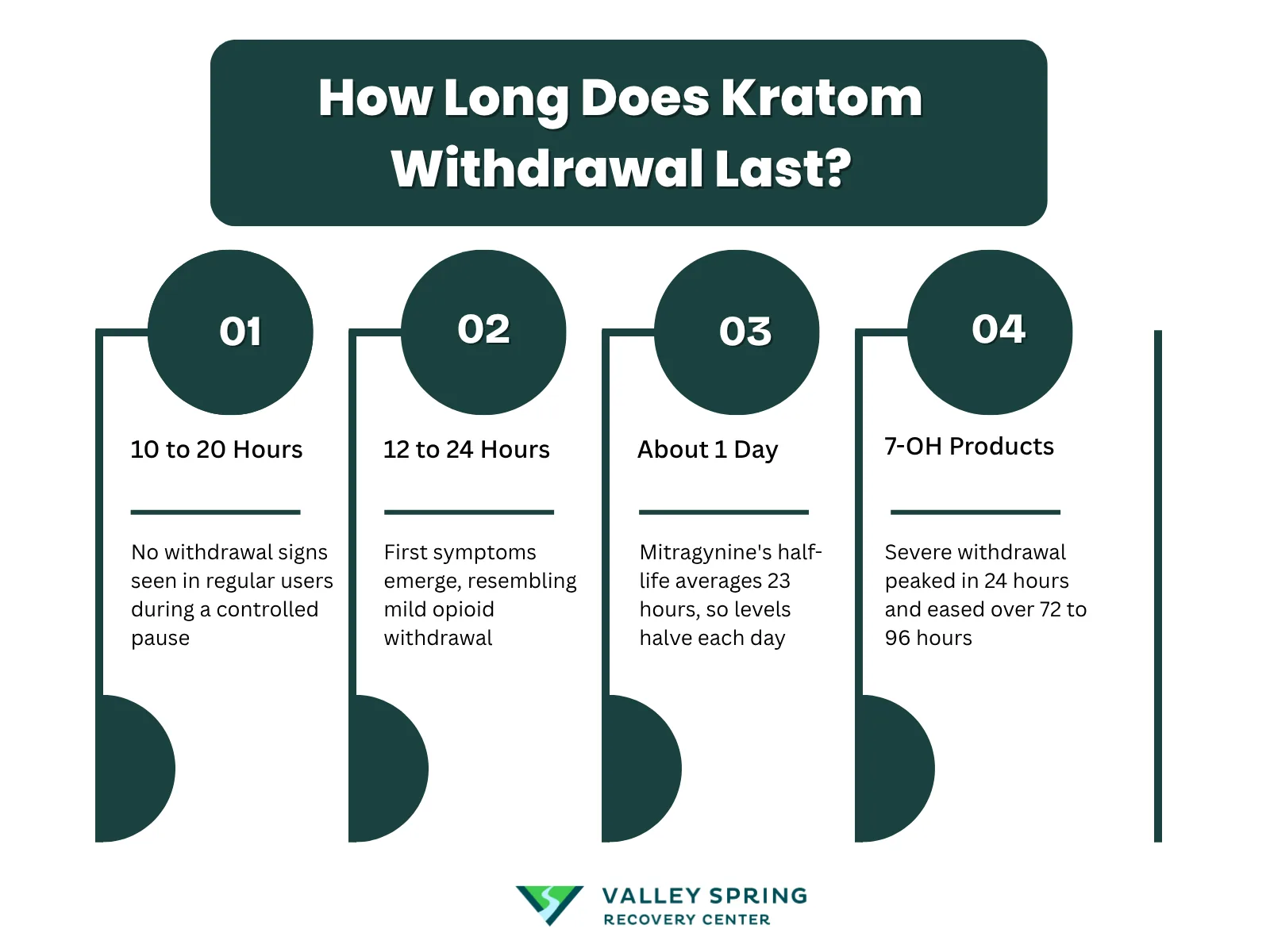
| Time since last dose | What is reported | Strength of evidence |
|---|---|---|
| 10 to 20 hours | No withdrawal signs observed in regular users during a controlled pause (Vicknasingam and colleagues, Yale Journal of Biology and Medicine, 2020). | Small controlled trial |
| 12 to 24 hours | First symptoms emerge, resembling mild opioid withdrawal (Stanciu, American Psychiatric Association, 2022). | Expert clinical estimate |
| About 1 day | Mitragynine's half-life averages 23 hours, so blood levels halve in about a day (Trakulsrichai and colleagues, 2015). | Pharmacokinetic study, 9 users |
| First 24 hours to 4 days (7-OH products) | Severe opioid-type withdrawal peaked in the first 24 hours and improved over 72 to 96 hours with medical treatment (Stanciu, Cureus, 2026). | Single case report |
Most treatment-center guides describe physical kratom withdrawal symptoms easing within about a week, with sleep, mood and cravings taking longer. None of those guides cites a study for the figure, so treat a 1-week course as a common clinical description, not a measured average. Heavier daily use, longer use and concentrated products extend withdrawal.
Is Kratom Withdrawal as Bad as Opioid Withdrawal?
Kratom withdrawal from plain leaf is generally milder than withdrawal from heroin, fentanyl or prescription opioids. Stanciu described leaf kratom withdrawal as resembling mild opioid withdrawal, and in Singh's 2018 study most anxiety and depression during cessation was mild. Comparison depends heavily on the product, because concentrated kratom products behave more like opioids than like the leaf.
Withdrawal From 7-OH and Concentrated Kratom Products
Withdrawal from concentrated 7-OH and mitragynine pseudoindoxyl products is faster and closer to full opioid withdrawal than leaf kratom withdrawal. Stanciu's 2026 case report in Cureus contrasted the "mild, delayed withdrawal" of traditional kratom with "rapid-onset, full-spectrum opioid-like withdrawal" from mitragynine pseudoindoxyl, including withdrawal between doses spaced more than 5 to 6 hours apart. These products are sold as tablets, gummies, drink mixes and shots.
Harms from kratom products are rising. Towers and colleagues' 2026 report in the CDC's Morbidity and Mortality Weekly Report counted 3,434 kratom exposure calls to U.S. poison centers in 2025, up from 258 in 2015. In New Jersey, the Ocean County Health Department warned in January 2026 of an increase in overdoses linked to 7-OH and kratom. In 2026 the Drug Enforcement Administration also began federal scheduling actions on 7-OH and related compounds.
Who Is Most Likely to Experience Kratom Withdrawal?
Kratom withdrawal is most likely in people who use large amounts several times a day, for months, or who have a history of opioid use. How common withdrawal is depends on who is studied. In a 2020 survey of 2,798 U.S. kratom users by Garcia-Romeu and colleagues in Drug and Alcohol Dependence, 2% met criteria for moderate or severe kratom use disorder. In Singh's 2014 Malaysian sample of long-term daily tea drinkers, more than half had severe dependence.
The research identifies 4 risk factors for kratom withdrawal:
- High daily dose: withdrawal is reported mainly with more than 3 grams of leaf taken more than twice a day, according to a 2023 expert forum in Drug and Alcohol Dependence Reports.
- Frequent servings: drinking 3 or more glasses of kratom tea a day raised the odds of severe dependence and withdrawal in Singh's 2014 study.
- Long duration: withdrawal severity rose with the number of weeks of regular use in Smith's 2022 study.
- Opioid history: people with past opioid use report kratom withdrawal more often.
The 2023 expert forum was funded by kratom industry groups, the American Kratom Foundation and the International Plant and Herbal Alliance, which readers should weigh when reading its conclusions.
Should You Taper Off Kratom or Stop Cold Turkey?
Tapering off kratom is a gradual dose reduction that works best when a clinician sets the pace. A taper lowers the daily amount in small steps over days to weeks, so the body readjusts to less kratom at each step instead of losing all of it overnight. The 2023 expert forum listed gradual tapering among the approaches to evaluate for kratom withdrawal, and no trial has yet compared tapering with stopping abruptly.
Self-tapering is not appropriate in 4 situations:
- Using 7-OH or concentrated products, which cause faster, more severe withdrawal.
- Having a history of opioid use disorder, because relapse to opioids after lost tolerance raises overdose risk.
- Being pregnant, because the FDA reports withdrawal signs in newborns exposed to kratom.
- Living with depression, anxiety or other substance use that withdrawal can worsen.
What Do Doctors Give You for Kratom Withdrawal?
Doctors treat kratom withdrawal with supportive medications for specific symptoms, and sometimes with buprenorphine, because NIDA reports that no medical therapies are approved for kratom withdrawal or kratom use disorder. Supportive medications reported in the medical literature include clonidine and lofexidine, plus medications for diarrhea, nausea and sleep. Stanciu's 2026 case used clonidine, hydroxyzine, gabapentin, loperamide and anti-nausea medication. A prescriber chooses medications and doses after an assessment.
Can Suboxone Treat Kratom Withdrawal?
Suboxone (buprenorphine and naloxone) has treated kratom withdrawal successfully in case reports and case series, but no controlled trial has tested it. Smith, Epstein and Weiss's 2024 review in Current Psychiatry Reports found that 17 of 19 surveyed addiction physicians chose buprenorphine for kratom use disorder. The same review recommends medication for opioid use disorder as first-line treatment when kratom use disorder occurs together with opioid use disorder, and an individual risk-benefit decision when it does not. The largest case series, published by Broyan and colleagues in Substance Abuse in 2022, followed 28 patients on long-term buprenorphine, and 82% tested negative for mitragynine at week 12.
When Does Kratom Withdrawal Need Medical Detox?
Kratom withdrawal needs medical detox when symptoms are severe, when concentrated products or opioids are involved, or when another health condition raises the risk. There are 6 signs that withdrawal calls for medical supervision:
- Using 7-OH, mitragynine pseudoindoxyl or other concentrated products.
- Using opioids, benzodiazepines or alcohol alongside kratom.
- Vomiting or diarrhea that prevents keeping fluids down.
- Pregnancy during kratom use.
- Thoughts of suicide or severe depression during withdrawal.
- Repeated failed attempts to stop or taper alone.
Medical detox provides monitoring and symptom medications around the clock until withdrawal stabilizes. Valley Spring Recovery Center does not provide detox on site; its admissions team arranges medical detox placement with a detox provider and keeps contact through stabilization so treatment continues afterward.
What Treatment Follows Kratom Withdrawal at Valley Spring Recovery?
Treatment after kratom withdrawal at Valley Spring Recovery Center is outpatient addiction care at 3 levels: Partial Care, Intensive Outpatient and Outpatient, at 830 Broadway in Norwood, Bergen County, New Jersey. Withdrawal ends the physical dependence, but cravings, sleep problems and the reasons behind kratom use continue, and those are the focus of rehabilitation.
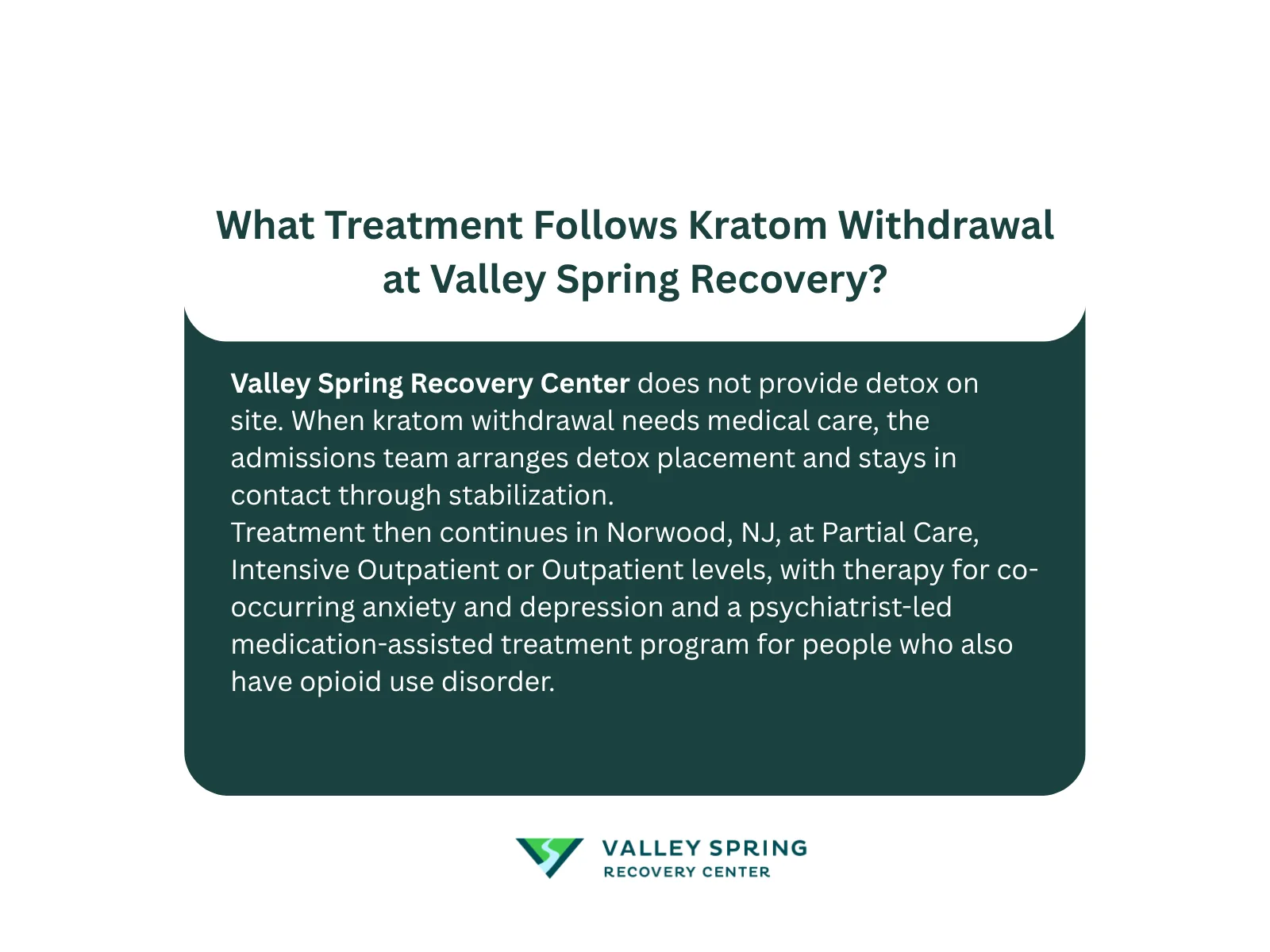
Valley Spring's on-staff psychiatrist runs a medication-assisted treatment program that includes buprenorphine (Suboxone and Brixadi) and naltrexone (Vivitrol), considered for people whose kratom use occurs with opioid use disorder. Therapists also treat co-occurring anxiety and depression, which are common among kratom users. Outpatient kratom rehab after withdrawal continues at these same levels of care.
Frequently Asked Questions About Kratom Withdrawal
What is the hardest day of kratom withdrawal?
No study has identified a peak day for leaf kratom withdrawal. Clinicians describe symptoms starting within 12 to 24 hours. With concentrated 7-OH products, a 2026 case report found withdrawal peaked within the first 24 hours.
How do you switch from kratom to Suboxone?
A prescriber decides when and how to start Suboxone after an in-person assessment. Timing depends on which product was used last and when, so the switch is a medical plan, not a home plan.
Does Suboxone stop all kratom withdrawal symptoms?
No, Suboxone is not proven to stop kratom withdrawal, because no controlled trial has tested it. Case series report stabilization on buprenorphine, and therapy addresses the sleep problems, anxiety and cravings that medication leaves.
Can you die from kratom withdrawal?
No published source records a death from kratom withdrawal itself. The dangers are dehydration, relapse and overdose after returning to opioids or 7-OH with lower tolerance, especially when other sedatives are involved. Call 911 if someone is hard to wake or breathing slowly.
Do people go to rehab for kratom?
Yes, people with kratom use disorder receive treatment in detox, outpatient and residential programs. In a 2020 survey of 2,798 kratom users, 0.6% had sought treatment for adverse effects of kratom.
How long does kratom stay in your system?
Mitragynine, kratom's main alkaloid, has an average half-life of about 23 hours. Blood levels halve roughly every day, which explains why withdrawal begins within about a day of the last dose.
Sources & References18ShowHide
- National Institute on Drug Abuse (2026). Kratom.
- U.S. Food and Drug Administration (2025). FDA and Kratom.
- American Psychiatric Association (2022). Psychiatric News Alert: kratom withdrawal, remarks by Cornel Stanciu, MD.
- Singh, D., Müller, C. P., & Vicknasingam, B. K. (2014). Kratom (Mitragyna speciosa) dependence, withdrawal symptoms and craving in regular users. Drug and Alcohol Dependence, 139, 132–137.
- Singh, D., et al. (2018). Severity of Kratom (Mitragyna speciosa Korth.) Psychological Withdrawal Symptoms. Journal of Psychoactive Drugs.
- Smith, K. E., et al. (2022). Assessment of Kratom Use Disorder and Withdrawal Among an Online Convenience Sample of US Adults. Journal of Addiction Medicine.
- Smith, K. E., et al. (2022). Searching for a Signal: Self-Reported Kratom Dose-Effect Relationships Among a Sample of US Adults With Regular Kratom Use Histories. Frontiers in Pharmacology, 13, 765917.
- Vicknasingam, B., et al. (2020). Kratom and Pain Tolerance: A Randomized, Placebo-Controlled, Double-Blind Study. Yale Journal of Biology and Medicine.
- Trakulsrichai, S., et al. (2015). Pharmacokinetics of mitragynine in man. Drug Design, Development and Therapy.
- Stanciu, C. N. (2026). Severe Early-Onset Withdrawal Following Intentional Use of Mitragynine Pseudoindoxyl. Cureus.
- Towers, E. B., et al. (2026). Increases in Kratom-Related Reports to Poison Centers — National Poison Data System, United States, 2015–2025. Morbidity and Mortality Weekly Report, 75(11), 139–145.
- Ocean County Health Department (2026). Rising Public Health Concerns Over Kratom Use in NJ.
- Garcia-Romeu, A., et al. (2020). Kratom (Mitragyna speciosa): User demographics, use patterns, and implications for the opioid epidemic. Drug and Alcohol Dependence, 208, 107849.
- Henningfield, J. E., et al. (2023). Kratom withdrawal: Discussions and conclusions of a scientific expert forum. Drug and Alcohol Dependence Reports, 7, 100142 (funded by the American Kratom Foundation and the International Plant and Herbal Alliance).
- Smith, K. E., Epstein, D. H., & Weiss, S. T. (2024). Controversies in Assessment, Diagnosis, and Treatment of Kratom Use Disorder. Current Psychiatry Reports.
- Broyan, V. R., et al. (2022). Long-term buprenorphine treatment for kratom use disorder: A case series. Substance Abuse.
- Mun, C. J., Timmons, P., & Cano, M. (2026). Prevalence and Correlates of Past-year Kratom Use Among US Adults: Findings From the 2021–2023 NSDUH. Journal of Addiction Medicine, 20(5), 538–547.
- Federal Register (2026). Schedules of Controlled Substances: Temporary Placement of 7-Hydroxymitragynine.