


Clinical guide
Nicotine Withdrawal: Symptoms, Timeline and How Long It Lasts
Nicotine withdrawal peaks 2 to 3 days after the last dose. See the day-by-day timeline, how long cravings last, and what eases quitting pouches or vapes.
By Lisa Siclari·Reviewed by Stephen LaTourette, Pharm.D., RPh, CADC Intern·9 min read
Published ·Updated
Nicotine withdrawal is the set of physical and mood symptoms that appear when a person who uses nicotine every day stops or cuts down. Nicotine withdrawal follows the same pattern whether the nicotine came from cigarettes, e-cigarettes (vapes) or oral nicotine pouches such as Zyn.
Nicotine withdrawal symptoms begin 4 to 24 hours after the last dose and are strongest on days 2 to 3, according to Cleveland Clinic. Irritability, anxiety, poor concentration and trouble sleeping ease over the following 2 to 4 weeks, while cravings last longer.
FDA-approved cessation medications reduce nicotine withdrawal symptoms, and free quitline support is available to adults in New Jersey.
What Is Nicotine Withdrawal?
Nicotine withdrawal is the body's response to losing nicotine after the brain has adapted to a steady daily supply. Regular nicotine use changes nicotinic receptors in the brain, so stopping produces withdrawal symptoms until those receptors readjust. Withdrawal is one sign of physical dependence and one of the criteria for nicotine addiction, also called tobacco use disorder.
The DSM-5, the American Psychiatric Association's diagnostic manual, defines tobacco withdrawal with 3 criteria:
- Daily use of tobacco or nicotine for at least several weeks.
- Four or more of 7 withdrawal symptoms within 24 hours of stopping or cutting down.
- Clinically significant distress or impaired functioning that another condition does not better explain.
What Are the Symptoms of Nicotine Withdrawal?
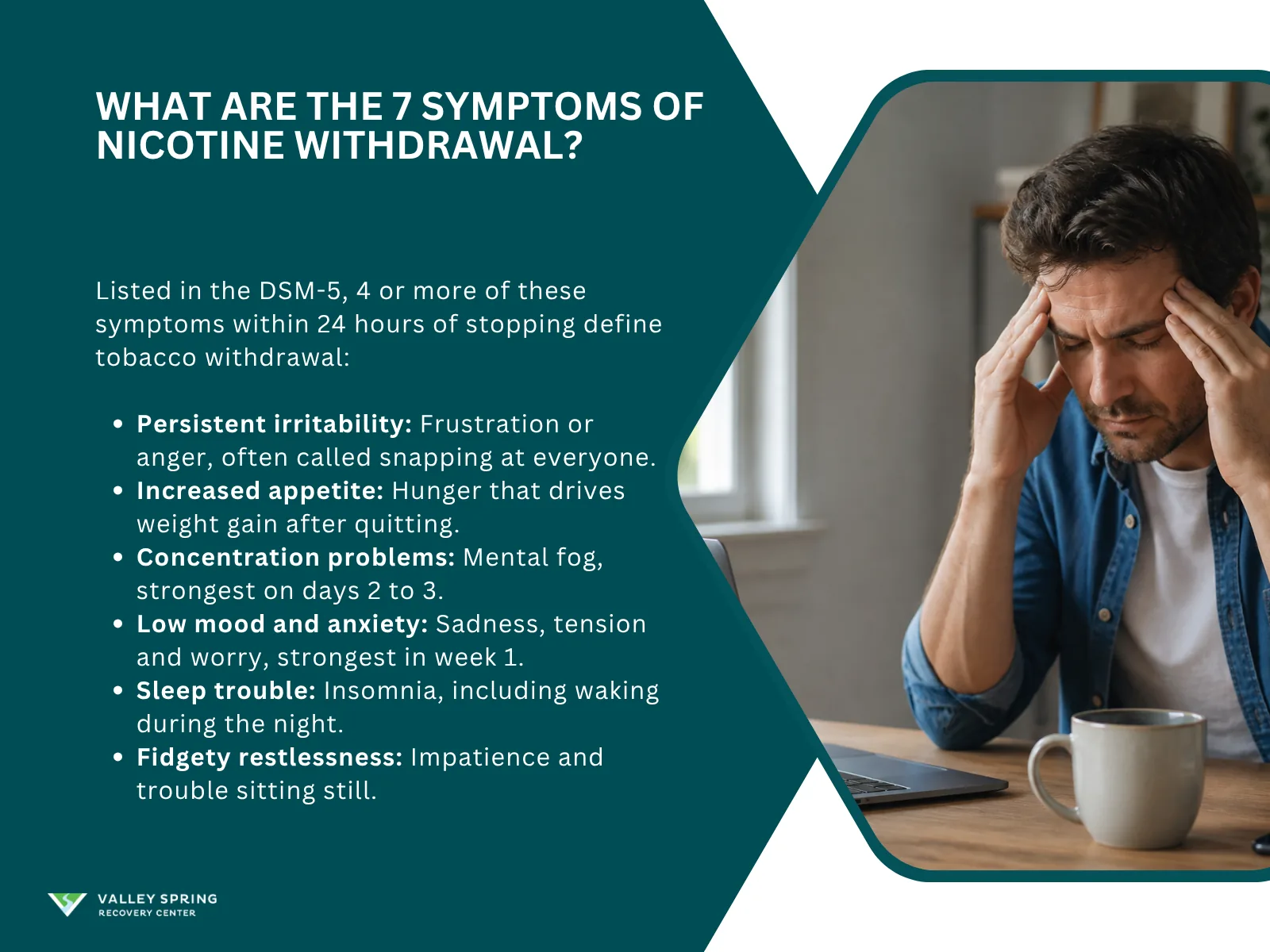
The 7 symptoms of nicotine withdrawal listed in the DSM-5 are irritability, anxiety, difficulty concentrating, increased appetite, restlessness, depressed mood and insomnia:
- Irritability, frustration or anger, which people describe as "snapping at everyone."
- Anxiety and tension, especially in the first week.
- Difficulty concentrating, often called "brain fog."
- Increased appetite, which drives weight gain after quitting.
- Restlessness and impatience.
- Depressed mood, sadness or low motivation.
- Insomnia, including waking during the night.
Craving is the most familiar withdrawal experience, although the DSM-5 counts craving as a sign of tobacco use disorder instead of a withdrawal symptom. People also report headaches, constipation, cough, dizziness and vivid dreams after quitting. John Hughes's 2007 review of 120 studies in Nicotine & Tobacco Research found that constipation, cough, dizziness, increased dreaming and mouth ulcers may be true abstinence effects, while drowsiness and fatigue are not. Researchers measure withdrawal with the Minnesota Nicotine Withdrawal Scale (MNWS), developed by Hughes and Dorothy Hatsukami in 1986, which rates 9 core symptoms on a 0-to-4 scale.
What Is the Nicotine Withdrawal Timeline?
The nicotine withdrawal timeline runs from first symptoms within 24 hours, to a peak on days 2 to 3, to steady improvement over weeks 2 to 4. The stages below come from studies of cigarette smokers summarized by Cleveland Clinic and by McLaughlin, Dani and De Biasi's 2015 review in Current Topics in Behavioral Neurosciences.
| Time since last nicotine | What happens |
|---|---|
| 4 to 24 hours | Cravings, irritability, restlessness and anxiety begin. |
| Days 2 to 3 | Symptoms peak; irritability, anxiety, poor concentration and insomnia are strongest. |
| Days 4 to 7 | Symptoms remain high but start to ease; the first week carries the highest risk of a slip. |
| Weeks 2 to 4 | Mood, sleep and concentration return toward baseline for most people. |
| 1 month and beyond | Cue-driven cravings continue in waves; appetite and weight changes persist. |
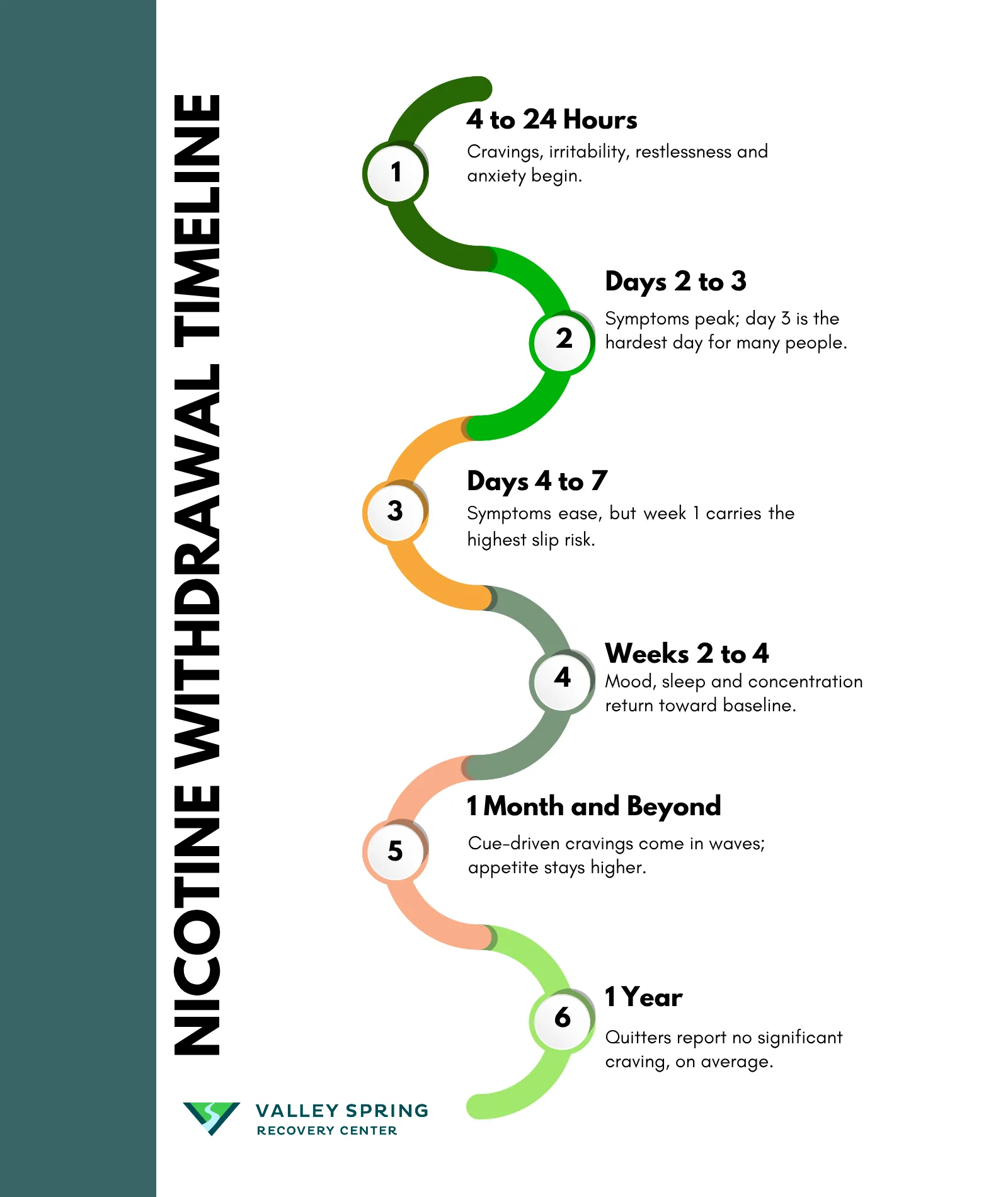
Day 3 is the hardest day for many people because symptoms reach their peak on days 2 to 3. Smokefree.gov, the National Cancer Institute's quit-smoking site, reports that the first week after quitting carries the highest risk of returning to nicotine.
How Long Does Nicotine Withdrawal Last?
Nicotine withdrawal lasts about 10 days to 4 weeks for most symptoms, depending on how it is measured. Hughes's 2007 review found that valid withdrawal symptoms peak within the first week and last 2 to 4 weeks. Shiffman and colleagues' 2006 study in Addiction tracked 214 smokers with daily electronic diaries and found that withdrawal symptoms returned to each person's own baseline within 10 days. The shorter figure reflects daily measurement against each smoker's starting point, while the longer range pools many older studies.
Cravings last longest. Schlam and colleagues' 2012 study of 572 people who tried to quit found that, on average, successful quitters reported no significant craving 1 year later. Withdrawal from alcohol, opioids and benzodiazepines follows different timelines and carries different medical risks, which the general guide to drug withdrawal covers in detail.
How Does Withdrawal Differ for Cigarettes, Vapes and Nicotine Pouches?
Withdrawal from cigarettes, vapes and nicotine pouches produces the same core symptoms because nicotine is the drug in all three. The published withdrawal timelines come from studies of cigarette smokers, so timelines for vapes and pouches are applied from that research rather than measured separately.
Vape Withdrawal
Vape withdrawal follows the cigarette pattern: symptoms within a day, a peak around days 2 to 3 and improvement over several weeks. In New Jersey, 6.1% of adults used e-cigarettes every day or some days in 2024, compared with 8.0% nationally, according to the CDC's Behavioral Risk Factor Surveillance System.
Nicotine Pouch (Zyn) Withdrawal
Nicotine pouch withdrawal, including Zyn withdrawal, produces irritability, cravings, poor concentration and sleep changes on the same timeline as other nicotine products. A 2021 CDC laboratory analysis of 37 US pouch brands, led by Stephen Stanfill and published in Nicotine & Tobacco Research, found 1.29 to 6.11 mg of nicotine per pouch. On January 16, 2025, the U.S. Food and Drug Administration authorized marketing of 20 Zyn products in 3 mg and 6 mg strengths, and on June 30, 2026, the FDA authorized a modified risk claim for using Zyn instead of cigarettes. The FDA states that Zyn is not FDA approved, is not safe and is not a quit-smoking product. Quitting nicotine pouches like Zyn follows the same withdrawal timeline as quitting cigarettes or vapes.
How Does Nicotine Withdrawal Affect Anxiety, Mood and Sleep?
Nicotine withdrawal raises anxiety, irritability and low mood for the first 2 to 4 weeks, then mental health improves beyond where it started. Many people use nicotine to feel calmer, but part of that calm is relief from withdrawal between doses. Taylor and colleagues' 2014 meta-analysis of 26 studies in the BMJ found that quitting smoking was linked to lower anxiety, depression and stress compared with continuing to smoke, and the improvement was similar in people with psychiatric disorders.
Insomnia and vivid dreams are common in the first week of withdrawal. Low mood that deepens after the first month, or any thoughts of suicide, calls for a clinical assessment.
Why Do People Gain Weight After Quitting Nicotine?
People gain weight after quitting nicotine because appetite increases and nicotine's effect on metabolism stops. Aubin and colleagues' 2012 meta-analysis of 62 studies in the BMJ measured average weight gain in people who quit smoking without medication:
- 1.12 kg (about 2.5 pounds) at 1 month.
- 2.85 kg (about 6.3 pounds) at 3 months.
- 4.23 kg (about 9.3 pounds) at 6 months.
- 4.67 kg (about 10.3 pounds) at 12 months.
Weight change varies widely between people. In the same analysis, about 16% of quitters lost weight and about 13% gained more than 10 kg.
What Eases Nicotine Withdrawal?
Nicotine withdrawal is eased most by FDA-approved cessation medications combined with counseling, which the U.S. Preventive Services Task Force gives its highest Grade A recommendation for adults. The FDA has approved 7 cessation products:
- Nicotine patch, sold over the counter for adults 18 and older.
- Nicotine gum, sold over the counter.
- Nicotine lozenge, sold over the counter.
- Nicotine nasal spray, available by prescription.
- Nicotine inhaler, available by prescription.
- Varenicline, a prescription tablet.
- Bupropion SR, a prescription tablet.
The Task Force found insufficient evidence to recommend e-cigarettes as a way to quit smoking, and switching from cigarettes to vapes or pouches continues nicotine dependence.
Where Can You Get Help for Nicotine Withdrawal in New Jersey?
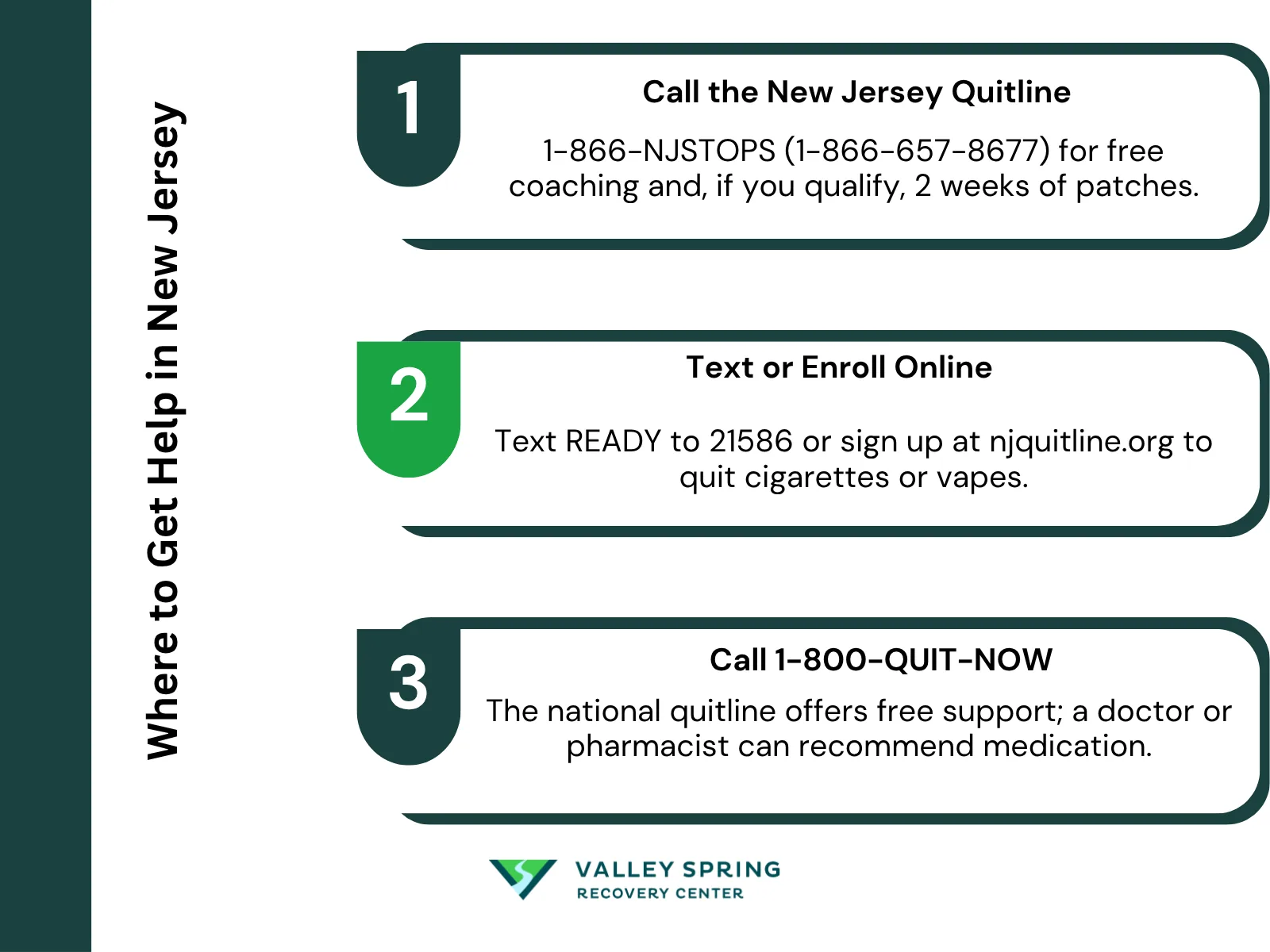
New Jersey residents get free help for nicotine withdrawal through the New Jersey Quitline, which offers quit coaching and, for people who qualify, 2 weeks of free nicotine patches. There are 4 free ways to reach quitline support from New Jersey:
- Call the New Jersey Quitline at 1-866-NJSTOPS (1-866-657-8677).
- Text READY to 21586 to start with the New Jersey Quitline by text.
- Enroll online at njquitline.org for quitting cigarettes or vapes.
- Call 1-800-QUIT-NOW (1-800-784-8669), the national quitline.
A primary care provider or pharmacist can recommend nicotine replacement or prescribe varenicline or bupropion. New Jersey's adult smoking rate was 8.6% in 2024, below the national 11.6%, according to CDC Behavioral Risk Factor Surveillance System data reported by America's Health Rankings.
Nicotine use often continues alongside alcohol use, drug use, anxiety or depression. Valley Spring Recovery Center in Norwood, New Jersey, does not provide nicotine cessation treatment; for people whose nicotine use sits alongside a substance use disorder or a mental health condition, Valley Spring provides dual diagnosis treatment at partial care, intensive outpatient and outpatient levels.
Frequently Asked Questions About Nicotine Withdrawal
What is the hardest day of quitting nicotine?
Day 3 is the hardest day for most people. Nicotine has cleared the body by then, and irritability, anxiety and cravings peak on days 2 to 3 before easing over the following weeks.
Can nicotine withdrawal cause headaches?
Yes, people commonly report headaches in the first 2 to 3 weeks after quitting, according to Cleveland Clinic. A "nicotine headache" can also come from too much nicotine, a different problem from withdrawal.
Can nicotine withdrawal cause brain fog?
Yes, difficulty concentrating is 1 of the 7 DSM-5 nicotine withdrawal symptoms. Brain fog is strongest on days 2 to 3 and improves within 2 to 4 weeks for most people.
How long does anxiety from nicotine withdrawal last?
Anxiety from nicotine withdrawal lasts about 2 to 4 weeks for most people. After that, anxiety falls below pre-quit levels on average, according to a 2014 BMJ meta-analysis of 26 studies.
Is it better to quit nicotine cold turkey or taper off?
Either approach works best with FDA-approved medication and counseling, which the U.S. Preventive Services Task Force gives a Grade A recommendation. A clinician or quitline coach helps choose between a set quit date and gradual reduction.
What happens when you stop using nicotine pouches?
Stopping nicotine pouches causes the same withdrawal as quitting cigarettes: cravings, irritability, poor concentration and sleep changes. Symptoms start within a day and ease over 2 to 4 weeks.
Sources & References20ShowHide
- American Psychiatric Association (2013). Diagnostic and Statistical Manual of Mental Disorders, Fifth Edition (DSM-5): Tobacco Withdrawal, as summarized by PsychDB.
- McLaughlin, I., Dani, J. A., & De Biasi, M. (2015). Nicotine Withdrawal. Current Topics in Behavioral Neurosciences, 24, 99–123.
- Hughes, J. R. (2007). Effects of abstinence from tobacco: valid symptoms and time course. Nicotine & Tobacco Research, 9(3), 315–327.
- Shiffman, S., et al. (2006). Natural history of nicotine withdrawal. Addiction.
- Schlam, T. R., Piper, M. E., Cook, J. W., Fiore, M. C., & Baker, T. B. (2012). Life 1 year after a quit attempt: real-time reports of quitters and continuing smokers.
- Cleveland Clinic (2024). Nicotine Withdrawal.
- Cleveland Clinic (2024). Nicotine Headache.
- Aubin, H. J., Farley, A., Lycett, D., Lahmek, P., & Aveyard, P. (2012). Weight gain in smokers after quitting cigarettes: meta-analysis. BMJ, 345, e4439.
- Taylor, G., et al. (2014). Change in mental health after smoking cessation: systematic review and meta-analysis. BMJ, 348, g1151.
- Centers for Disease Control and Prevention (2024). 7 Common Withdrawal Symptoms, Tips From Former Smokers.
- National Cancer Institute, Smokefree.gov. Managing Nicotine Withdrawal.
- PhenX Toolkit. Minnesota Nicotine Withdrawal Scale (Hughes & Hatsukami, 1986), protocol 721001.
- U.S. Food and Drug Administration (2022). Want to Quit Smoking? FDA-Approved and FDA-Cleared Cessation Products Can Help.
- U.S. Preventive Services Task Force (2021). Tobacco Smoking Cessation in Adults, Including Pregnant Persons: Interventions.
- U.S. Food and Drug Administration (2025). FDA Authorizes Marketing of 20 ZYN Nicotine Pouch Products after Extensive Scientific Review.
- U.S. Food and Drug Administration, Center for Tobacco Products (2026). FDA Authorizes 20 ZYN Nicotine Pouches to Be Marketed with Specific Modified Risk Claim.
- Stanfill, S., et al. (2021). Characterization of Total and Unprotonated (Free) Nicotine Content of Nicotine Pouch Products. Nicotine & Tobacco Research, 23(9).
- America's Health Rankings (2024). Smoking in New Jersey and E-Cigarette Use in New Jersey, CDC BRFSS data.
- New Jersey Department of Health, Tobacco Control. Get Help Quitting.
- New Jersey Quitline. NJ Quit Smoking, Quit Vaping.