


Mental health guide
Narcissistic Personality Disorder: Traits, Causes, Treatment
Narcissistic personality disorder affects 6.2% of U.S. adults in their lifetime. DSM-5 criteria, grandiose and vulnerable types, causes, treatment.
By Paul James Roeser·Reviewed by Dr. Michael Olla, MD·8 min read
Published ·Updated
Narcissistic personality disorder (NPD) is a personality disorder defined in the DSM-5-TR by a pervasive pattern of grandiosity, a need for admiration, and a lack of empathy, beginning by early adulthood and present across contexts. The American Psychiatric Association classifies NPD in Cluster B, the personality disorder group marked by dramatic, emotional, or erratic features, alongside borderline, antisocial, and histrionic personality disorders.
NPD is more common than its cultural reputation as a rare condition suggests. In the Wave 2 National Epidemiologic Survey on Alcohol and Related Conditions (NESARC), a face-to-face survey of 34,653 U.S. adults, lifetime prevalence of NPD was 6.2%, with higher rates in men (7.7%) than in women (4.8%), per Stinson and colleagues' 2008 report in the Journal of Clinical Psychiatry.
Psychotherapy is the primary treatment, and the co-occurring conditions that travel with NPD, led by substance use disorders at 64.2% of lifetime cases, respond to established treatment. The diagnosis, the causes, and the comorbidity data follow.
What Is Narcissistic Personality Disorder?
Narcissistic personality disorder is a Cluster B personality disorder defined by a pervasive pattern of grandiosity, a constant need for admiration, and a lack of empathy for others, per the DSM-5-TR. A personality disorder differs from an episode-based condition: the pattern is stable, long-standing, and traceable to adolescence or early adulthood rather than arriving in discrete episodes.
Prevalence estimates in community samples range from 0% to 6.2%, per the StatPearls clinical review, with the NESARC survey's 6.2% lifetime figure at the top of that range. The DSM-5-TR reports that 50% to 75% of individuals diagnosed with NPD are male. Grandiosity in NPD is not confidence: it is an inflated self-appraisal that requires external validation to survive, which is why criticism produces rage or contempt rather than reflection. The diagnosis itself is criterion-based, and the criteria are countable.

Clinical perspective
Narcissism gets confused with confidence, but underneath it is usually the opposite — a self-image so fragile it needs constant outside reinforcement just to stay upright. That fragility is what makes treatment hard, because the same defenses that protect the ego from criticism also protect it from the parts of therapy that would actually help.
What Are the DSM-5 Criteria for NPD?
The DSM-5-TR requires at least 5 of 9 criteria, all reflecting grandiosity, need for admiration, or impaired empathy, present since early adulthood and across contexts. A licensed clinician makes the diagnosis through clinical interview; no questionnaire diagnoses NPD on its own.
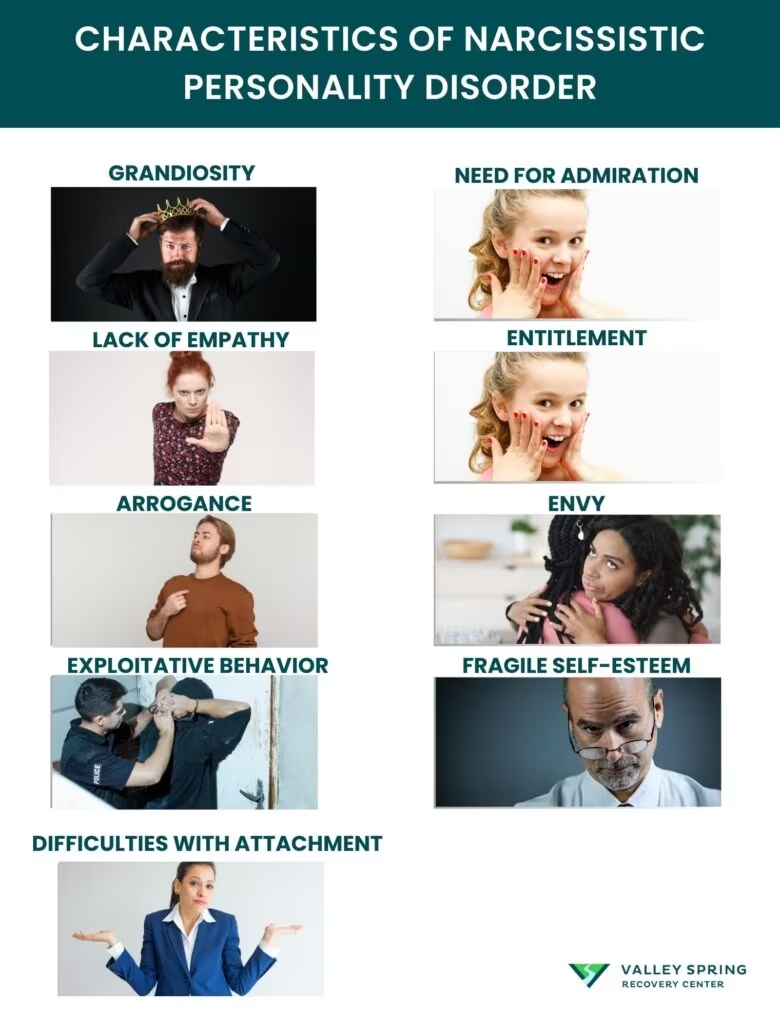
The 9 diagnostic criteria:
- Grandiose self-importance: exaggerating achievements and expecting recognition as superior without commensurate accomplishment.
- Fantasies of unlimited success: preoccupation with idealized power, brilliance, beauty, or love.
- Belief in being special: conviction of being unique and understandable only by high-status people or institutions.
- Need for excessive admiration: dependence on continuous external validation.
- Entitlement: expectation of especially favorable treatment or automatic compliance.
- Interpersonal exploitation: use of others to achieve personal ends.
- Lack of empathy: unwillingness to recognize or identify with the feelings and needs of others.
- Envy: envy of others, or the belief that others are envious of them.
- Arrogance: haughty behaviors and attitudes.
The criteria describe one diagnosis, but the presentation of that diagnosis takes two documented forms.
What Are the Types of Narcissism?
Clinical research distinguishes 2 presentations of pathological narcissism: grandiose narcissism, expressed as overt self-importance, dominance, and entitlement, and vulnerable narcissism, expressed as hypersensitivity to criticism, insecurity, and defensive withdrawal. The DSM-5-TR codes a single NPD diagnosis; the two presentations describe how it shows.
Grandiose presentations match the popular image: visible arrogance, status-seeking, and aggressive responses to challenge. Vulnerable presentations hide the same entitlement and self-focus behind shyness, victimhood, and resentment, and are missed in casual observation. Clinical literature also describes malignant narcissism, a severe pattern combining narcissistic and antisocial features with aggression. One person shifts between presentations over time, which is part of why researchers treat them as dimensions of one disorder rather than separate conditions. Whichever presentation dominates, the developmental question is the same: where the pattern comes from.
What Causes Narcissistic Personality Disorder?
NPD develops from a combination of measured genetic contribution and individually specific environmental experience. In Luo and colleagues' 2014 twin study of 304 pairs, published in PLOS ONE, heritability was 23% for narcissistic grandiosity and 35% for interpersonal entitlement, and the genetic and environmental influences on the two dimensions were 92% to 93% unique to each dimension, with only 7% to 8% shared between them. The study also found considerable non-shared environmental influence, meaning the remaining variance in each dimension traces to experiences not shared within the family.
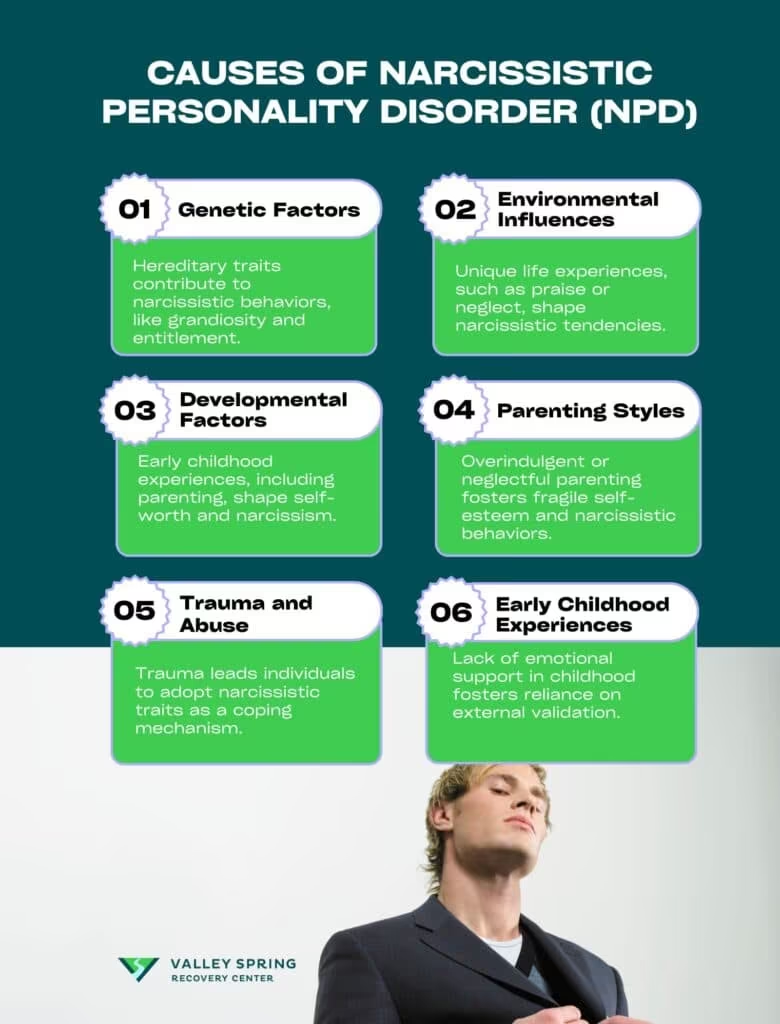
The unique-environment finding matters because it points away from a single parenting recipe. Developmental research associates both overvaluation, where a child is treated as exceptional and entitled, and inconsistent or neglectful caregiving with later narcissistic traits, and the twin data indicates each child's specific experience, not the household average, does the shaping. Cause is one lens on the disorder; the sharper clinical lens is what separates NPD from the conditions it resembles.
How Does NPD Differ From Other Personality Disorders?
NPD is distinguished from its Cluster B neighbors by its motive: admiration and status, where antisocial personality disorder seeks gain without regard for norms, borderline personality disorder fears abandonment, and histrionic personality disorder seeks emotional attention. The four Cluster B disorders differentiated:
| Disorder | Core driver | Key contrast with NPD |
| Narcissistic personality disorder | Admiration, status, grandiose self-image | Reference row for the contrasts |
| Borderline personality disorder | Fear of abandonment, unstable identity | Rapidly shifting emotions and self-image, where NPD holds a stable inflated self-view |
| Antisocial personality disorder | Gain and dominance without remorse | Overt norm violation and deceit, where NPD seeks recognition within social rules |
| Histrionic personality disorder | Emotional attention and approval | Dramatic emotionality, where NPD wants admiration for superiority, not sympathy |
Two of these neighbors have their own explainer pages: borderline personality disorder, the most frequent differential, and paranoid personality disorder, a Cluster A condition whose suspicion-driven grievance is confused with narcissistic entitlement. Differential diagnosis separates look-alikes; comorbidity counts the conditions that arrive together.
Which Conditions Co-Occur With NPD?
In the NESARC survey, 64.2% of adults with lifetime NPD also had a lifetime substance use disorder, 54.7% had an anxiety disorder, and 49.5% had a mood disorder, per Stinson and colleagues' 2008 NESARC report. Alcohol use disorder alone reached 51.1%, drug use disorders 26.5%, bipolar I disorder 20.1%, and PTSD 25.7%.
The substance figures are the clinically urgent ones. A person with NPD who drinks against shame and self-esteem injury is medicating the disorder's most painful edge, and the 51.1% lifetime alcohol use disorder rate shows how routinely that happens. Mood comorbidity complicates diagnosis in the other direction: grandiosity during a manic episode of bipolar disorder mimics narcissistic grandiosity, and the differentiator is time course, episodic in bipolar disorder and continuous in NPD. Comorbidity defines much of the treatment picture, because the co-occurring conditions are where treatment has its strongest tools.
How Is Narcissistic Personality Disorder Treated?
Psychotherapy is the primary treatment for NPD, with no FDA-approved medication for the disorder itself, per the StatPearls review of narcissistic personality disorder. The same review singles out transference-focused psychotherapy, a structured psychodynamic treatment that works on the patient's distorted self- and other-representations as they appear in the therapy relationship, as the approach that may have more success than other therapies, in an outcome literature the chapter describes as limited.
Honest framing of prognosis belongs here. StatPearls characterizes NPD as a lifelong condition, and treatment engagement is the central obstacle, because the disorder itself resists the self-examination therapy requires. The workable clinical picture is still substantial: sustained psychotherapy builds self-awareness, emotional regulation, and functional relationships, and the comorbid depression, anxiety, and substance use disorders that drive most treatment entries respond to their own evidence-based treatments. A person with NPD who stays in treatment changes what the disorder costs them.
What Are the Most Common Questions About NPD?
Common questions: heredity, curability, insight, diagnosis, age, and the trait-versus-disorder boundary.
Is Narcissistic Personality Disorder Genetic?
Partly. Twin research measured heritability at 23% for grandiosity and 35% for entitlement, with the remaining variance traced to environmental experiences not shared within families, per Luo and colleagues' 2014 study of 304 twin pairs.
Can NPD Be Cured?
No cure exists, and StatPearls characterizes the course as lifelong. Sustained psychotherapy reduces the disorder's costs: better emotional regulation, more stable relationships, and treatment of the co-occurring depression, anxiety, and substance use that drive most impairment.
Do People With NPD Know They Have It?
Insight is limited. NPD is ego-syntonic, meaning the traits feel consistent with who the person believes they are, so the disorder rarely registers as a problem from the inside. Treatment entry is driven by comorbid conditions and relationship consequences.
How Is NPD Diagnosed?
A licensed mental health professional diagnoses NPD through clinical interview against the DSM-5-TR criteria, requiring 5 of 9 criteria present since early adulthood and across contexts, and rules out mania, substance effects, and other personality disorders.
At What Age Is NPD Diagnosed?
Diagnosis requires a stable pattern with onset traceable to adolescence or early adulthood, per the DSM-5-TR, so clinicians diagnose it in adulthood. Narcissistic traits in adolescents are developmentally common and are not diagnosed as a personality disorder.
Is Narcissism the Same as NPD?
No. Narcissism is a personality trait distributed across the population. NPD is a diagnosis requiring 5 of 9 DSM-5-TR criteria plus persistent impairment. High self-regard without impairment is a trait, not a disorder.
Sources & References4ShowHide
- Stinson FS, Dawson DA, Goldstein RB, et al. Prevalence, Correlates, Disability, and Comorbidity of DSM-IV Narcissistic Personality Disorder: Results from the Wave 2 NESARC. J Clin Psychiatry, 2008 (PMC) — Lifetime NPD 6.2% (men 7.7%, women 4.8%); n = 34,653 face-to-face interviews; comorbidity among lifetime NPD: any SUD 64.2%, alcohol use disorders 51.1%, drug use disorders 26.5%, any anxiety disorder 54.7%, any mood disorder 49.5%, bipolar I 20.1%, PTSD 25.7%.
- Mitra P, Torrico TJ, Fluyau D. Narcissistic Personality Disorder. StatPearls, NCBI Bookshelf — Community prevalence 0% to 6.2%; Cluster B classification; 5-of-9 DSM criteria; psychotherapy as preferred treatment with transference-focused therapy that may have more success; no FDA-approved medications; course usually lifelong.
- Luo YLL, Cai H, Song H. A Behavioral Genetic Study of Intrapersonal and Interpersonal Dimensions of Narcissism. PLOS ONE, 2014 (PubMed) — 304 twin pairs; heritability 23% (grandiosity) and 35% (entitlement); genetic and environmental influences 92-93% unique to each dimension, 7-8% shared.
- American Psychiatric Association. Diagnostic and Statistical Manual of Mental Disorders, Fifth Edition, Text Revision (DSM-5-TR) — Print reference: pervasive pattern of grandiosity, need for admiration, lack of empathy; 50% to 75% of those diagnosed are male; personality disorder onset traceable to adolescence or early adulthood.