


Mental health guide
PTSD Signs, Types, Risk Factors and Effects Explained
PTSD develops after trauma and persists past 1 month. Crisis steps, the 4 DSM-5-TR symptom clusters, risk data, diagnosis, and treatment evidence.
By Paul James Roeser·Reviewed by Dr. Michael Olla, MD·8 min read
Published ·Updated
Post-traumatic stress disorder (PTSD) is a mental health condition that develops after exposure to actual or threatened death, serious injury, or sexual violence, with symptoms persisting for more than 1 month. The DSM-5-TR classifies PTSD among the trauma- and stressor-related disorders, a chapter created in 2013 when PTSD moved out of the anxiety disorders. PTSD raises suicide risk. Free, confidential support is available 24/7 from the 988 Suicide & Crisis Lifeline: call or text 988, or chat at 988lifeline.org.
According to the National Institute of Mental Health (NIMH), 3.6% of U.S. adults had PTSD in the past year and lifetime prevalence is 6.8%, with women affected at 5.2% against 1.8% for men. The National Center for PTSD counts it in plainer terms, from a different data source: about 6 of every 100 people develop PTSD at some point in life, 8 of 100 women and 4 of 100 men, and roughly 13 million American adults had PTSD in 2020. Its annual estimate, about 5 in 100 adults, runs above NIMH's 3.6%, because the two draw on different surveys and years.
PTSD is treatable. Trauma-focused psychotherapy is the preferred treatment, two SSRI medications carry FDA clearance for the condition, and most people who go through a traumatic event never develop PTSD at all.
What Should You Do During a Suicidal Crisis?
Contact the 988 Suicide & Crisis Lifeline immediately, by calling 988, texting 988, or chatting at 988lifeline.org, when PTSD brings thoughts of suicide or self-harm. All three channels are free, confidential, and staffed 24 hours a day. Spanish-speaking counselors answer when a caller presses 2 or texts the word AYUDA to 988. Deaf and hard-of-hearing users connect in American Sign Language by dialing 988 from a videophone. Veterans reach the Veterans Crisis Line by calling 988 and pressing 1.
Call 911 when someone has harmed themselves or is in immediate danger. Two further steps protect a person through a crisis: stay with them until help is connected, and reduce access to lethal means in the home. People with PTSD are at increased risk for suicide and warrant regular screening, per the StatPearls review, which is why suicide assessment is built into PTSD care rather than treated as a separate concern. Crisis support stabilizes the emergency. Trauma-focused treatment is what lowers the risk over time, and it starts from what the diagnosis requires.
What Is PTSD?
PTSD is a trauma- and stressor-related disorder diagnosed when symptoms from 4 defined clusters persist for more than 1 month after a qualifying trauma and cause functional impairment, per the DSM-5-TR criteria summarized in the StatPearls PTSD review.
The qualifying exposure, criterion A, runs through 4 defined routes: experiencing the event directly, witnessing it in person, learning that it happened to a close family member or friend, and repeated exposure to aversive details of trauma, the route that covers first responders and investigators. The definition matters because it separates PTSD from ordinary stress: a hard month at work is a stressor, not a criterion A event. What the trauma produces is a symptom pattern with a specific four-part shape.

Clinical perspective
PTSD is a smoke detector that never learned to reset. Long after the danger has passed, the alarm is still going off, and substances are one of the fastest ways to make an alarm go quiet for a few hours. The work isn't just quieting the alarm — it's teaching the nervous system that the fire is actually out.
What Are the Symptoms of PTSD?
The DSM-5-TR organizes PTSD symptoms into 4 clusters with minimum counts: at least 1 intrusion symptom, at least 1 avoidance symptom, at least 2 negative changes in thinking and mood, and at least 2 changes in arousal and reactivity, per the StatPearls review. Each cluster with its core examples:
| Cluster | Required | Core symptoms |
| Intrusion | 1 or more | Involuntary memories, trauma nightmares, flashbacks, intense distress at reminders, physical reactions to reminders |
| Avoidance | 1 or more | Avoiding trauma-related thoughts and feelings; avoiding people, places, and situations that trigger reminders |
| Negative changes in thinking and mood | 2 or more | Inability to recall key features of the event, persistent negative beliefs, distorted blame, detachment, loss of interest, persistent fear, guilt, or shame |
| Arousal and reactivity | 2 or more | Irritability, hypervigilance, exaggerated startle, impaired concentration, sleep disturbance, reckless behavior |
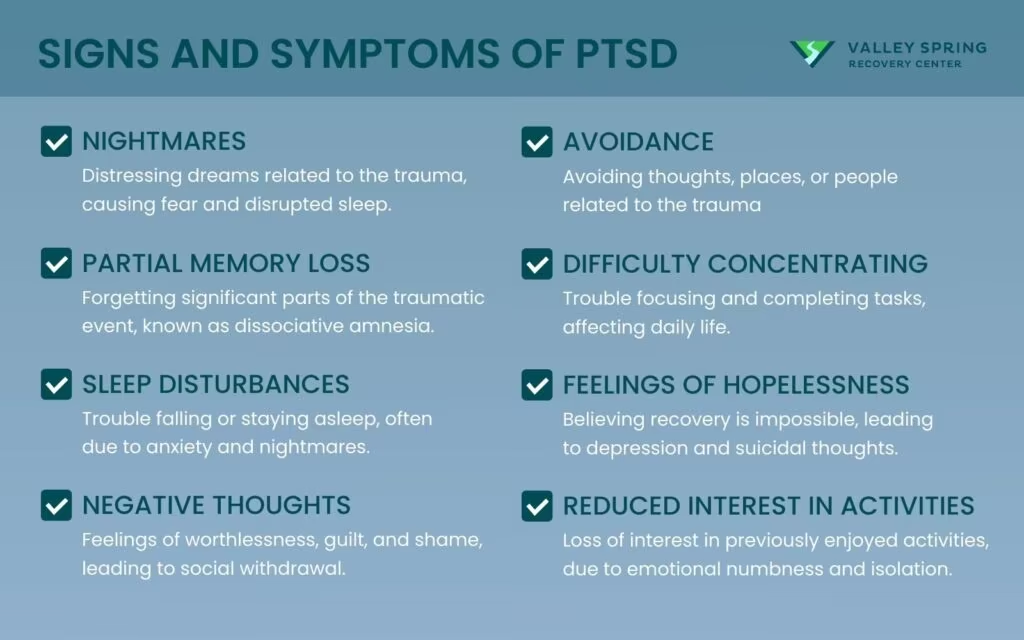
Sleep sits in the arousal cluster and compounds every other symptom: trauma nightmares fragment sleep, and chronic insomnia deepens irritability, concentration problems, and low mood. The negative-mood cluster carries the heaviest risk because persistent shame and hopelessness lead toward suicidal thinking. The risk gradient that separates one trauma-exposed person from another comes next.
Who Develops PTSD After Trauma?
A minority of trauma-exposed people develop PTSD: most people who go through a traumatic event do not develop the disorder, per the National Center for PTSD, and the documented risk gradient explains much of the difference.
Sex is the largest documented factor: women develop PTSD at twice the rate of men, 8% against 4% lifetime per the National Center for PTSD, a gap driven in part by higher rates of sexual violence and interpersonal trauma. Event type and dose matter: prolonged, repeated, or interpersonal trauma carries more risk than a single impersonal event. Trauma history compounds: prior exposure raises the risk from the next event. The severity data completes the picture: among adults with past-year PTSD, 36.6% had serious impairment and 33.1% had moderate impairment, per NIMH's PTSD statistics. Risk describes populations; the diagnostic categories describe what a clinician actually distinguishes between.
How Is PTSD Different From Other Trauma Responses?
PTSD is separated from related trauma responses by time and threshold: acute stress disorder covers the first 3 days to 1 month after trauma, PTSD requires symptoms persisting beyond 1 month, and complex PTSD, a diagnosis in the ICD-11 rather than the DSM-5-TR, follows prolonged or repeated trauma.
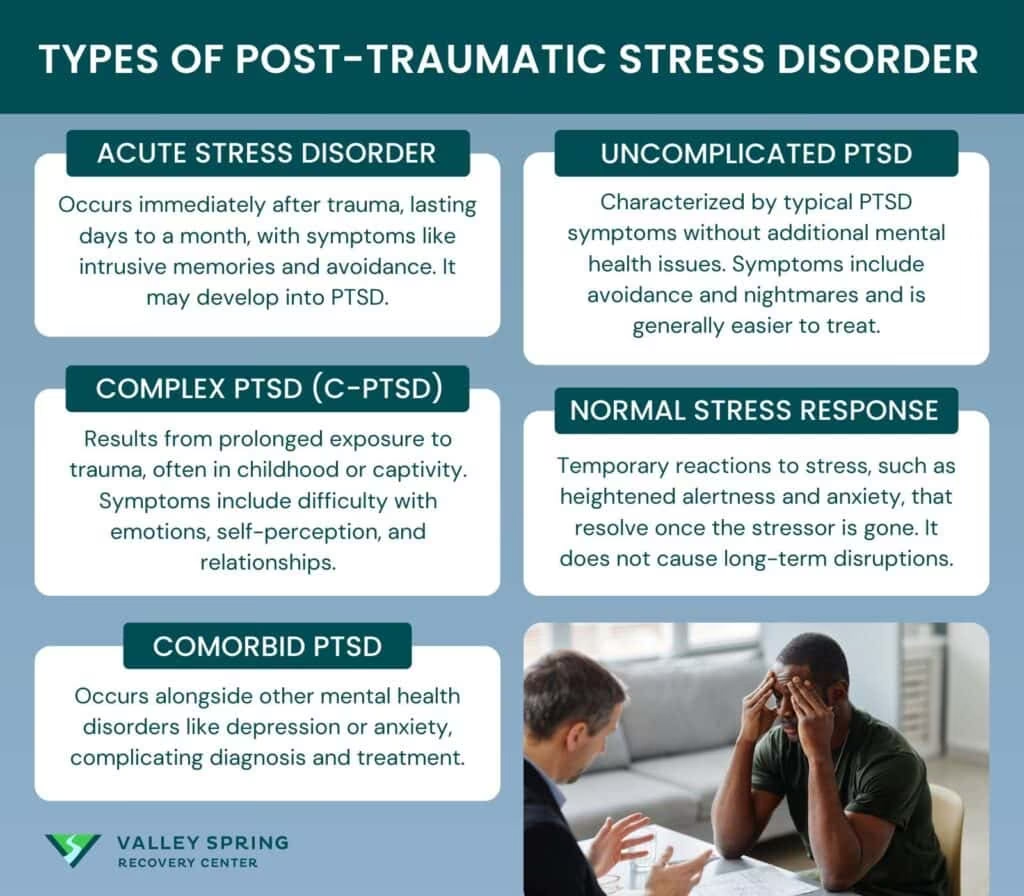
Three distinctions do the diagnostic work. A normal stress response, alertness, poor sleep, and intrusive thoughts in the days after a frightening event, resolves on its own and is not a disorder. Acute stress disorder names the same symptom picture as PTSD inside the first month; when it persists past 1 month, the diagnosis converts to PTSD. The DSM-5-TR also defines a delayed-expression specifier for cases where full criteria are not met until at least 6 months after the event. Whichever category fits, the confirmation process is the same.
How Is PTSD Diagnosed?
PTSD is diagnosed through a clinical interview that maps symptoms to the DSM-5-TR criteria, supported by standardized instruments including the PCL-5, a 20-item self-report checklist, and structured interviews such as the CAPS-5.
The interview establishes the criterion A event, walks the 4 symptom clusters with their minimum counts, confirms the 1-month duration and functional impairment, and rules out substance effects and medical causes, criterion H in the DSM-5-TR's 8-criterion structure. Co-occurring conditions are assessed at the same time, because trauma is a documented risk factor for major depressive disorder, anxiety disorders, and substance use disorders, per the StatPearls review. Diagnosis is the gate to treatment, and the treatment evidence is specific.
How Is PTSD Treated?
PTSD is treated with trauma-focused psychotherapy as the preferred treatment, and with sertraline or paroxetine, the 2 SSRIs cleared by the FDA for PTSD, when medication is used, per the StatPearls PTSD review.
The psychotherapy category includes 3 evidence-based forms. Cognitive behavioral approaches, including cognitive processing therapy, restructure the trauma-related beliefs that maintain guilt and threat perception. Exposure-based therapy, including prolonged exposure, has the person approach trauma memories and avoided situations in a graded, controlled sequence until they lose their charge. Eye movement desensitization and reprocessing (EMDR) pairs trauma recall with bilateral stimulation to reduce the memory's distress. Avoidance is the symptom that keeps PTSD alive, and every effective therapy works by reversing it. Trauma-focused PTSD treatment is delivered locally on IOP and outpatient schedules in Norwood, New Jersey. Untreated, the same avoidance is what pulls substances into the picture.
Trauma treatment also addresses intrusion, avoidance, hyperarousal, and functional impairment in people whose trauma responses do not meet every PTSD criterion; the treatment plan follows the clinical presentation rather than assuming one diagnosis.
How Does PTSD Relate to Substance Use?
Trauma is a documented risk factor for substance use disorders, per the StatPearls review, and the mechanism is self-medication: alcohol and drugs blunt intrusion and arousal symptoms in the short term while blocking the recovery that ends them.
Drinking to sleep, to silence intrusive memories, or to face avoided situations builds tolerance and dependence on top of the trauma, the pattern covered in full on the alcohol use disorder page. The clinical consequence is directional: treating only the substance use leaves the trauma driving relapse, and treating only the trauma leaves withdrawal and craving disrupting therapy, so integrated treatment addresses both conditions together.
What Are the Most Common Questions About PTSD?
Common questions: symptom onset, natural recovery, children, flashbacks, disability status, and the PTSD-anxiety boundary.
When Do PTSD Symptoms Start?
Symptoms begin within 3 months of the event in most documented cases. The DSM-5-TR defines a delayed-expression specifier for people who do not meet full criteria until 6 months or more after the trauma.
Does PTSD Go Away on Its Own?
Reactions in the first month after trauma resolve without treatment in most people. Once symptoms persist past 1 month and meet PTSD criteria, trauma-focused psychotherapy is the documented path to recovery, and avoidance prolongs the disorder.
Can Children and Teens Develop PTSD?
Yes. An estimated 5.0% of U.S. adolescents aged 13 to 18 have had PTSD in their lifetime, 8.0% of girls and 2.3% of boys, per NIMH's National Comorbidity Survey Adolescent Supplement. The DSM-5-TR includes criteria for children 6 and younger.
What Is a Flashback?
A flashback is an intrusion symptom in which a person feels the traumatic event is happening again, with sensory re-experiencing rather than ordinary remembering. Flashbacks range from brief moments to episodes with lost awareness of surroundings.
Is PTSD a Disability?
Yes, when it substantially limits major life activities. PTSD qualifies under the Americans with Disabilities Act, and 36.6% of adults with past-year PTSD had serious impairment per NIMH, so workplace accommodations are a documented need.
What Is the Difference Between PTSD and Anxiety?
PTSD requires a traumatic event and centers on re-experiencing, avoidance, and hypervigilance tied to that event. Anxiety disorders involve excessive fear and worry without a required trauma. The DSM-5-TR classifies them in separate chapters.
Sources & References4ShowHide
- NIMH — Post-Traumatic Stress Disorder (PTSD) Statistics — Past-year prevalence 3.6% of U.S. adults (women 5.2%, men 1.8%); lifetime 6.8%; serious impairment 36.6%, moderate 33.1%; adolescents 5.0% lifetime (girls 8.0%, boys 2.3%). NCS-R and NCS-A.
- National Center for PTSD (U.S. Department of Veterans Affairs) — How Common Is PTSD in Adults? — About 6 of every 100 people develop PTSD in their lifetime (8 of 100 women, 4 of 100 men); about 13 million American adults had PTSD in 2020; annual estimate about 5 of every 100 adults, above NIMH's 3.6% past-year figure because the two draw on different surveys and years; most trauma-exposed people do not develop PTSD.
- Torrico TJ, Mann SK, Marwaha R. Posttraumatic Stress Disorder. StatPearls, NCBI Bookshelf (updated February 25, 2024) — DSM-5-TR 8-criterion structure with cluster minimums (intrusion 1+, avoidance 1+, negative cognition/mood 2+, arousal 2+); duration over 1 month; sertraline and paroxetine FDA-cleared; trauma-focused psychotherapy preferred, including CBT, exposure-based therapy, and EMDR; increased suicide risk warranting regular screening; trauma as risk factor for MDD, anxiety, and substance use disorders.
- American Psychiatric Association. Diagnostic and Statistical Manual of Mental Disorders, Fifth Edition, Text Revision (DSM-5-TR). Washington, DC: American Psychiatric Publishing, 2022 — Criterion A exposure routes, acute stress disorder window (3 days to 1 month), delayed-expression specifier, and criteria for children 6 and younger. Print reference.