


Mental health guide
Restless Legs Syndrome (RLS): Definition, Symptom, Cause, and Treatment
Restless legs syndrome affects 7.2% of adults with an urge to move the legs at rest. Diagnostic criteria, causes, treatment, and the opioid connection.
By Paul James Roeser·Reviewed by Dr. Michael Olla, MD·6 min read
Published ·Updated
Restless legs syndrome (RLS) is a neurological sensorimotor disorder defined by an irresistible urge to move the legs, accompanied by uncomfortable sensations that begin at rest and improve with movement. Symptoms follow a diurnal pattern, worsening in the evening and at night, which is why the disorder's primary casualty is sleep. RLS is also called Willis-Ekbom disease.
The disorder is common and underdiagnosed. 7.2% of adults report RLS symptoms in the past year and 2.7% carry symptoms frequent and distressing enough to warrant medical treatment, yet only 6.2% of that clinically significant group had received an RLS diagnosis, per Allen and colleagues' REST general population study of 15,391 adults in Archives of Internal Medicine. RLS affects both sexes and is more common in women, per the National Institute of Neurological Disorders and Stroke (NINDS).
RLS carries a second relevance for addiction treatment: opioid withdrawal provokes RLS symptoms, and RLS management intersects with addiction medicine in both directions.
What Is Restless Legs Syndrome (RLS)?
Restless legs syndrome is a chronic movement disorder in which an irresistible urge to move the legs arises at rest, paired with non-painful but uncomfortable sensations described as crawling, pulling, itching, or throbbing, per the StatPearls clinical review, which counts more than 3 million U.S. cases annually.
Two features define the clinical picture. The first is the diurnal rhythm: symptoms concentrate in the evening and at night, delaying sleep onset and fragmenting sleep. The second is periodic leg movements of sleep, involuntary jerking movements that accompany RLS in most patients and further degrade sleep quality. The disorder may begin in childhood, and diagnosis is often delayed until the third decade of life, per StatPearls. What patients feel day to day follows from those two features.

Clinical perspective
Restless legs syndrome sits at an interesting intersection — it's neurological, but the same dopamine pathway involved in RLS is involved in a lot of what gets treated psychiatrically, and it's disruptive to sleep in a way that compounds anxiety and mood problems if it goes untreated. It shouldn't be dismissed as a minor annoyance — poor sleep from RLS can make an existing mood disorder measurably harder to stabilize.
What Are the Symptoms of Restless Legs Syndrome?
The 4 core symptoms of RLS are an urge to move the legs, onset or worsening during rest or inactivity, partial or total relief with movement, and worsening in the evening or at night, the same four features the diagnostic criteria formalize.
Severity ranges from an occasional evening nuisance to nightly symptoms that make sitting through a meeting, a flight, or a film difficult. The downstream symptom is chronic sleep deprivation: daytime fatigue, irritability, and impaired concentration. In the REST study, the 2.7% of adults with clinically significant RLS scored below population norms on the SF-36 health survey, matching patients with other chronic medical conditions. Those sensations have a documented biology behind them.
What Are the Causes of Restless Legs Syndrome?
RLS develops from 3 documented mechanisms: genetics, low brain iron, and dysfunction in the basal ganglia's dopamine signaling, per NINDS. The disorder runs in families, specific gene variants are associated with it, and disrupted dopamine levels produce involuntary movement, the same circuitry disturbed in Parkinson's disease, which carries an elevated RLS risk.
Neurotransmitter imbalance alters signaling across interacting chemical systems, while RLS evidence specifically implicates dopamine pathways involved in movement.
Dopamine regulates movement, motivation, reward, and learning through distinct brain pathways. Secondary RLS arises from identifiable conditions: iron deficiency, kidney failure, and pregnancy each produce or worsen symptoms, per NINDS, and resolving the underlying condition improves the RLS.
How Is Restless Legs Syndrome Diagnosed?
RLS is diagnosed clinically, against the 5 essential criteria of the International Restless Legs Syndrome Study Group, per Allen and colleagues' 2014 updated consensus criteria in Sleep Medicine. The 5 criteria:
- An urge to move the legs, usually accompanied by uncomfortable sensations
- Onset or worsening during rest or inactivity
- Partial or total relief by movement
- Worsening in the evening or at night
- Exclusion of mimicking conditions such as leg cramps, positional discomfort, and myalgia, the differential-diagnosis criterion added in the 2014 update to improve specificity
Blood work checks iron levels and kidney function to identify secondary causes, and sleep studies quantify periodic leg movements when the picture is unclear, per NINDS. The underdiagnosis problem is documented: in the REST study, 81.0% of people with clinically significant RLS had discussed their symptoms with a primary care physician, and only 6.2% had received the diagnosis. Healthcare providers screening patients in addiction treatment carry an extra reason to ask: opioid tapering provokes the same symptoms. A confirmed diagnosis opens a tiered treatment sequence.
How Is Restless Legs Syndrome Treated?
RLS is treated with lifestyle changes first, then iron repletion where iron is low, then prescription medication for moderate-to-severe disease, per NINDS.
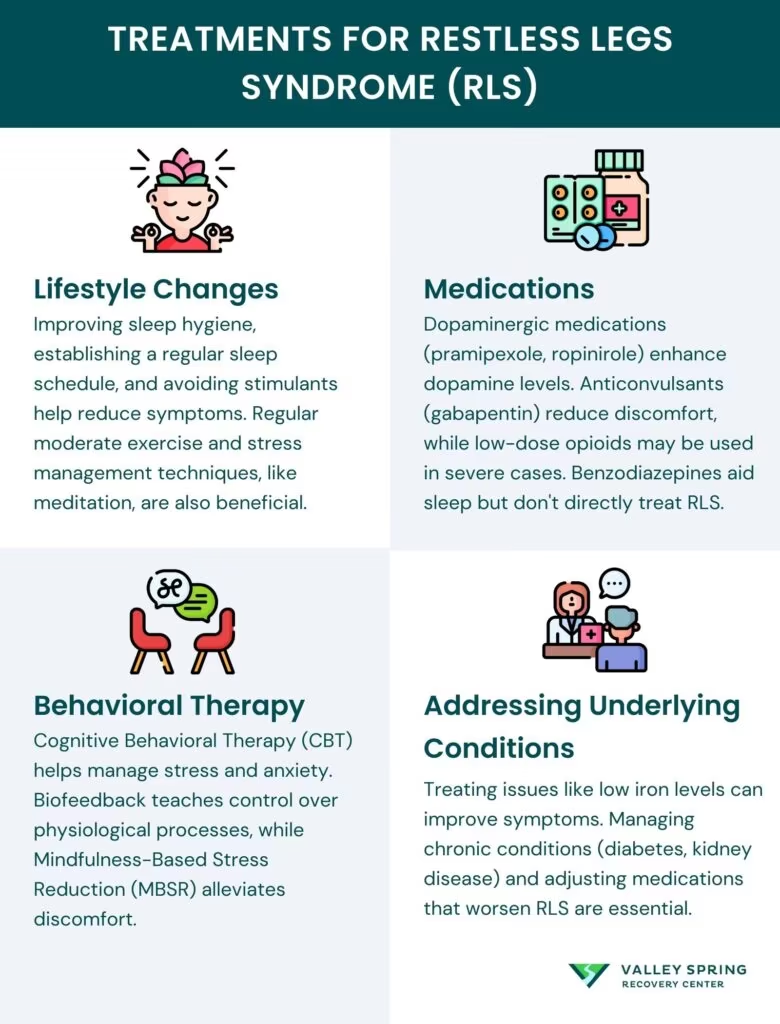
The 4 documented treatment tiers:
- Lifestyle changes: Regular moderate exercise, consistent sleep schedules, leg massage, and warm baths reduce symptom frequency, and reducing caffeine, alcohol, and nicotine removes three documented aggravators.
- Iron supplementation: Iron repletion treats the low-brain-iron mechanism directly and reduces symptoms in patients with low iron levels, per NINDS.
- Anti-seizure medications: Gabapentin enacarbil and pregabalin are the anti-seizure agents NINDS names for moderate to severe RLS; the related compound gabapentin carries separate sedation, interaction, dependence, and misuse considerations.
- Dopaminergic agents: Drugs such as carbidopa/levodopa help. Long-term use may worsen symptoms, per NINDS, so prescribers monitor for symptom escalation and adjust course.
Lyrica (pregabalin) is an alpha-2-delta ligand used for moderate to severe restless legs syndrome. Sedation, prescribed dose, other depressants, and any pattern of harmful use belong in the medication review.
One further tier exists for the small group whose severe symptoms fail all 4 tiers, and it overlaps with addiction medicine.
What Is the Relationship Between RLS and Opioids?
The relationship runs in both directions: low-dose opioids are a specialist option for severe refractory RLS, and opioid withdrawal provokes RLS symptoms, the pattern Winkelman's 2023 commentary in the Journal of Clinical Sleep Medicine calls a double-edged sword.
On the treatment side, Silber and colleagues' 2018 consensus paper in Mayo Clinic Proceedings reserves opioid therapy for RLS that has failed the standard treatments, with screening and monitoring for misuse risk, because opioids carry dependence and opioid use disorder risk at any indication.
Agents studied in refractory RLS include methadone and extended-release oxycodone. Tramadol also inhibits serotonin and norepinephrine reuptake. Prescribing decisions belong to a sleep or movement-disorder specialist, and no opioid is a first-line RLS treatment.
On the withdrawal side, the numbers are prospective: among 97 adults undergoing supervised prescription opioid tapering at the Mayo Clinic Pain Rehabilitation Center, RLS symptom frequency rose from 28% at admission to a peak of 41% two weeks after discharge, and 36.1% of participants developed RLS symptoms de novo during the taper, with higher morphine-milligram-equivalent exposure carrying higher risk, per McCarter and colleagues' 2023 study. For a person in early opioid recovery, new restless legs are a documented, usually self-limited withdrawal phenomenon rather than a mystery illness.
What Are the Most Common Questions About Restless Legs Syndrome?
Common questions: the opioid-withdrawal timeline, sleep impact, curability, and when to seek help.
How Long Do Restless Legs Last After Opioid Withdrawal?
Withdrawal-related RLS peaked two weeks after discharge and returned to near-baseline frequency by 3 months after opioid discontinuation in the McCarter 2023 prospective cohort. A minority develop persistent symptoms that warrant their own evaluation.
Why Does RLS Disrupt Sleep?
Symptoms follow a diurnal rhythm that peaks in the evening and at night, exactly when the body is at rest, and periodic leg movements of sleep fragment the sleep that is achieved, per the StatPearls review.
Can Restless Legs Syndrome Be Cured?
Secondary RLS resolves when the underlying cause, iron deficiency, kidney disease, or pregnancy, is treated or passes. Primary RLS is chronic and managed rather than cured, with the IRLSSG course specifiers distinguishing chronic-persistent from intermittent disease.
When Does RLS Warrant Medical Evaluation?
Symptoms occurring at least twice weekly with moderate or severe distress, the REST study's clinical-significance threshold, warrant evaluation. Iron studies and kidney function tests are the standard first step, per NINDS, because secondary causes are correctable.
Sources & References7ShowHide
- Allen RP, Walters AS, Montplaisir J, et al. Restless legs syndrome prevalence and impact: REST general population study. Archives of Internal Medicine, 2005 — 15,391 completed questionnaires: past-year RLS symptoms of any frequency 7.2%; at least weekly 5.0%; at least twice weekly with moderate-severe distress 2.7%; 81.0% of that group had discussed symptoms with a physician and only 6.2% received an RLS diagnosis.
- Allen RP, Picchietti DL, Garcia-Borreguero D, et al. Restless legs syndrome/Willis-Ekbom disease diagnostic criteria: updated International Restless Legs Syndrome Study Group (IRLSSG) consensus criteria. Sleep Medicine, 2014 — The updated consensus criteria: five essential criteria including the added differential-diagnosis requirement, a clinical-significance specifier, and chronic-persistent versus intermittent course specifiers.
- Mansur A, Castillo PR, Rocha Cabrero F, Bokhari SRA. Restless Legs Syndrome. StatPearls, NCBI Bookshelf (updated February 27, 2023) — More than 3 million U.S. cases annually; also called Willis-Ekbom disease; diurnal pattern with worse symptoms at night; periodic leg movements of sleep; underdiagnosed, with diagnosis often delayed until the third decade of life.
- NINDS — Restless Legs Syndrome (National Institute of Neurological Disorders and Stroke) — RLS runs in families with specific gene variants; low brain iron and basal ganglia dopamine dysfunction as mechanisms; more common in women; medication classes including gabapentin enacarbil and pregabalin, iron supplementation, dopaminergic agents whose long-term use may worsen symptoms, and opioids for severe refractory cases.
- Silber MH, Becker PM, Buchfuhrer MJ, et al. The Appropriate Use of Opioids in the Treatment of Refractory Restless Legs Syndrome. Mayo Clinic Proceedings, 2018 — Specialist consensus on reserving low-dose opioid therapy for refractory RLS that has failed first-line treatments, with screening and monitoring for misuse risk.
- McCarter SJ, Labott JR, Mazumder MK, et al. Emergence of restless legs syndrome during opioid discontinuation. Journal of Clinical Sleep Medicine, 2023 — 97 adults in supervised prescription opioid tapering: RLS symptom frequency 28% at admission, peaking at 41% two weeks post-discharge, near baseline by 3 months; 36.1% developed de novo RLS during the taper; higher morphine milligram equivalent doses carried higher risk.
- Winkelman JW. Opioids and restless legs syndrome: a double-edged sword. Journal of Clinical Sleep Medicine, 2023 (PMC) — Commentary accompanying McCarter et al.: opioids both treat refractory RLS and, in withdrawal, provoke it.