


Mental health guide
Trichotillomania: Definition, Symptoms, Causes, Effect, and Treatment
Trichotillomania affects 1.7% of U.S. adults with compulsive hair pulling. Symptoms, causes, DSM-5-TR criteria, and the treatments with trial evidence.
By Paul James Roeser·Reviewed by Dr. Michael Olla, MD·9 min read
Published ·Updated
Trichotillomania is a mental health condition defined by recurrent pulling out of one's own hair, resulting in hair loss, repeated attempts to stop, and clinically significant distress or impairment, per the DSM-5-TR, which classifies it in the obsessive-compulsive and related disorders chapter. The disorder affects 1.7% of U.S. adults, according to Grant, Dougherty, and Chamberlain's 2020 survey of 10,169 adults in Psychiatry Research.
Trichotillomania is a body-focused repetitive behavior (BFRB), a category of disorders in which a repeated grooming behavior damages the body: hair pulling in trichotillomania, skin picking in excoriation disorder. Pulling targets the scalp most often, then eyebrows and eyelashes, and the resulting hair loss drives shame, concealment, and avoidance of medical care.
The disorder is treatable. Habit reversal training carries the strongest therapy evidence, and N-acetylcysteine is the pharmacologic agent with a positive placebo-controlled trial, per Grant and Chamberlain's 2016 review in the American Journal of Psychiatry.
What Is Trichotillomania?
Trichotillomania is a chronic disorder of recurrent, compulsive hair pulling that produces visible hair loss and functional impairment, classified by the American Psychiatric Association in the DSM-5-TR among the obsessive-compulsive and related disorders. The DSM-5-TR requires three findings for the diagnosis: recurrent pulling resulting in hair loss, repeated attempts to decrease or stop, and clinically significant distress or impairment.
The condition is old and the name is newer: hair-pulling disorder was first described in ancient Greece, and the term trichotillomania was coined in the late 18th century, per Pereyra and Saadabadi's StatPearls review. The behavior follows a tension-and-relief loop in which an urge builds, the pull discharges it, and relief reinforces the next urge. That loop is what treatment targets, and its scale in the population is measured.

Clinical perspective
Trichotillomania gets filed under 'bad habit' by a lot of people, including sometimes the person doing it, and that framing gets in the way of treatment. It sits on the same spectrum as OCD, with the brain stuck in a loop, this time expressed through pulling rather than checking or counting. What it does not share is the treatment protocol: habit reversal training is the behavioral approach with the best evidence here, rather than the exposure work used for OCD, and the medication picture differs too. Being told 'it is basically OCD, take an SSRI' is why a lot of people conclude treatment does not work for them, when what happened is the wrong treatment was tried.
How Common Is Trichotillomania?
1.7% of U.S. adults have current trichotillomania, per Grant and colleagues' 2020 survey of 10,169 adults aged 18 to 69 in Psychiatry Research, and the wider literature places point prevalence between 0.5% and 2.0%, per Grant and Chamberlain's 2016 review.
The 2020 survey overturned an older assumption about sex distribution. Rates did not differ significantly by gender, 1.8% of males against 1.7% of females, while clinical samples skew heavily female because women seek treatment at higher rates. Onset timing does differ: mean age of onset is 17.7 years overall, 14.8 years in females and 19.0 years in males. The same survey recorded moderate-to-high distress from the disorder and high comorbidity, which the symptoms themselves begin to explain.
What Are the Symptoms of Trichotillomania?
The 5 core symptoms of trichotillomania are recurrent hair pulling, mounting tension before pulling or when resisting it, relief or gratification during pulling, visible hair loss or bald patches, and repeated failed attempts to stop. Pulling concentrates on the scalp, eyebrows, and eyelashes, and a share of patients also engage in trichophagia, chewing or swallowing the pulled hair.
Concealment is part of the presentation. People with trichotillomania cover bald patches with hairstyles, makeup, scarves, or wigs, avoid swimming and windy weather, and frequently present to a dermatologist before or instead of a psychiatrist, per the StatPearls review, which records stigma-driven underreporting across the disorder.
"Trichotillomania is a complex disorder where individuals experience a cycle of stress and anxiety that leads to hair pulling. This behavior provides a temporary sense of relief, but as bald spots start to appear, the visible signs of hair loss often intensify feelings of distress. This creates a reinforcing loop where the anxiety about bald spots exacerbates the urge to pull, perpetuating the cycle of hair pulling and psychological discomfort."
Dr Michael Olla
Two pulling styles are described clinically: focused pulling, performed with full awareness in response to an urge, and automatic pulling, performed absently during sedentary activities such as reading or watching television. Most people show both.
What Causes Trichotillomania?
Trichotillomania develops from combined genetic, neurobiological, and environmental contributions: the disorder clusters in families, laboratory findings implicate reward and habit circuitry rather than the fear circuitry of anxiety disorders, and stress precipitates and worsens pulling episodes, per Grant and Chamberlain's 2016 review.
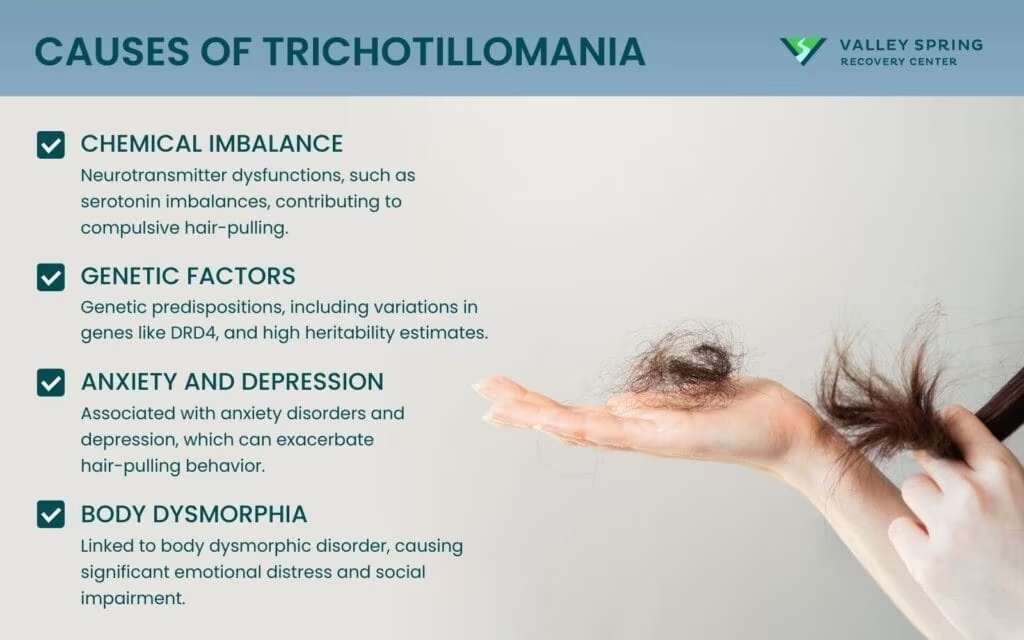
The glutamate system is implicated by treatment response: N-acetylcysteine, a glutamate modulator, reduced hair-pulling symptoms in a randomized placebo-controlled trial (Grant, Odlaug, and Kim, 2009, Archives of General Psychiatry), a finding that ties the disorder's mechanism to compulsive-habit circuitry. Onset in adolescence, earlier in girls than boys, points to developmental and hormonal timing as an additional factor. Where trichotillomania sits relative to OCD follows directly from this mechanism question.
How Is Trichotillomania Different From OCD?
Trichotillomania differs from OCD in that hair pulling is driven by an urge and followed by relief or gratification, while OCD compulsions are driven by intrusive obsessional thoughts and performed to prevent a feared outcome. The DSM-5 grouped the two in one chapter in 2013, yet Grant and Chamberlain's 2016 review records that several first-line OCD treatments appear ineffective for trichotillomania, so the grouping does not carry over to treatment planning.
The characteristics that separate trichotillomania from OCD clinically:
| Characteristic | Trichotillomania | Obsessive-compulsive disorder |
| Driving experience | Urge and tension, discharged by pulling | Intrusive obsessional thoughts |
| Function of the behavior | Relief or gratification from the act itself | Prevention of a feared outcome |
| Sex distribution | No significant gender difference in the general population (Grant et al., 2020) | Higher past-year prevalence in women (NIMH) |
| First-line therapy | Habit reversal training | Exposure and response prevention |
| SSRI response | Not established for hair pulling itself | Established at OCD-specific doses |
OCD carries its own diagnostic instruments, the Y-BOCS severity scale, and its own first-line therapy, exposure and response prevention. Trichotillomania rarely travels alone, and its companions shape the treatment plan.
What Conditions Co-Occur With Trichotillomania?
79% of people with trichotillomania have at least one co-occurring mental health condition, most commonly anxiety and depressive disorders, OCD, PTSD, and ADHD, per Grant and colleagues' 2020 prevalence survey.
Excoriation (skin-picking) disorder is the closest relative: the DSM-5-TR places both among the body-focused repetitive behaviors, the two share the tension-and-relief loop, and they co-occur in the same individuals. Compulsive behavioral patterns outside the BFRB family also overlap, including exercise addiction, where a repeated behavior persists despite physical harm. Eating disorders share the combination of ritualized behavior, body-image distress, and concealment. The overlap is one reason a full psychiatric assessment accompanies the trichotillomania diagnosis.
Trichotillomania is not classified as self-harm: pulling aims to discharge tension rather than to inflict injury, which separates it from the non-suicidal self-injury seen in conditions such as borderline personality disorder. Distress from the disorder is still real, and anyone whose distress reaches thoughts of suicide or self-harm calls or texts 988, the Suicide & Crisis Lifeline, free and confidential, 24 hours a day. Untreated, the disorder's effects accumulate in measurable ways.
What Are the Effects of Trichotillomania?
The effects of trichotillomania span 3 domains: physical damage including hair loss, scalp irritation, and skin infection; psychological consequences including shame and worsening of co-occurring depression and anxiety; and social withdrawal driven by concealment.
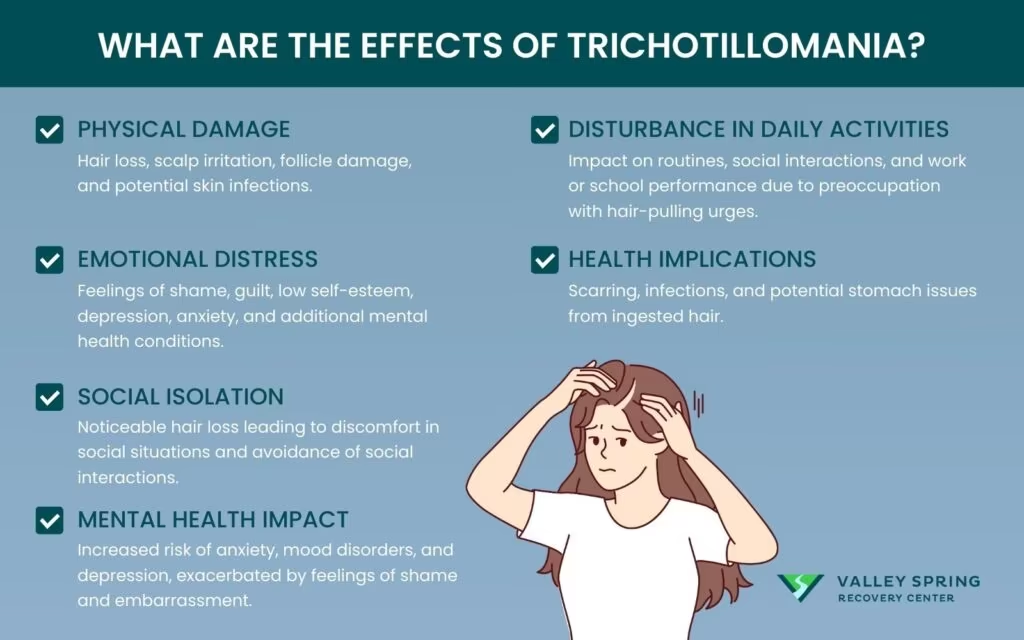
Trichophagia adds a medical risk: swallowed hair accumulates in the stomach as a trichobezoar, a hair mass that obstructs the digestive tract and requires surgical removal in severe cases. The psychological weight is documented in the 2020 survey's finding of moderate-to-high distress, and the concealment behaviors, avoided appointments, covered scalps, declined social plans, are what keep the disorder underdiagnosed. Diagnosis, when it happens, is straightforward.
How Is Trichotillomania Diagnosed?
Trichotillomania is diagnosed through a clinical interview that confirms the three DSM-5-TR criteria: recurrent pulling with hair loss, repeated attempts to stop, and clinically significant distress or impairment. Severity is graded with the Massachusetts General Hospital Hairpulling Scale, the self-report instrument used as the primary outcome measure in the field's randomized trials, including the 2009 N-acetylcysteine study.
Because patients present to dermatology first, per the StatPearls review, the medical workup often starts with the scalp: a punch biopsy distinguishes trichotillomania from alopecia areata and fungal causes of hair loss when the history is unclear. The differential resolved, treatment follows the evidence.
How Is Trichotillomania Treated?
Trichotillomania is treated with habit reversal training, the behavioral therapy with the strongest evidence, and with N-acetylcysteine or olanzapine as the pharmacologic options carrying trial support, per Grant and Chamberlain's 2016 review.
Habit reversal training runs on three components: awareness training that makes automatic pulling conscious, competing-response training that substitutes an incompatible motor action when the urge arrives, and social support that reinforces both. The N-acetylcysteine evidence is specific: in a 12-week double-blind trial of 50 adults, 1,200 to 2,400 mg daily left 56% of patients much or very much improved against 16% on placebo, with improvement first significant at week 9 and no adverse events in the treatment group (Grant, Odlaug, and Kim, 2009). SSRIs, effective for OCD, have not shown the same effect on hair pulling itself, though they remain relevant where depression or an anxiety disorder co-occurs, and psychiatric evaluation sorts that out per patient. Valley Spring Recovery Center treats trichotillomania within its outpatient mental health treatment programs in Norwood, New Jersey, where therapy and psychiatric medication management run on IOP and OP schedules.
What Are the Most Common Questions About Trichotillomania?
Common questions: genetics, classification, self-harm, duration, choice, and the anxiety relationship.
Is Trichotillomania Genetic?
Genetics contribute without deciding the outcome. The disorder clusters in families, per Grant and Chamberlain's 2016 review, and family history raises risk. No single gene explains it, and environmental stress shapes onset and course.
Is Trichotillomania in the DSM-5?
Yes. Trichotillomania (hair-pulling disorder) appears in the DSM-5 and DSM-5-TR in the obsessive-compulsive and related disorders chapter, alongside excoriation disorder, with three diagnostic criteria: recurrent pulling with hair loss, repeated attempts to stop, and significant distress or impairment.
Is Trichotillomania a Form of Self-Harm?
No. Pulling discharges tension and delivers relief rather than aiming to inflict injury, which distinguishes it from non-suicidal self-injury. The distress is still clinically significant, and 988 answers by call or text when distress reaches crisis, 24 hours a day.
How Long Does Trichotillomania Last?
Untreated trichotillomania runs a chronic course with waxing and waning severity, per Grant and Chamberlain's 2016 review. Onset averages 17.7 years of age, and symptoms persist into adulthood for most people who do not receive treatment.
Is Trichotillomania a Choice?
No. The DSM-5-TR criteria include repeated attempts to decrease or stop pulling, so failed self-control is part of the diagnosis itself. Habit reversal training exists precisely because willpower alone does not interrupt the urge-pull-relief loop.
Is Trichotillomania Part of Anxiety?
No. Trichotillomania is its own diagnosis in the obsessive-compulsive and related disorders chapter, not an anxiety disorder. Anxiety disorders co-occur frequently, within the 79% comorbidity rate recorded by Grant and colleagues in 2020.
Sources & References5ShowHide
- Grant JE, Dougherty DD, Chamberlain SR. Prevalence, gender correlates, and co-morbidity of trichotillomania. Psychiatry Research, 2020 (PMC) — Survey of 10,169 U.S. adults aged 18-69: current prevalence 1.7% (males 1.8%, females 1.7%); mean onset 17.7 years (males 19.0, females 14.8); 79% carried one or more comorbidities, led by anxiety/depressive disorders, OCD, PTSD, and ADHD.
- Grant JE, Chamberlain SR. Trichotillomania. American Journal of Psychiatry, 2016 (PMC) — Point prevalence 0.5% to 2.0%; documented in the medical literature since the 19th century; habit reversal therapy plus N-acetylcysteine or olanzapine as evidence-based approaches; several first-line OCD treatments appear ineffective for trichotillomania.
- Grant JE, Odlaug BL, Kim SW. N-acetylcysteine, a glutamate modulator, in the treatment of trichotillomania: a double-blind, placebo-controlled study. Archives of General Psychiatry, 2009 — 50 adults (45 women, 5 men), 12 weeks, 1,200-2,400 mg/day: 56% much or very much improved on NAC versus 16% on placebo (p = .003); significant improvement first noted at week 9; no adverse events in the NAC group.
- Pereyra AD, Saadabadi A. Trichotillomania. StatPearls, NCBI Bookshelf (updated June 26, 2023) — First described in ancient Greece, named in the late 18th century; stigma drives underreporting and concealment, and patients frequently present to a dermatologist before or instead of a psychiatrist.
- American Psychiatric Association. Diagnostic and Statistical Manual of Mental Disorders, Fifth Edition, Text Revision (DSM-5-TR). Washington, DC: American Psychiatric Publishing, 2022 — Diagnostic criteria: recurrent hair pulling resulting in hair loss, repeated attempts to decrease or stop, and clinically significant distress or impairment; classified with the obsessive-compulsive and related disorders; excoriation (skin-picking) disorder as the closest related body-focused condition. Print reference.