


Clinical guide
Addiction Treatment: Definition, Levels of Care, Therapies Used
Learn the levels of care, therapies, and ASAM Criteria guidelines used to plan addiction treatment based on each person's underlying causes and needs.
By Paul James Roeser·Reviewed by Noelle Mathew, LCSW, LCADC, CASAC-M·14 min read
Published ·Updated
Addiction treatment is the set of clinical services that diagnose a substance use disorder, reduce or stop substance use, and hold that change in place after the episode of care ends. Those services run across a graded continuum, from weekly counseling to hospital-based care, and the American Society of Addiction Medicine publishes the standard that defines each step of it.
The distance between who needs that care and who reaches it is the defining number in the field. The Substance Abuse and Mental Health Services Administration recorded 54.2 million people aged 12 or older, 19.1 percent of that population, as needing substance use treatment in 2023, and 12.8 million of them, 23.6 percent, as receiving any. Among the 48.5 million people who met criteria for a substance use disorder that year, 14.6 percent received treatment and 85.4 percent did not.
What Is Addiction Treatment?
Addiction treatment combines a multidimensional assessment, behavioral therapy, medication where an approved medication exists for the substance, and a written plan for continuing care. The intensity of each component is set by the severity of the disorder rather than by the substance involved.
The condition being treated is the substance use disorder defined in the fifth edition of the Diagnostic and Statistical Manual of Mental Disorders, scored on 11 criteria and graded mild, moderate or severe. Severity predicts who reaches care as well as what care they need. SAMHSA recorded past-year treatment receipt at 7.8 percent among people with a mild substance use disorder in 2023, 13.6 percent among people with a moderate disorder, and 33.2 percent among people with a severe disorder. Severity itself develops through the 6 stages of the addiction cycle, and the level of care assigned at intake reflects where in that progression a person presents.
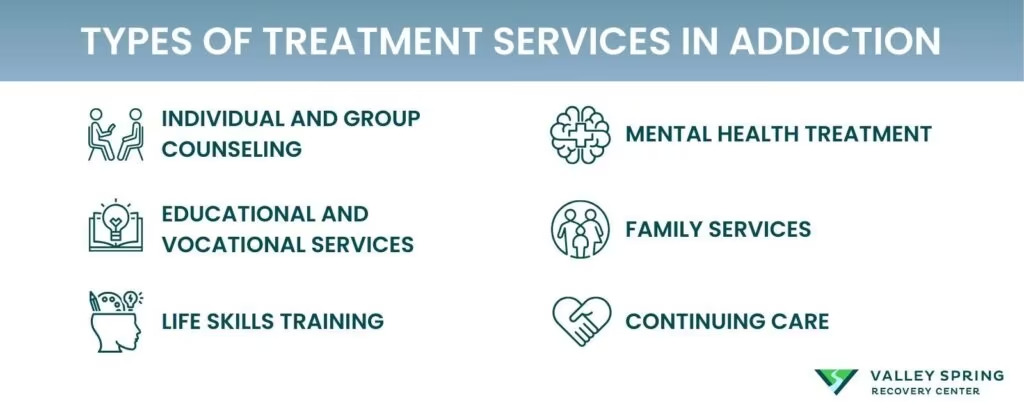
What Are The ASAM Levels Of Care In Addiction Treatment?
The ASAM Criteria Fourth Edition organizes addiction treatment into 4 broad levels, outpatient, intensive outpatient, residential and medically managed inpatient, subdivided by decimal gradation. The American Society of Addiction Medicine released the digital Fourth Edition in October 2023 and the print edition in December 2023.
The Fourth Edition renumbered the continuum, so a levels list copied from an older source names levels that no longer exist. Level 0.5 early intervention is gone from the continuum, and Early Intervention and Secondary Prevention became a chapter of the manual rather than a numbered level of care. The Third Edition ran a separate withdrawal management ladder alongside the main continuum; the Fourth Edition folded it into the medically managed x.7 tiers, mapping Level 1-WM to Level 1.7, Level 2-WM to Level 2.7, Level 3.2-WM into Level 3.5, and holding Level 3.7-WM at Level 3.7. Level 4 is named Medically Managed Inpatient. Three residential sub-levels remain: 3.1, 3.5 and 3.7.
The 10 adult levels are the continuum as published in The ASAM Criteria Fourth Edition, with the clinical-service hours ASAM assigns to each tier.
| Level | Fourth Edition name | What defines it |
| 1.0 | Long-Term Remission Monitoring | Ongoing monitoring for patients in stable remission, including medication management for those prescribed addiction medications. New in the Fourth Edition. |
| 1.5 | Outpatient Therapy | Clinically managed care delivering under 9 hours of clinical service per week. |
| 1.7 | Medically Managed Outpatient | Outpatient care with treatment planning led by medical staff. Absorbs Third Edition Level 1 withdrawal management. |
| 2.1 | Intensive Outpatient | Clinically managed care delivering 9 to 19 hours of clinical service per week, primarily counseling and psychoeducation. |
| 2.5 | High-Intensity Outpatient | Clinically managed care delivering at least 20 hours per week, with a greater focus on psychotherapy. The Third Edition called this partial hospitalization. |
| 2.7 | Medically Managed Intensive Outpatient | Medically managed intensive outpatient care. Absorbs Third Edition Level 2 withdrawal management. |
| 3.1 | Clinically Managed Low-Intensity Residential | Residential setting delivering 9 to 19 hours of clinical service per week. |
| 3.5 | Clinically Managed High-Intensity Residential | Residential setting delivering at least 20 hours per week. Absorbs Third Edition Level 3.2 residential withdrawal management. |
| 3.7 | Medically Managed Residential | Treatment planning led by medical staff, with a separate BIO standard for programs able to give intravenous fluids and medications and advanced wound care. |
| 4 | Medically Managed Inpatient | A hospital level of care, distinguished from residential care by the hospital regulatory framework around it. |
The Fourth Edition brings recovery residences into that continuum. The Fourth Edition Dimensional Admission Criteria recommend a recovery residence in addition to an outpatient level of care, so sober housing can accompany an outpatient level of care rather than replace it. Terminology moved with the numbering. ASAM renamed the Level 2.5 tier High-Intensity Outpatient on the grounds that partial hospitalization is a misnomer for services delivered outside a hospital, and New Jersey's own treatment reporting still files that tier under the older label.
What Is The Difference Between Inpatient And Outpatient Addiction Treatment?
The difference is residency. Inpatient and residential treatment place a patient inside the facility overnight at ASAM Levels 3.1 through 4, and outpatient treatment keeps a patient living at home at Levels 1.0 through 2.7. Both halves of the continuum deliver the same named therapies, at different intensities and under different supervision.
The 6 attributes separate the two halves, and every one of them derives from the level of care a facility is licensed for rather than from its amenities or its marketing.
| Attribute | Inpatient and residential | Outpatient |
| ASAM levels | 3.1, 3.5, 3.7 and 4 | 1.0, 1.5, 1.7, 2.1, 2.5 and 2.7 |
| Where the patient sleeps | In the facility, for the length of the stay | At home |
| Clinical service hours | 9 to 19 hours per week at Level 3.1, at least 20 hours at Levels 3.5 and 3.7 | Under 9 hours at Level 1.5, 9 to 19 hours at Level 2.1, at least 20 hours at Level 2.5 |
| Medical supervision | 24-hour nursing at Level 3.7, full hospital resources at Level 4 | Scheduled psychiatric and medical review at the x.7 tiers |
| Withdrawal management | Delivered at Levels 3.5, 3.7 and 4 | Delivered at Levels 1.7 and 2.7 |
| Median length of stay in New Jersey, 2023 | 19 days short-term residential, 36 days long-term residential | 84 days outpatient, 60 days intensive outpatient, 29 days partial hospitalization |
A drug rehab center is defined by its license, level of care, staffing, assessment process, and delivered services rather than by the word rehab in its name. Inside the outpatient half of the continuum, families must also distinguish intensive outpatient from standard outpatient care.
What Is The Difference Between Intensive Outpatient And Outpatient Treatment?
Hours per week separate them. Intensive outpatient treatment at ASAM Level 2.1 delivers 9 to 19 hours of clinical service per week, and outpatient therapy at Level 1.5 delivers under 9 hours. A third tier, high-intensity outpatient at Level 2.5, delivers at least 20 hours per week without an overnight stay.
Both levels are clinically managed, meaning treatment planning is led by clinical staff rather than medical staff, and both hold the same core content: individual therapy, group process sessions and psychoeducation. Intensive outpatient concentrates that content into a schedule dense enough to substitute for residential structure, which is why programs commonly run it in evening blocks that leave a working week intact. Standard outpatient care spreads the same content across fewer contact hours once a person has stabilized. Level 1.0 sits below both as long-term remission monitoring, a maintenance tier for people already in stable remission, including those continuing on addiction medications. Moving between these tiers is a clinical decision rather than a graduation, and the direction of travel matters as much as the destination.
How Long Does Addiction Treatment Last?
Addiction treatment lasts at least 3 months, and the New Jersey Department of Human Services recorded a 2023 median of 84 days in outpatient care, 60 days in intensive outpatient and 29 days in partial hospitalization. The National Institute on Drug Abuse sets 3 months as the minimum duration at which drug use significantly reduces or stops, with better outcomes at longer durations.
New Jersey publishes what happened rather than what a program schedule promises. The state's Division of Mental Health and Addiction Services recorded 82,176 substance use treatment admissions and 81,957 discharges in calendar year 2023, submitted by providers through the New Jersey Substance Abuse Monitoring System. The 8 levels of care account for 79,887 of the 81,800 discharges with a recorded length of stay.
| Level of care | Discharges | Mean stay (days) | Median stay (days) |
| Outpatient care | 16,558 | 134 | 84 |
| Intensive outpatient | 16,168 | 90 | 60 |
| Partial hospitalization | 2,445 | 50 | 29 |
| Opioid maintenance, outpatient | 10,691 | 550 | 189 |
| Halfway house | 1,943 | 122 | 116 |
| Long-term residential | 5,118 | 68 | 36 |
| Short-term residential | 11,012 | 20 | 19 |
| Detox residential | 15,952 | 8 | 7 |
Two readings of that table are worth holding together. Residential detox runs a median of 7 days, which is shorter than every other level on the list and shorter than the 3-month minimum the evidence supports, so detox on its own is a beginning rather than a course of treatment. Opioid maintenance runs a median of 189 days and a mean of 550, because medication for opioid use disorder is a maintenance therapy rather than a fixed-length episode. The New Jersey statewide Substance Use Overview records both figures for the same year. What happens between those levels decides whether the total adds up to an episode of care or a set of disconnected stays.
How Do People Move Between Levels Of Care?
People step down through the continuum as they stabilize. The route runs from residential or high-intensity outpatient care to intensive outpatient, then to outpatient therapy, then to remission monitoring, with contact hours falling at each step while the treatment plan carries forward. A step up runs the same route in reverse when risk rises.
The handover out of withdrawal management is where the continuum breaks most visibly. The National Institute on Drug Abuse states that detoxification alone without subsequent treatment generally leads to resumption of drug use. New Jersey measured that handover directly: of 15,918 detox discharges recorded in 2023, 42.5 percent transferred to a different level of care within the same agency, 7.1 percent had continuing care coordinated with a new agency, 24.7 percent refused continuing care, 5.0 percent were assessed as needing none and 20.5 percent were recorded as unknown. One in four people leaving detox in New Jersey therefore left the continuum at the point the evidence says the treatment begins.
Valley Spring Recovery Center delivers partial care, intensive outpatient and standard outpatient programming to adults 18 and older, with clients living at home throughout. A person who needs medically supervised withdrawal first is referred to a detox partner and admitted directly after that discharge, with provider-to-provider communication keeping the treatment plan continuous across the handover. Valley Spring does not provide the detoxification itself. Its intensive outpatient program in Norwood, New Jersey runs on an evening schedule.
Across the continuum as a whole, the clinical content of addiction treatment is drawn from the same short list of named methods.
What Therapies Are Used To Treat Addiction?
Addiction treatment is delivered through 5 evidence-based methods: cognitive behavioral therapy, contingency management, motivational interviewing, medication for addiction treatment, and family therapy. Each is manualized and each has been tested in randomized trials. Three of them carry a pooled effect size.
The 5 methods account for the largest share of a treatment schedule at a licensed facility.
- Cognitive behavioral therapy identifies the thoughts and situations that precede substance use and rehearses a different response to them.
- Contingency management pays a tangible reward on a verified negative drug test, reinforcing abstinence on a fixed schedule.
- Motivational interviewing resolves ambivalence about change by drawing the reasons for change from the patient rather than supplying them.
- Medication for addiction treatment applies approved medicines alongside counseling, including buprenorphine, methadone and naltrexone for opioid use disorder and naltrexone, acamprosate and disulfiram for alcohol use disorder.
- Family therapy works on the household patterns that maintain substance use and rebuilds communication between a patient and the people they live with.
The effect sizes behind those methods are modest and worth stating plainly. Magill, Molly and Ray, Lara A. pooled randomized trials of cognitive behavioral therapy for adults using alcohol and illicit drugs in their 2009 meta-analysis in the Journal of Studies on Alcohol and Drugs, and measured a small but statistically significant effect of g = 0.154, declining to g = 0.115 at 6 to 9 months and g = 0.096 at 12 months. Prendergast, Michael and colleagues measured contingency management in their 2006 meta-analysis in Addiction at d = 0.42 overall, rising to d = 0.65 for opiate use and d = 0.66 for cocaine use. Lundahl, Brad W. and colleagues pooled 119 motivational interviewing studies in their 2010 meta-analysis in Research on Social Work Practice, spanning substance use alongside diet, exercise, safe sex, gambling and treatment engagement, and measured g = 0.28 against weak comparison conditions and g = 0.09 against specific active treatments, a result no longer distinguishable from the alternative. Those pooled figures cover every behaviour studied, not substance use alone.
Numbers of that size mean the method matters less than the match between the method and the person, which is the judgment the assessment at intake exists to make.
How Is The Right Level Of Care Chosen?
Placement is decided by a multidimensional assessment across the 6 dimensions of The ASAM Criteria Fourth Edition, not by the substance a person used, the number of prior treatment episodes, or a facility's available beds. Dimensions 1 through 5 produce the level-of-care recommendation, and Dimension 6 establishes which level the patient is willing and able to engage in.
The 6 dimensions are assessed at intake and reassessed as the clinical picture changes.
- Intoxication, withdrawal and addiction medications, covering intoxication risk, withdrawal risk and medication needs.
- Biomedical conditions, covering physical health concerns, pregnancy-related concerns and sleep problems.
- Psychiatric and cognitive conditions, covering active symptoms, persistent disability, cognitive functioning, trauma-related needs and psychiatric history.
- Substance use-related risks, covering the likelihood of risky substance use and of risky substance-related behaviors.
- Recovery environment interactions, covering the ability to function in the current environment, its safety, its support and its cultural perceptions of substance use.
- Person-centered considerations, covering barriers to care including social determinants of health, patient preferences and the need for motivational enhancement.
Dimension 6 is new. The Third Edition scored readiness to change as an independent driver of placement; the Fourth Edition distributes readiness across the other dimensions and replaces that slot with person-centered considerations. The Fourth Edition also states its admission principle directly: admission is based on patient needs rather than on arbitrary prerequisites such as prior treatment failure. A person who has been through treatment before therefore enters at the level their current assessment supports.
An assessment is the only step that produces a level of care, so the practical first action is booking one with a licensed provider and asking which levels its license authorizes.
What Are The Most Common Questions About Addiction Treatment?
Common questions about drug addiction treatment: whether treatment works, program choice for men, treatment that does not hold the first time, virtual care, detox as a prerequisite, and what follows the end of a program.
Does Addiction Treatment Work?
Yes. The National Institute on Drug Abuse cites conservative estimates of 4 to 7 dollars returned per dollar invested in addiction treatment, through reduced drug-related crime and criminal justice costs, rising to a 12 to 1 ratio once healthcare savings are counted.
Which Is Better For Men, Inpatient Or Outpatient Rehab?
Neither is better by category. The assessment decides, weighing withdrawal risk, the safety of the home environment and psychiatric severity. Drug and alcohol rehab for men adds gender-responsive peer context and programming only when those features match the person's assessed needs.
What Happens When Treatment Does Not Hold The First Time?
The plan is reassessed and the level of care is adjusted. A relapse or return to use is a signal to review triggers, medication, support, and treatment intensity rather than evidence that care failed.
Is Virtual Addiction Treatment A Separate Level Of Care?
No. Telehealth is a delivery mode, and the ASAM Criteria Fourth Edition treats it that way, adding a Telehealth and Other Health Technologies chapter rather than a numbered level.
Do You Need Detox Before Treatment?
Only when withdrawal risk requires it. Dimension 1 of the assessment decides. Withdrawal management now sits inside the continuum at the medically managed x.7 levels rather than on a separate ladder, and it discharges into treatment rather than ending it.
What Happens After A Treatment Program Ends?
Care steps down rather than stopping. The Fourth Edition adds Level 1.0 long-term remission monitoring for exactly that phase, covering recovery management checkups and continued medication management for people prescribed addiction medications.
Sources & References9ShowHide
- American Society of Addiction Medicine. The ASAM Criteria Fourth Edition (dissemination summary, hosted by the Colorado Department of Health Care Policy and Financing) — Source of the four broad levels, the 10-level adult continuum with its Fourth Edition names, the clinical-service hour bands, the recovery residence placement rule, the six dimensions and their subdimensions, and the list of new chapters including Early Intervention and Secondary Prevention.
- American Society of Addiction Medicine. The ASAM Criteria FAQ — Source of the October 2023 digital and December 2023 print release dates, the withdrawal management crosswalk from the Third Edition to the x.7 levels, the statement that Level 4 is a hospital level of care, and the note that High-Intensity Outpatient replaces partial hospitalization for Level 2.5.
- New Jersey Department of Human Services, Division of Mental Health and Addiction Services. Substance Use Overview 2023, Statewide — Source of the 82,176 admissions and 81,957 discharges for calendar year 2023, the length-of-stay table by level of care, and the detox continuing-care status figures at discharge.
- SAMHSA. Key Substance Use and Mental Health Indicators in the United States: Results from the 2023 National Survey on Drug Use and Health — Source of the 54.2 million people needing substance use treatment, the 23.6 percent who received any, the 48.5 million with a substance use disorder, and treatment receipt by severity at 7.8, 13.6 and 33.2 percent.
- NIDA. Principles of Drug Addiction Treatment: A Research-Based Guide (Third Edition) — Source of the minimum three months in treatment principle and the cost-benefit estimates of 4 to 7 dollars returned per dollar invested, rising to 12 to 1 once healthcare savings are counted.
- NIDA. Drugs, Brains, and Behavior: The Science of Addiction, Treatment and Recovery — Source of the statement that detoxification alone without subsequent treatment generally leads to resumption of drug use.
- Magill M, Ray LA. Cognitive-behavioral treatment with adult alcohol and illicit drug users: a meta-analysis of randomized controlled trials. Journal of Studies on Alcohol and Drugs, 2009;70(4):516-527 — Source of the cognitive behavioral therapy effect sizes: g = 0.154 at post-treatment, g = 0.115 at 6 to 9 months and g = 0.096 at 12 months.
- Prendergast M, Podus D, Finney J, Greenwell L, Roll J. Contingency management for treatment of substance use disorders: a meta-analysis. Addiction, 2006;101(11):1546-1560 — Source of the contingency management effect sizes: d = 0.42 overall, d = 0.65 for opiate use and d = 0.66 for cocaine use.
- Lundahl BW, Kunz C, Brownell C, Tollefson D, Burke BL. A Meta-Analysis of Motivational Interviewing: Twenty-Five Years of Empirical Studies. Research on Social Work Practice, 2010;20(2):137-160 — Source of the motivational interviewing effect sizes across 119 studies: g = 0.28 against weak comparison groups and g = 0.09 against specific active treatments.