


Mental health guide
Anxiety Symptoms, Types, Causes and Effects Explained
Anxiety disorders affect 19.1% of U.S. adults each year. The 9 DSM-5-TR types, symptoms, causes, prevalence by disorder, and evidence-based treatment.
By Paul James Roeser·Reviewed by Dr. Michael Olla, MD·8 min read
Published ·Updated
Anxiety is the body's anticipatory response to a perceived future threat, expressed as worry, tension, and physical arousal. Anxiety becomes an anxiety disorder when the fear or worry is persistent, out of proportion to the actual situation, and impairing enough to disrupt work, school, or relationships. The Diagnostic and Statistical Manual of Mental Disorders, Fifth Edition, Text Revision (DSM-5-TR), published by the American Psychiatric Association, defines the anxiety disorders as a distinct diagnostic chapter with its own criteria for each condition.
Anxiety disorders are the most common class of mental health condition in the United States. According to the National Institute of Mental Health (NIMH), drawing on the National Comorbidity Survey Replication (NCS-R), 19.1% of U.S. adults had an anxiety disorder in the past year, and 31.1% experience one at some point in their lives. Past-year prevalence runs higher in women (23.4%) than in men (14.3%).
Two treatments carry the strongest evidence for anxiety disorders: cognitive behavioral therapy built around exposure, and antidepressant medication in the SSRI and SNRI classes.
What Is an Anxiety Disorder?
An anxiety disorder is a mental health condition in which fear or worry is persistent, excessive relative to the real threat, and severe enough to impair daily functioning, per the DSM-5-TR. Ordinary anxiety before a test or a job interview resolves when the stressor passes. Disorder-level anxiety persists, generalizes across situations, and worsens without treatment.
Severity varies across the diagnosed population. In the NCS-R data reported by NIMH's anxiety disorder statistics, 43.5% of adults with an anxiety disorder had mild impairment, 33.7% had moderate impairment, and 22.8% had serious impairment. Generalized anxiety disorder, the reference diagnosis for chronic worry, requires excessive anxiety on more days than not for at least 6 months. The 6-month duration criterion separates a disorder from a rough season of life, and the same diagnostic precision separates one anxiety disorder from another, which is where the DSM-5-TR's type list begins.

Clinical perspective
Anxiety isn't one thing — it's a family of conditions, and the treatment plan changes depending on which member of that family is actually in play. Panic disorder, generalized anxiety, social anxiety — they can look similar from the outside, but the mechanism and the medication choice differ for each. That distinction is the formulation work that comes before any prescription.
What Are the Types of Anxiety Disorders?
The DSM-5-TR names 9 anxiety disorder diagnoses: separation anxiety disorder, selective mutism, specific phobia, social anxiety disorder, panic disorder, agoraphobia, generalized anxiety disorder, substance/medication-induced anxiety disorder, and anxiety disorder due to another medical condition. Obsessive-compulsive disorder and post-traumatic stress disorder left this chapter in 2013, when the DSM-5 moved each into its own diagnostic class. The anxiety disorders form one diagnostic chapter among the mental health conditions the DSM-5-TR classifies, alongside the depressive, bipolar, and trauma- and stressor-related disorders.
The 9 anxiety disorder types:
- Separation anxiety disorder: excessive fear about being apart from an attachment figure, diagnosed in children and in adults.
- Selective mutism: consistent failure to speak in specific social situations despite speaking normally elsewhere, with onset in childhood.
- Specific phobia: intense fear of a particular object or situation, including animals, heights, blood, or flying, with active avoidance. Specific phobia includes five DSM subtypes organized by the feared object or situation.
- Social anxiety disorder: fear of scrutiny and negative evaluation in social or performance situations.
- Panic disorder: recurrent unexpected panic attacks plus persistent worry about further attacks or their consequences.
- Agoraphobia: fear of situations where escape feels difficult, including public transportation, open spaces, and crowds.
- Generalized anxiety disorder: excessive, hard-to-control worry across multiple life domains for at least 6 months.
- Substance/medication-induced anxiety disorder: anxiety produced directly by a substance, including caffeine, stimulants such as cocaine, or a prescribed medication.
- Anxiety disorder due to another medical condition: anxiety caused physiologically by a condition such as hyperthyroidism.
Each of these diagnoses carries its own prevalence figures, and the differences between them are large.
How Common Is Each Anxiety Disorder?
Specific phobia is the most common anxiety disorder, at 9.1% of U.S. adults in the past year, followed by social anxiety disorder at 7.1%, with generalized anxiety disorder and panic disorder at 2.7% each, per NIMH's disorder-level statistics from the National Comorbidity Survey Replication. Those national estimates do not provide current state prevalence; the analysis of social anxiety treatment search interest by state explains what normalized Google Trends scores measure and why they cannot rank prevalence.
| Anxiety disorder | Past-year prevalence (U.S. adults) | Lifetime prevalence |
| Specific phobia | 9.1% | 12.5% |
| Social anxiety disorder | 7.1% | 12.1% |
| Generalized anxiety disorder | 2.7% | 5.7% |
| Panic disorder | 2.7% | 4.7% |
Every disorder in the table shows higher rates in women than in men: 12.2% versus 5.8% for specific phobia, 3.8% versus 1.6% for panic disorder, and 3.4% versus 1.9% for generalized anxiety disorder. Prevalence describes how widespread these conditions are; symptoms describe what they feel like.
What Are the Signs and Symptoms of Anxiety?
Anxiety produces two symptom groups: cognitive symptoms, led by uncontrollable worry and fear of losing control, and physical symptoms, led by muscle tension, a racing heart, and disturbed sleep. The generalized anxiety disorder criteria make the physical group explicit: diagnosis requires 3 or more of 6 associated symptoms, per the DSM-5-TR.
The 6 associated symptoms in the generalized anxiety disorder criteria:
- Restlessness: feeling keyed up, on edge, or unable to sit still.
- Fatigue: becoming easily tired even without physical exertion.
- Concentration difficulty: losing the thread of tasks or conversations, with the mind going blank.
- Irritability: a short temper disproportionate to the trigger.
- Muscle tension: sustained tightness, most reported in the neck, shoulders, and jaw.
- Sleep disturbance: difficulty falling asleep, staying asleep, or waking unrefreshed. Persistent sleep disturbance that outlasts the anxious period is assessed separately as insomnia.
Panic attacks add a distinct acute cluster: chest pain, shortness of breath, dizziness, numbness, and a surge of fear that peaks within minutes. Symptoms answer what anxiety looks like; causes answer where it comes from.
What Causes Anxiety Disorders?
Anxiety disorders develop from an interaction of genetic vulnerability and environmental exposure, not from a single cause. NIMH's research programs on anxiety examine both tracks: brain development and biology on the genetic side, and family and life-experience factors on the environmental side.
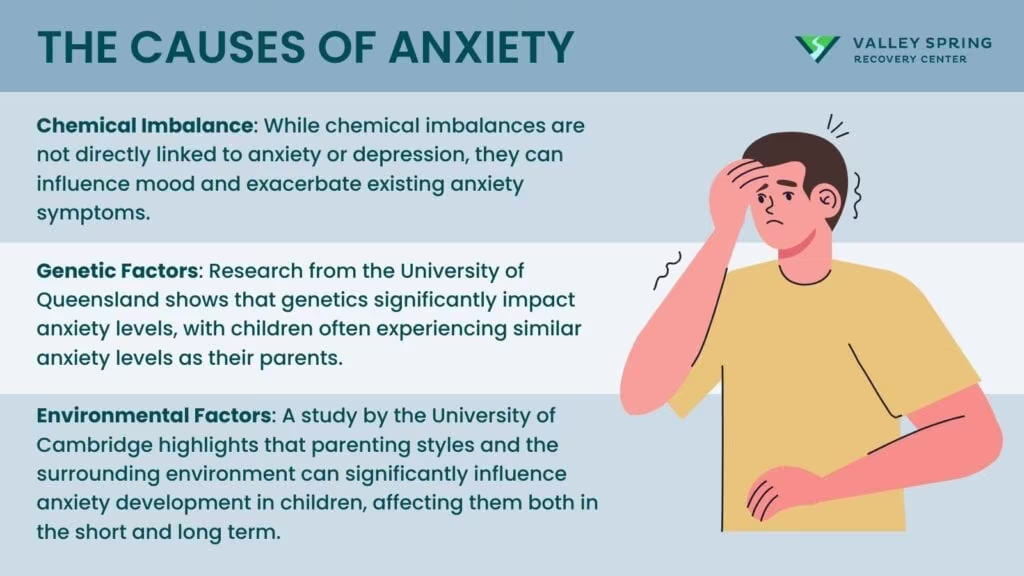
Three contributing factors carry the strongest evidence. First, family aggregation: anxiety disorders run in families, and prevalence is approximately twice as high in women as in men, per the StatPearls clinical review of generalized anxiety disorder. Second, temperament and early adversity: behavioral inhibition in childhood and exposure to trauma both raise risk. Third, direct physiological induction: caffeine, prescription stimulants, illicit stimulants, and withdrawal states each produce anxiety symptoms, which the DSM-5-TR codes as substance/medication-induced anxiety disorder. Cause is one axis of confusion around anxiety; the other is its boundary with everyday stress.
How Is Anxiety Different From Stress?
Per NIMH's fact sheet on stress and anxiety, stress is a response to an external cause, such as a deadline or an argument, while anxiety is the internal reaction, and anxiety persists after the external cause is gone. Stress resolves when the stressor resolves. Anxiety that continues without a stressor, attaches to new situations, and impairs functioning is the pattern that meets disorder criteria.
Anxiety also travels with low mood. Anxiety disorders and depression co-occur at high rates, and the combination raises impairment above either condition alone. The distinction between a passing state and a treatable disorder matters because the treatable disorder has treatments with measured effects.
How Are Anxiety Disorders Treated?
The two first-line treatments for anxiety disorders are cognitive behavioral therapy centered on exposure, and antidepressant medication in the SSRI and SNRI classes, with a documented medication response rate of 30% to 50%, per the StatPearls review of generalized anxiety disorder.
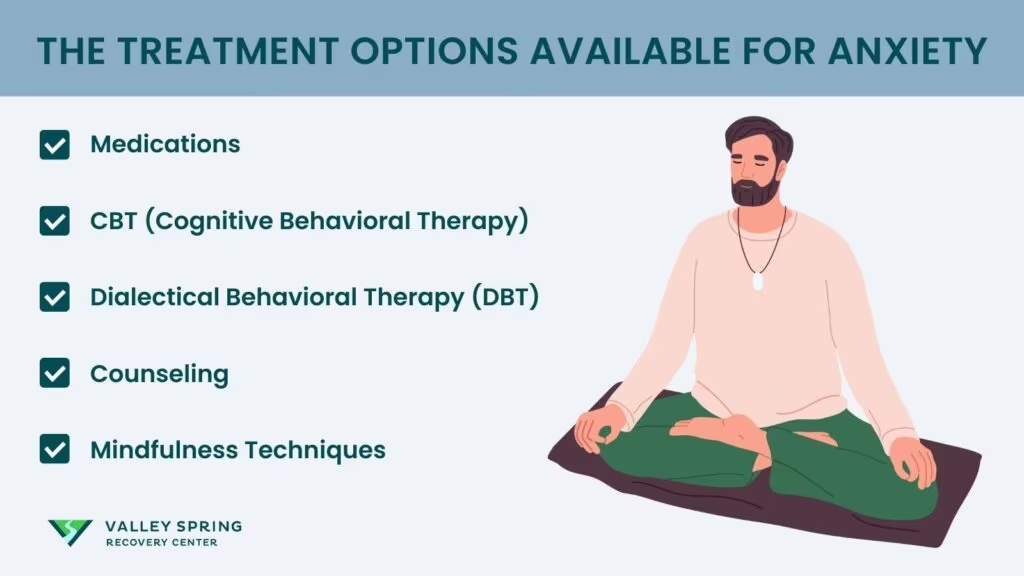
Cognitive behavioral therapy for anxiety changes maladaptive thought patterns and pairs them with gradual exposure: the person confronts feared situations in planned steps until the fear response weakens. In the broader exposure-therapy literature, exposure is the component that carries the treatment effect for phobias, social anxiety disorder, and panic disorder. On the medication side, SSRIs and SNRIs, including escitalopram, duloxetine, venlafaxine, and paroxetine, require slow titration and at least 4 weeks of continuation before effectiveness is assessed, per the same StatPearls review. A licensed prescriber matches the agent and the duration to the diagnosis. Both first-line approaches are available through anxiety treatment at Valley Spring Recovery Center, delivered at the IOP and outpatient levels in Norwood, New Jersey.
What Are the Most Common Questions About Anxiety?
Common questions: heredity, prevention, physical effects, panic attacks, and the threshold for professional help.
Is Anxiety Genetic?
Genetics contribute without deciding the outcome. Anxiety disorders aggregate in families, prevalence is approximately twice as high in women, and NIMH funds research on the specific gene-environment interactions involved. A family history raises risk; it does not guarantee a disorder.
Can Anxiety Disorders Be Prevented?
No proven method prevents an anxiety disorder. Early treatment changes the trajectory: cognitive behavioral therapy and SSRI/SNRI medication reduce symptoms and impairment, and treating the disorder early limits the avoidance patterns that entrench it.
Is Anxiety a Mental Illness?
Yes, when it meets diagnostic criteria. The DSM-5-TR classifies 9 anxiety disorders as mental health conditions. Time-limited anxiety tied to a real stressor is a normal response, not an illness.
Can Anxiety Cause Physical Symptoms?
Yes. Anxiety produces muscle tension, elevated heart rate, sweating, trembling, shortness of breath, gastrointestinal distress, and sleep disturbance. The DSM-5-TR's generalized anxiety criteria require 3 of 6 associated physical and cognitive symptoms for diagnosis.
What Is the Difference Between Anxiety and a Panic Attack?
A panic attack is an abrupt surge of intense fear that peaks within minutes. Anxiety is a sustained state. Panic disorder is diagnosed when attacks recur unexpectedly and generate persistent worry about future attacks.
When Does Anxiety Require Professional Help?
Seek evaluation when anxiety persists past its trigger, disrupts work, school, sleep, or relationships, or drives avoidance. Contact the 988 Suicide & Crisis Lifeline by call, text, or chat at 988lifeline.org when anxiety comes with thoughts of self-harm.
Sources & References8ShowHide
- NIMH — Any Anxiety Disorder Statistics (National Comorbidity Survey Replication) — Past-year prevalence 19.1% of U.S. adults (females 23.4%, males 14.3%); lifetime 31.1%; severity split mild 43.5%, moderate 33.7%, serious 22.8%.
- NIMH — Specific Phobia Statistics — Past-year 9.1% (females 12.2%, males 5.8%); lifetime 12.5% (NCS-R).
- NIMH — Social Anxiety Disorder Statistics — Past-year 7.1%; lifetime 12.1% (NCS-R).
- NIMH — Generalized Anxiety Disorder Statistics — Past-year 2.7% (females 3.4%, males 1.9%); lifetime 5.7% (NCS-R).
- NIMH — Panic Disorder Statistics — Past-year 2.7% (females 3.8%, males 1.6%); lifetime 4.7% (NCS-R).
- Munir S, Takov V. Generalized Anxiety Disorder. StatPearls, NCBI Bookshelf — DSM criteria: excessive anxiety and worry for at least 6 months plus 3+ of 6 associated symptoms; prevalence approximately twice as high in women; SSRI/SNRI response rate 30% to 50% with at least 4 weeks to assess effectiveness; CBT with gradual exposure as primary psychological intervention.
- NIMH — I'm So Stressed Out! Fact Sheet — Stress is a response to an external cause; anxiety is the internal reaction that persists after the stressor is gone.
- American Psychiatric Association. Diagnostic and Statistical Manual of Mental Disorders, Fifth Edition, Text Revision (DSM-5-TR) — Print reference: the 9 anxiety disorder diagnoses; OCD and PTSD reclassified out of the anxiety disorders chapter in DSM-5 (2013).