


Mental health guide
Phobia: Symptoms, Causes, Types, Diagnosis and Treatment
Specific phobia affects 9.1% of U.S. adults yearly. The three DSM-5-TR phobic disorders, 5 specific phobia types, symptoms, causes, diagnosis, treatment.
By Paul James Roeser·Reviewed by Dr. Michael Olla, MD·10 min read
Published ·Updated
A phobia is a marked, persistent fear of a specific object or situation that is out of proportion to the real danger the object or situation poses. The fear arrives almost every time the trigger appears, it drives active avoidance, and the DSM-5-TR requires it to last 6 months or longer before it counts as a disorder.
Phobic fear is common enough to be measured precisely. An estimated 9.1% of U.S. adults had specific phobia in the past year and 12.5% experience it at one point or another in life, per the National Institute of Mental Health's National Comorbidity Survey Replication data, the highest past-year rate NIMH reports for any single anxiety disorder. Social anxiety disorder reaches 7.1% past-year and 12.1% lifetime prevalence, and agoraphobia reaches 0.9% past-year and 1.3% lifetime.
Three separate DSM-5-TR diagnoses carry phobic fear, and which one applies changes the treatment target. Sorting them starts with what a phobia is and is not.
What Is a Phobia?
A phobia is a fear of a specific object or situation that is disproportionate to the actual danger, provokes immediate anxiety on nearly every exposure, and produces avoidance or endurance with intense distress, sustained for 6 months or longer, per the DSM-5-TR criteria set out in the StatPearls specific phobia review.
Two features separate a phobia from a preference. The first is proportionality: the fear exceeds the realistic threat, which is what distinguishes a phobia of dogs from caution around an unfamiliar dog. The second is cost: the diagnosis requires clinically significant distress or functional impairment, so a fear of deep-sea diving in a person who never dives carries no diagnosis while a fear of needles that blocks blood draws does. Phobias sit inside the anxiety disorders chapter alongside generalized anxiety and panic disorder, and the boundary between ordinary fear and a phobic disorder is drawn on those two features.

Clinical perspective
Specific phobias often respond well to exposure-based therapy because it works directly with the fear response. The hard part isn't the biology — it's convincing someone to walk toward the thing their entire nervous system is telling them to run from. That's where the therapeutic relationship matters as much as the technique.
How Is a Phobia Different From Ordinary Fear?
Ordinary fear matches its threat and ends when the threat ends, while a phobia exceeds the threat, persists 6 months or longer, and reorganizes behavior around avoiding the trigger. Fear of a growling dog protects a person. Fear that keeps that person off sidewalks does not.
The functional cost is measurable rather than theoretical. Among U.S. adults with past-year specific phobia, 21.9% had serious impairment on the Sheehan Disability Scale, 30.0% moderate impairment, and 48.1% mild impairment, per NIMH's specific phobia statistics. Agoraphobia carries the heaviest burden of the three phobic diagnoses, with serious impairment in 40.6% of past-year cases. Ordinary fear produces no such distribution, because ordinary fear resolves.
What Are the Three Phobic Disorders in the DSM-5-TR?
The DSM-5-TR carries phobic fear in 3 diagnoses: specific phobia, fear of a particular object or situation; social anxiety disorder, fear of scrutiny and negative evaluation by other people; and agoraphobia, fear of situations where escape is difficult. All 3 require 6 months of duration. What separates them:
| Diagnosis | What the fear targets | Threshold criteria | U.S. adult prevalence |
| Specific phobia | One object or situation, falling in 1 of 5 specifier categories | Fear disproportionate to actual danger, 6 months or longer, with distress or impairment | 9.1% past year; 12.5% lifetime |
| Social anxiety disorder | Scrutiny, judgment, and negative evaluation by other people | 6 months or longer; a performance-only specifier applies when the fear is limited to speaking or performing in public | 7.1% past year; 12.1% lifetime |
| Agoraphobia | Situations where escape is difficult or help unavailable | Marked fear in 2 or more of 5 situations, 6 months or longer | 0.9% past year; 1.3% lifetime |
Agoraphobia is defined by a counted list rather than a theme. The 5 agoraphobic situations are using public transportation, being in open spaces, being in enclosed spaces, standing in line or being in a crowd, and being outside the home alone, and 2 of the 5 are required for the diagnosis. Fear-driven avoidance also organizes obsessive-compulsive disorder and PTSD, which DSM-5 moved out of the anxiety disorders chapter into their own diagnostic classes in 2013, so a phobia diagnosis requires ruling those out. Specific phobia itself divides further.
What Are the 5 Types of Specific Phobia?
The DSM-5-TR sorts specific phobia into 5 specifier categories by stimulus: animal, natural environment, blood-injection-injury, situational, and other. Animal, natural environment, and blood-injection-injury stimuli are the most frequent presentations in that order, per the StatPearls specific phobia review.
The 5 specifier categories:
- Animal: fear of animals or insects, including dogs, snakes, spiders, and rodents.
- Natural environment: fear of features of the natural world, including heights, storms, water, and darkness.
- Blood-injection-injury: fear of blood, needles, injections, wounds, and medical procedures. This is the one category whose physical response runs downward rather than upward.
- Situational: fear of specific enclosed or confined circumstances, including flying, elevators, tunnels, and driving.
- Other: fear of stimuli outside the first 4 categories, including choking, vomiting, loud sounds, and costumed characters.
Category determines the trigger. The symptom pattern is shared across all 5, with one documented exception.
What Are the Symptoms of a Phobia?
Phobic exposure produces 3 symptom clusters: a physical sympathetic surge, anticipatory dread before the trigger is reached, and avoidance behavior that reshapes daily routines. The physical surge runs on norepinephrine, epinephrine, and cortisol, the same fight-or-flight chemistry that answers a real threat.
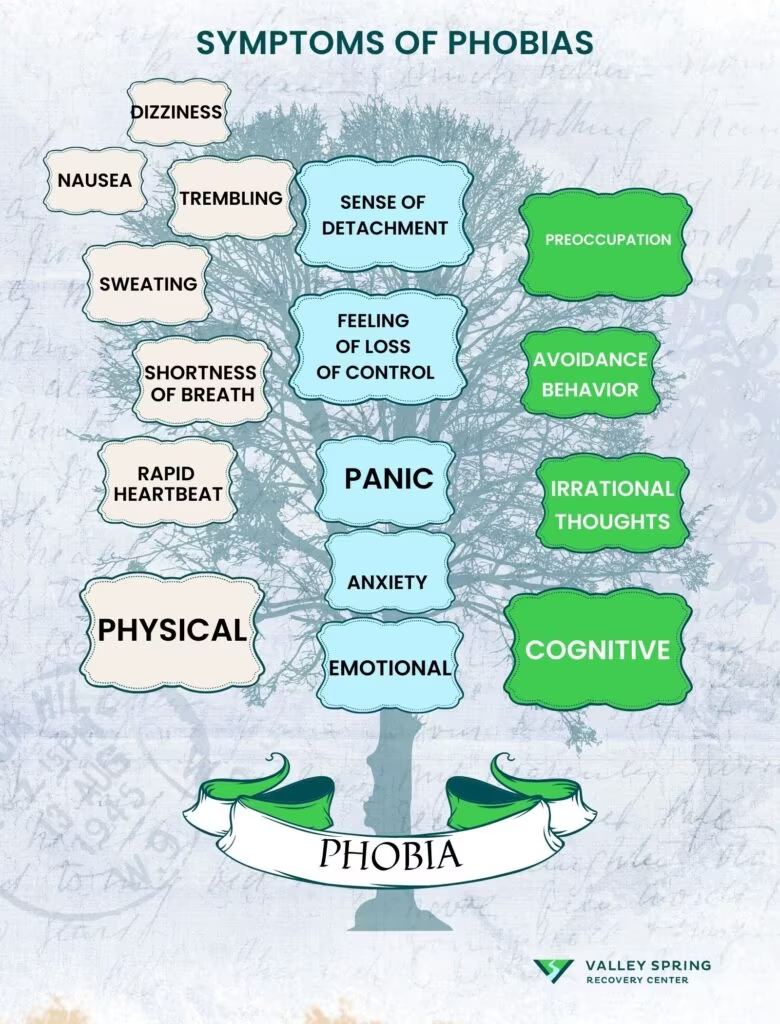
The 3 symptom clusters:
- Physical symptoms: racing heart, sweating, trembling, shortness of breath, chest tightness, nausea, and dizziness, arriving within seconds of exposure and reaching panic-attack intensity at the severe end.
- Cognitive symptoms: anticipatory dread in the hours or days before a known exposure, intrusive images of the feared outcome, and a sense of losing control during exposure.
- Behavioral symptoms: active avoidance of the trigger, endurance of the trigger with intense distress where avoidance is impossible, and the accumulating restrictions that avoidance imposes on travel, work, and medical care.
Blood-injection-injury phobia is the documented exception to the surge pattern. Exposure in that category produces a vasovagal response, a drop in heart rate and blood pressure ending in fainting, which is why StatPearls directs patients with this phobia to tense their bodies and remain seated during procedures. Where these responses come from is a question with 4 documented answers.
What Causes Phobias?
Phobias develop from 4 documented contributors: genetic and familial vulnerability, fear conditioning that pairs a neutral stimulus with a negative experience, observational learning from an anxious model, and fear neurocircuitry weighted toward danger cues over safety signals, per the StatPearls specific phobia review.
The 4 contributors:
- Genetic and familial vulnerability: twin studies show stronger inheritance in monozygotic than dizygotic pairs, anxiety disorders aggregate within families, and children of parents with depression or an anxiety disorder carry higher risk. DNA methylation of stress-related genes is the epigenetic mechanism under study.
- Fear conditioning: classical conditioning pairs a neutral stimulus with a negative experience, and the acquired fear generalizes to similar stimuli afterward.
- Observational learning: vicarious learning, social referencing, and anxiety modeling transmit fear without any direct negative experience. Overly protective or critical parenting and family accommodation of avoidance reinforce it.
- Fear neurocircuitry: greater excitatory conditioning to danger cues combines with impaired inhibitory conditioning to safety signals. The amygdala provokes the fear response, the hippocampus carries fear learning and extinction, and functional MRI links hypofunction of the prefrontal cortex and anterior cingulate cortex to emotional dysregulation.
Two demographic patterns hold across the phobic diagnoses: prevalence is higher in females than males, 12.2% against 5.8% for past-year specific phobia per NIMH, and rates fall with advancing age. Cause is probabilistic. Diagnosis is a defined checklist.
How Is a Phobia Diagnosed?
A phobia is diagnosed when all 7 DSM-5-TR criteria are met in a clinical interview, and the Anxiety Disorder Interview Schedule serves as the gold-standard structured evaluation, requiring a clinician severity rating of 4 or greater, per the StatPearls specific phobia review.
The 7 DSM-5-TR criteria for specific phobia:
- Marked fear or anxiety about a specific object or situation.
- The object or situation nearly always provokes immediate fear or anxiety.
- The object or situation is actively avoided, or endured with intense fear or anxiety.
- The fear is disproportionate to the actual danger posed.
- The fear, anxiety, or avoidance persists for 6 months or longer.
- The fear, anxiety, or avoidance causes clinically significant distress or functional impairment.
- The presentation is not better explained by another mental disorder.
Structured instruments carry the assessment in children and adolescents. The 41-question Screen for Child Anxiety-Related Emotional Disorders discriminates anxiety from non-anxiety presentations at a score of 25 or greater, a reduction of 55% or more in the total score predicts treatment response, and a reduction of 60% or more in parent-report scores predicts remission. The Youth Anxiety Measure devotes a 22-item second part to specific phobias and agoraphobia, and the Pediatric Anxiety Rating Scale tracks severity across treatment. A confirmed diagnosis points at one treatment with decades of evidence behind it.
How Are Phobias Treated?
Phobias are treated with exposure-based cognitive behavioral therapy as the first-line intervention, and no medication holds FDA approval for specific phobia, per the StatPearls specific phobia review. Exposure works by extinction: repeated contact with the trigger without the feared outcome rewrites the fear association the hippocampus stores.
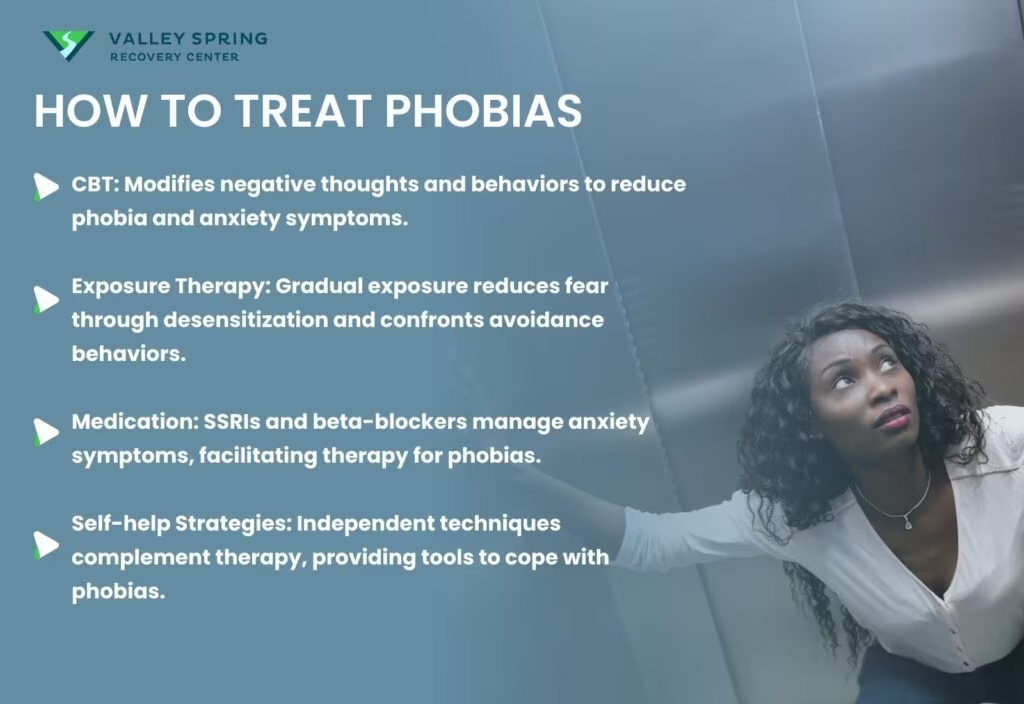
Exposure comes in 3 documented delivery formats. Systematic desensitization moves a patient up an anxiety-ranked hierarchy of stimuli while relaxation and breathing techniques hold arousal down. Flooding, also called implosion, raises exposure intensity to induce habituation faster. Virtual reality exposure therapy delivers the stimulus in a controlled simulation, and StatPearls calls that field relatively novel and in need of more research. Hypnosis and supportive therapy appear in the same review as additional modalities rather than as first-line options. Medication plays a defined secondary role: beta-blockers and benzodiazepines address panic-associated phobic anxiety, and benzodiazepine gains do not persist after discontinuation. For social anxiety disorder the picture differs, with sertraline, paroxetine, and venlafaxine FDA-approved, medication acting faster and cognitive behavioral therapy holding longer.
Untreated phobic anxiety carries downstream cost. Social anxiety disorder predicts the later development of major depression and alcohol use disorder, per the StatPearls social anxiety disorder review, and comorbid psychiatric conditions occur in up to 90% of people with social anxiety disorder. Treating the phobia early is what keeps that sequence from starting.
What Are the Most Common Questions About Phobias?
Common questions: the most frequent phobias, onset age, heredity, spontaneous recovery, panic attacks, and hypnosis.
What Are the Most Common Phobias?
Animal stimuli rank first, natural environment stimuli second, and blood-injection-injury stimuli third among specific phobia presentations, per StatPearls. Across the 3 phobic diagnoses, specific phobia is the most prevalent at 12.5% lifetime, per NIMH.
At What Age Do Phobias Start?
Onset concentrates young. The majority of people with social anxiety disorder report symptoms starting before age 20, and agoraphobia prevalence peaks at ages 13 to 17 at 2.0% in the 12-month figures StatPearls reports, falling to 0.4% after age 65.
Are Phobias Hereditary?
Genetics contribute without deciding the outcome. Twin studies show stronger inheritance in identical than fraternal pairs, and children of parents with an anxiety or depressive disorder carry elevated risk, per StatPearls. Learning and conditioning supply the rest.
Do Phobias Go Away Without Treatment?
Prevalence falls with advancing age, and untreated social anxiety disorder specifically raises the risk of depression and alcohol use disorder, per StatPearls. Avoidance sustains a phobia by preventing the extinction learning that exposure therapy delivers deliberately.
What Is the Difference Between a Phobia and a Panic Attack?
A phobia is a diagnosis defined by a specific feared trigger. A panic attack is a discrete surge of intense fear with physical symptoms, which occurs during phobic exposure and also occurs with no identifiable trigger.
Does Hypnosis Cure Phobias?
No. StatPearls lists hypnosis among additional treatment modalities, not first-line ones, and makes no efficacy claim for it. Exposure-based cognitive behavioral therapy holds the first-line evidence for phobias.
Sources & References7ShowHide
- NIMH — Specific Phobia Statistics — Past-year prevalence 9.1% of U.S. adults (females 12.2%, males 5.8%); lifetime 12.5%. Sheehan Disability Scale severity among past-year cases: serious 21.9%, moderate 30.0%, mild 48.1%. National Comorbidity Survey Replication, 2001-2003.
- NIMH — Social Anxiety Disorder Statistics — Past-year prevalence 7.1% (females 8.0%, males 6.1%); lifetime 12.1%. Severity among past-year cases: serious 29.9%, moderate 38.8%, mild 31.3%. NCS-R, 9,282 respondents, February 2001 to April 2003.
- NIMH — Agoraphobia Statistics — Past-year prevalence 0.9% (females 0.9%, males 0.8%); lifetime 1.3%. Severity among past-year cases: serious 40.6%, moderate 30.7%, mild 28.7%. NCS-R, 2001-2003.
- Samra CK, Torrico TJ, Abdijadid S. Specific Phobia. StatPearls, NCBI Bookshelf (updated August 12, 2024) — Seven DSM-5-TR criteria including the 6-month duration requirement; 5 specifier categories (animal, natural environment, blood-injection-injury, situational, other) with animal, natural environment and blood-injection-injury most frequent; prevalence estimates 7.7% to 12.5% (chapter's phrasing: lifetime 12-month), higher in females, falling with age. Etiology: monozygotic over dizygotic twin inheritance, familial aggregation, DNA methylation of stress-related genes, excitatory conditioning to danger cues with impaired inhibitory conditioning to safety signals, vicarious learning and social referencing. Pathophysiology: amygdala fear response, hippocampal fear learning and extinction, prefrontal and anterior cingulate hypofunction, norepinephrine, epinephrine, cortisol, dopamine modulation, low 5-HT1A activity. Assessment: ADIS gold standard with clinician severity rating 4 or greater; SCARED 41 questions, cutoff 25, 55% reduction in the total score predicts response and 60% reduction in parent-report scores predicts remission; Youth Anxiety Measure 22-item part II; Pediatric Anxiety Rating Scale. Treatment: exposure-based CBT optimal, systematic desensitization, flooding, virtual therapy described as relatively novel and requiring more research, with hypnosis, supportive therapy and family therapy listed as other modalities and no evidence-status statement attached to them; no FDA-approved medication for specific phobia; beta-blockers and benzodiazepines for panic-associated phobias with gains not persisting after discontinuation; blood-injection-injury patients tense and remain seated to prevent vasovagal fainting.
- Balaram K, Marwaha R. Agoraphobia. StatPearls, NCBI Bookshelf (updated November 11, 2024) — DSM-5-TR requires marked fear in 2 or more of 5 situations: public transportation, open spaces, enclosed spaces, standing in line or in a crowd, being outside the home alone; 6-month duration. Lifetime prevalence 0.9% in men and 2.0% in women; 12-month prevalence approximately 1.7%; highest at ages 13 to 17 (2.0%), lowest at 65 and older (0.4%).
- Rose GM, Tadi P. Social Anxiety Disorder. StatPearls, NCBI Bookshelf (updated October 25, 2022) — Six-month duration requirement; performance-only specifier when fear is restricted to performing or speaking in public; worldwide prevalence 5% to 10% and lifetime 8.4% to 15%; majority report onset before age 20; comorbid psychiatric disorders in up to 90% of patients; social anxiety disorder predicts development of major depression and alcohol use disorder; sertraline, paroxetine and venlafaxine FDA-approved; medication acts faster and CBT has longer-lasting effects.
- American Psychiatric Association. Diagnostic and Statistical Manual of Mental Disorders, Fifth Edition, Text Revision (DSM-5-TR). Washington, DC: American Psychiatric Publishing, 2022 — The three phobic diagnoses inside the anxiety disorders chapter; the specific phobia specifier categories; reclassification of obsessive-compulsive disorder and PTSD out of the anxiety disorders chapter in DSM-5 (2013). Print reference.