


Mental health guide
Catatonia: Features, Causes, Diagnosis, and Treatment
Catatonia is a syndrome of 3 or more of 12 psychomotor features requiring urgent medical evaluation. Features, three forms, causes, diagnosis, treatment.
By Paul James Roeser·Reviewed by Dr. Michael Olla, MD·8 min read
Published ·Updated
Catatonia is a neuropsychiatric syndrome of disturbed movement, speech, and responsiveness, diagnosed when 3 or more of 12 psychomotor features are present at the same time. The features run in both directions: immobility, mutism, and rigidity at one pole, purposeless agitation and repetitive movement at the other.
Catatonia is uncommon and measurable. Iyer, Spurling, and Rizvi's StatPearls catatonia review records a United Kingdom incidence of 4.3 episodes per 100,000 person-years, a 1-year United Kingdom prevalence of 4.4 per 100,000 persons, and a 1-year United States prevalence of approximately 5.1 per 100,000 persons drawn from hospitalization data. Mood disorders account for more cases of catatonia than schizophrenia does.
Catatonia requires urgent medical evaluation. Delayed diagnosis raises the risk of malnutrition, infection, and death.
Is Catatonia a Medical Emergency?
Catatonia requires urgent medical evaluation in every presentation, and malignant catatonia, the form that adds fever at or above 38.5 degrees Celsius, autonomic instability, delirium, and rigidity, is a life-threatening emergency needing immediate hospital care. Call 911 when immobility or agitation arrives with fever, unstable vital signs, or an inability to eat and drink.
Contact the 988 Suicide & Crisis Lifeline, by calling 988, texting 988, or chatting at 988lifeline.org, when catatonic symptoms arrive alongside thoughts of suicide or self-harm, the combination documented in severe depressive episodes. All three 988 channels are free, confidential, and staffed 24 hours a day. Spanish-speaking counselors answer when a caller presses 2 or texts AYUDA to 988, and deaf and hard-of-hearing users connect in American Sign Language by dialing 988 from a videophone.
Catatonia arriving with a first psychotic episode carries the same urgency. Psychosis develops in an estimated 15 to 100 people out of 100,000 each year, with onset concentrated between the late teens and mid-20s, per the National Institute of Mental Health's Understanding Psychosis publication, and early treatment improves the course of a first episode. What emergency clinicians are recognizing is a defined feature set.
What Is Catatonia?
Catatonia is a neuropsychiatric syndrome diagnosed when 3 or more of 12 psychomotor features are present, spanning reduced movement, excessive movement, and abnormal responsiveness to the environment, per the DSM-5-TR criteria summarized in the StatPearls catatonia review.
Catatonia is a syndrome rather than a standalone diagnosis. The DSM-5-TR carries it in 3 forms: as a specifier attached to another mental disorder, as catatonic disorder due to another medical condition, and as unspecified catatonia. DSM-5 introduced that structure in 2013, when it combined the schizophrenia subtypes under one general diagnosis and retired catatonic schizophrenia, per the StatPearls catatonic schizophrenia chapter. That structure is why catatonia appears in the records of people with major depression, bipolar disorder, and schizophrenia alike, and in the records of people with autoimmune encephalitis who carry no psychiatric diagnosis at all. The syndrome is defined by its features.
What Are the 12 Features of Catatonia?
The DSM-5-TR lists 12 catatonia features: stupor, catalepsy, waxy flexibility, mutism, negativism, posturing, mannerism, stereotypy, agitation, grimacing, echolalia, and echopraxia. Diagnosis requires 3 or more of the 12, and a single person moves between opposite features across one episode.
The 12 features:
- Stupor: absent psychomotor activity and no active relation to the environment, in a person who remains awake.
- Catalepsy: passive adoption of a posture held against gravity after someone else places the limb there.
- Waxy flexibility: slight, even resistance to repositioning by an examiner, the quality that gives the sign its name.
- Mutism: absent or minimal verbal response in a person with intact hearing and no aphasia.
- Negativism: opposition to instructions or to external stimuli, including resistance to being moved.
- Posturing: spontaneous maintenance of a posture against gravity, sustained for extended periods.
- Mannerism: an odd, circumstantial caricature of an ordinary action.
- Stereotypy: repetitive, non-goal-directed movement, such as rocking or hand-flapping.
- Agitation: excessive motor activity unrelated to any external trigger and unresponsive to redirection.
- Grimacing: sustained distortion of the facial muscles.
- Echolalia: repetition of another person's words.
- Echopraxia: imitation of another person's movements.
Which features dominate determines which form of catatonia a clinician is treating.
What Are the Types of Catatonia?
Catatonia presents in 3 clinical forms: akinetic (withdrawn) catatonia, dominated by stupor and mutism, hyperkinetic (excited) catatonia, dominated by purposeless hyperactivity, and malignant catatonia, which adds fever, autonomic instability, delirium, and rigidity. The 3 forms differ in urgency rather than in kind. The distinction clinicians act on:
| Form | Dominant features | Clinical urgency |
| Akinetic (retarded) catatonia | Stupor, mutism, negativism, posturing, refusal of food and fluid | Urgent evaluation; complications follow immobility and poor intake |
| Hyperkinetic (excited) catatonia | Purposeless agitation, stereotypy, echolalia, echopraxia, combativeness | Urgent evaluation; injury and exhaustion drive the risk |
| Malignant catatonia | Any catatonic picture plus fever at or above 38.5 degrees Celsius, autonomic instability, rigidity, delirium | Immediate emergency care; rhabdomyolysis and multiorgan dysfunction follow untreated cases |
Form describes the presentation. The underlying condition explains it.
What Causes Catatonia?
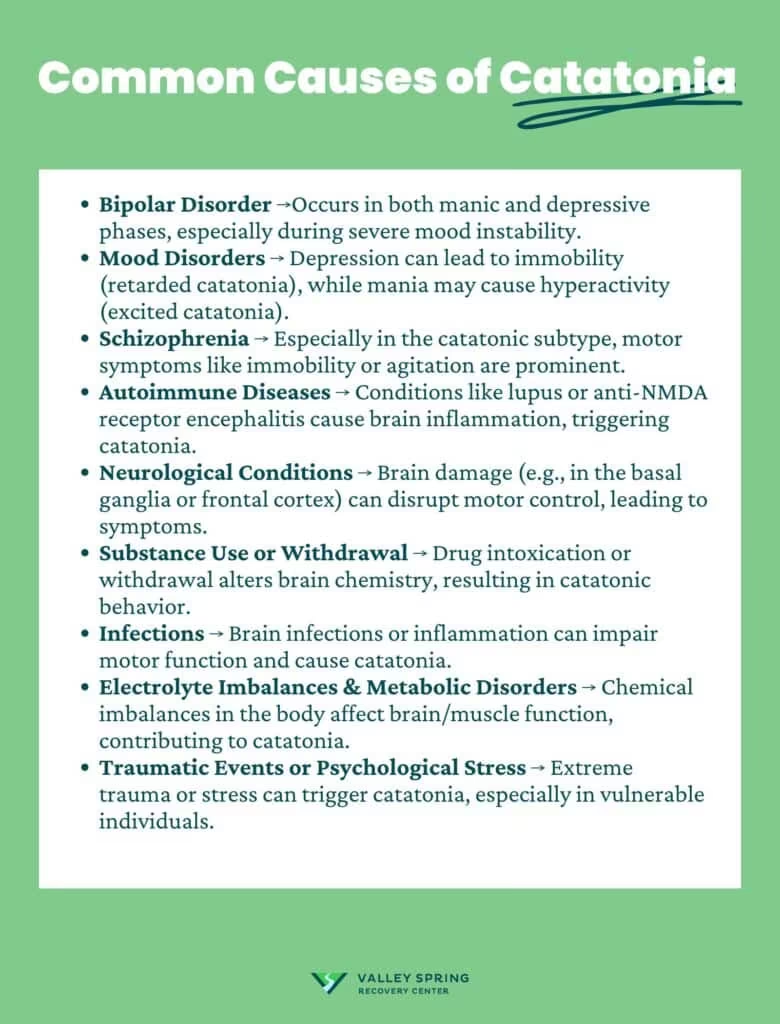
Catatonia arises from 5 documented cause categories: psychiatric disorders, neurologic disease, metabolic and toxic states, drug intoxication and withdrawal, and autoimmune and inflammatory conditions, and mood disorders account for more cases than schizophrenia does, per the StatPearls catatonia review.
The 5 cause categories:
- Psychiatric disorders: major depressive disorder, bipolar disorder, schizophrenia, schizoaffective disorder, autism spectrum disorder, and trauma- and stress-related disorders including PTSD and dissociative stupor.
- Neurologic disease: temporal lobe epilepsy, nonconvulsive status epilepticus, postictal states, traumatic brain injury, stroke, hypoxic-ischemic encephalopathy, and delirium.
- Metabolic and toxic states: metabolic and infectious encephalopathy and Wilson disease, the copper-accumulation disorder with neurologic and psychiatric presentations.
- Drug intoxication and withdrawal: cannabis and cocaine intoxication, and withdrawal from alcohol, opioids, and benzodiazepines. Antipsychotic medication paradoxically precipitates or worsens catatonia in a subset of patients, which is why prescribing decisions in a catatonic patient belong to a physician.
- Autoimmune and inflammatory conditions: anti-NMDA receptor encephalitis, the autoimmune encephalitides targeting GAD65, GABA-A, GABA-B, LGI1, DPPX, and glycine receptors, and PANDAS and PANS in pediatric patients.

Catatonia during alcohol withdrawal signals a withdrawal state requiring medical management rather than observation at home. Sorting a psychiatric cause from a medical one is the work of diagnosis.
How Is Catatonia Diagnosed?
Catatonia is diagnosed through a structured bedside examination, most commonly the Bush-Francis Catatonia Rating Scale, whose 14-item screening instrument reaches 100% sensitivity and 88% specificity, followed by medical testing to identify the underlying cause, per the StatPearls catatonia review.
The full Bush-Francis Catatonia Rating Scale rates 23 items on a 0-to-3 severity scale, which gives clinicians a number to track across an episode rather than an impression. A lorazepam challenge test supports the diagnosis and starts treatment in the same step: meaningful improvement in key features arrives within minutes in some patients, is commonly assessed over 30 to 120 minutes, and takes up to 2 or 3 hours in others, and a negative response fails to exclude catatonia, occurring in approximately 20% or more of patients. The differential is broad and matters clinically, because 2 of its entries are themselves emergencies: neuroleptic malignant syndrome and serotonin syndrome. Akinetic mutism, malignant hyperthermia, locked-in syndrome, stiff person spectrum disorders, Parkinson disease, stroke, delirium, dementia, and selective mutism complete the list. A confirmed diagnosis routes into treatment with documented response rates.
How Is Catatonia Treated?
Catatonia is treated with benzodiazepine therapy, which produces response rates of 60% to 80%, and electroconvulsive therapy, which produces remission in approximately 70% to 90% of recent case series, alongside treatment of the underlying condition, per the StatPearls catatonia review. Dosing and delivery are physician decisions made at the bedside.
Supportive medical care runs in parallel and prevents the complications that make catatonia dangerous. The documented complication set includes dehydration, malnutrition, aspiration pneumonia, urinary retention, pressure ulcers, venous thromboembolism, rhabdomyolysis, and multiorgan dysfunction, so hydration, nutrition, skin care, and clot prophylaxis are part of treatment rather than adjuncts to it. Treating the underlying condition is what prevents recurrence: catatonia in a mood disorder resolves alongside the mood episode, and catatonia in autoimmune encephalitis resolves with immunotherapy for the encephalitis. Recognizing psychotic features early matters for the same reason, which is why hallucinations and disorganized behavior appearing beside catatonic signs change the diagnostic path.
What Are the Most Common Questions About Catatonia?
Common questions: duration, reversibility, schizophrenia, stress, consciousness, and how to help.
How Long Does Catatonia Last?
Duration tracks treatment timing and the underlying cause. A positive lorazepam challenge produces improvement within 30 to 120 minutes, sometimes up to 2 or 3 hours, per StatPearls. Untreated, episodes risk malnutrition, infection, and venous thromboembolism.
Does Catatonia Go Away?
Yes, with treatment. Benzodiazepine therapy produces response rates of 60% to 80% and electroconvulsive therapy produces remission in approximately 70% to 90% of recent series, per StatPearls. Recurrence tracks how well the underlying condition is managed.
Is Catatonia a Symptom of Schizophrenia?
No longer as a subtype. DSM-5 retired catatonic schizophrenia in 2013 and made catatonia a specifier applied across diagnoses. Catatonia occurs in schizophrenia, and mood disorders account for more cases, per StatPearls.
Can Stress or Trauma Trigger Catatonia?
Trauma- and stress-related disorders, including PTSD and dissociative stupor, are documented psychiatric causes of catatonia, per StatPearls. A stress trigger does not remove the need for medical evaluation, because the medical differential stays identical.
Is a Person With Catatonia Conscious?
Yes. Stupor in catatonia describes absent psychomotor activity in a person who remains awake, not unconsciousness. Recall varies. Some people report no recollection, others intact awareness with no ability to communicate, per StatPearls, so speak to the person throughout.
How Do You Help Someone in a Catatonic State?
Call 911 and get the person to medical care. Catatonia requires urgent evaluation, and untreated episodes produce dehydration, aspiration pneumonia, and venous thromboembolism, per StatPearls. Speak calmly and stay present while help arrives.
Sources & References4ShowHide
- Iyer V, Spurling BC, Rizvi A. Catatonia. StatPearls, NCBI Bookshelf (updated December 13, 2025) — DSM-5-TR requires 3 or more of 12 psychomotor features. UK incidence 4.3 episodes per 100,000 person-years; UK 1-year prevalence 4.4 per 100,000; US 1-year prevalence of catatonia-related hospitalizations approximately 5.1 per 100,000 persons. Mood disorders account for more cases than schizophrenia. Bush-Francis Catatonia Rating Scale: 23 items rated 0 to 3, 14-item screen with 100% sensitivity and 88% specificity. Lorazepam challenge improves key features within minutes to 2 to 3 hours; negative response in approximately 20% or more does not exclude catatonia. Benzodiazepine response 60% to 80%; ECT remission approximately 70% to 90%. Malignant catatonia: fever at or above 38.5 C, autonomic instability, rigidity, delirium. Etiology spans mood, psychotic, autism spectrum and trauma-related disorders; epilepsy, TBI, stroke, hypoxic-ischemic encephalopathy, delirium; metabolic and infectious encephalopathy and Wilson disease; cannabis and cocaine intoxication and alcohol, opioid and benzodiazepine withdrawal; antipsychotics as paradoxical precipitants; anti-NMDA receptor and other autoimmune encephalitides, PANDAS and PANS. Complications: dehydration, malnutrition, aspiration pneumonia, urinary retention, pressure ulcers, venous thromboembolism, rhabdomyolysis, multiorgan dysfunction. Differential includes neuroleptic malignant syndrome and serotonin syndrome.
- NIMH — Understanding Psychosis — Between 15 and 100 people out of 100,000 develop psychosis each year; onset concentrated in the late teens to mid-20s; early treatment improves the course of a first episode.
- Catatonic Schizophrenia. StatPearls, NCBI Bookshelf (NBK563222, archived chapter) — In 2013 the American Psychiatric Association combined the schizophrenia subtypes under the general category of schizophrenia, and DSM-5 placed catatonia in its own category with schizophrenia as a specifier.
- American Psychiatric Association. Diagnostic and Statistical Manual of Mental Disorders, Fifth Edition, Text Revision (DSM-5-TR). Washington, DC: American Psychiatric Publishing, 2022 — The three DSM-5-TR catatonia entries: catatonia associated with another mental disorder (specifier), catatonic disorder due to another medical condition, and unspecified catatonia. Print reference.