


Mental health guide
Schizophrenia Symptoms, Types, Causes and Effects Explained
Schizophrenia affects 0.25% to 0.64% of U.S. adults. DSM-5-TR criteria, positive and negative symptoms, the retired subtypes, causes, diagnosis, treatment.
By Paul James Roeser·Reviewed by Dr. Michael Olla, MD·7 min read
Published ·Updated
Schizophrenia is a psychotic disorder that disrupts thinking, perception, emotional expression, and behavior, producing delusions, hallucinations, disorganized speech, and reduced motivation and expression. The DSM-5-TR places it at the head of the schizophrenia spectrum and other psychotic disorders.
According to the National Institute of Mental Health (NIMH), estimates of the prevalence of schizophrenia and related psychotic disorders in the United States range between 0.25% and 0.64%, with onset concentrated between the late teens and early thirties, earlier in males than in females. Schizophrenia ranks among the top 15 leading causes of disability worldwide.
Schizophrenia is treatable, and the timing of treatment changes its course. A first psychotic episode, new hallucinations, or new delusions call for urgent evaluation.
When Is Schizophrenia a Medical Emergency?
Call 911 when psychotic symptoms come with danger to self or others, and contact the 988 Suicide & Crisis Lifeline, by calling 988, texting 988, or chatting at 988lifeline.org, when they come with thoughts of suicide or self-harm. All three 988 channels are free, confidential, and staffed 24 hours a day. Spanish-speaking counselors answer when a caller presses 2 or texts AYUDA to 988, and deaf and hard-of-hearing users connect in American Sign Language by dialing 988 from a videophone.
The suicide risk is documented and specific: an estimated 4.9% of people with schizophrenia die by suicide, a rate far greater than the general population's, per NIMH's schizophrenia statistics, so a crisis plan belongs in every treatment plan. A first psychotic episode deserves urgent evaluation even without danger: psychosis develops in an estimated 15 to 100 people per 100,000 each year, per NIMH's Understanding Psychosis publication, and early treatment through coordinated specialty care improves the course of a first episode. What clinicians are evaluating for is a defined criteria set.
What Is Schizophrenia?
Schizophrenia is diagnosed when 2 or more of 5 defined symptoms are present for a significant portion of 1 month, at least one being delusions, hallucinations, or disorganized speech, with continuous signs persisting for at least 6 months including at least 1 month of active-phase symptoms, per the DSM-5-TR criteria summarized in the StatPearls schizophrenia review.
The 5 criterion symptoms are delusions, hallucinations, disorganized speech, grossly disorganized or catatonic behavior, and negative symptoms. The 6-month duration requirement separates schizophrenia from briefer psychotic disorders, and the impairment requirement ties the diagnosis to real functional decline in work, relationships, or self-care.

Clinical perspective
Schizophrenia carries more stigma than almost any diagnosis in psychiatry, and most of it comes from how the illness is portrayed rather than how it actually presents. With the right medication — especially the long-acting options — many people can become stable, work, and live lives that look nothing like the caricature. The gap between the stereotype and the reality is enormous.
What Are the Symptoms of Schizophrenia?
Schizophrenia produces 3 documented symptom groups: positive symptoms that add abnormal experiences, negative symptoms that subtract normal function, and cognitive symptoms that impair thinking.
The 3 symptom groups:
- Positive symptoms: delusions, fixed false beliefs held against contrary evidence, and hallucinations, perceptions without an external source. Auditory hallucinations affect 75% of people with schizophrenia and visual hallucinations 30%, per Waters and Fernyhough's 2017 systematic review in Schizophrenia Bulletin. Disorganized speech and behavior complete the group.
- Negative symptoms: blunted emotional expression, reduced speech, loss of motivation, social withdrawal, and diminished capacity for pleasure. Negative symptoms respond less to medication than positive symptoms and account for much of the long-term disability.
- Cognitive symptoms: impaired working memory, attention, processing speed, and decision-making. Cognitive symptoms arrive early, before the first psychotic episode in a substantial share of cases.
One symptom pattern is severe enough to carry its own criteria: catatonia, a psychomotor syndrome of immobility, mutism, and posturing. The symptom groups explain why the old subtype system was abandoned.
What Happened to the Types of Schizophrenia?
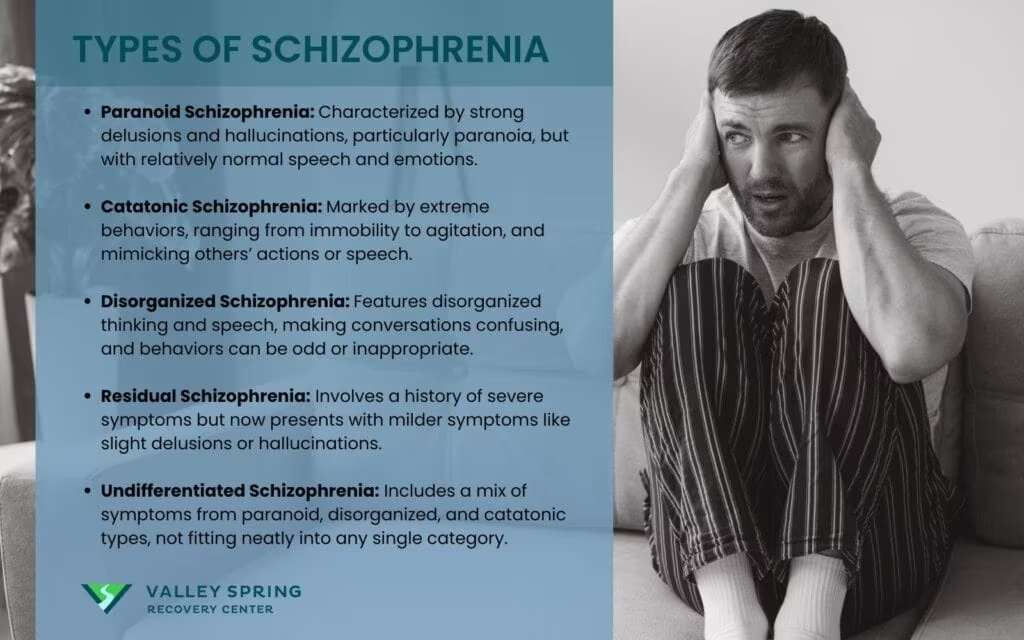
The DSM-5 removed the schizophrenia subtypes in 2013: paranoid, disorganized, catatonic, undifferentiated, and residual schizophrenia are no longer diagnoses, because the subtypes proved unstable over time and did not predict treatment response. How the DSM-5-TR handles each former subtype now:
| Former DSM-IV subtype | Prominent feature | DSM-5-TR handling |
| Paranoid | Delusions and auditory hallucinations | Folded into the single diagnosis; symptoms rated by severity |
| Disorganized | Disorganized speech and behavior, flat affect | Folded into the single diagnosis |
| Catatonic | Immobility, mutism, posturing | Catatonia is now a specifier applied across psychiatric and medical conditions |
| Undifferentiated | Mixed picture fitting no subtype | Retired; the single diagnosis covers it |
| Residual | Attenuated symptoms after an active phase | Covered by course specifiers such as "in partial remission" |
The dimensional approach rates each symptom's severity instead of sorting people into boxes, which fits how the underlying causes actually distribute.
What Causes Schizophrenia?
Schizophrenia develops from a genetic vulnerability interacting with environmental exposures: twin studies attribute approximately 80% of the risk to genetic factors, and the identical-twin concordance rate is approximately 60%, per the StatPearls schizophrenia review.
Three documented contributors complete the picture. First, specific genetic variants: the chromosome 22q11.2 deletion raises lifetime risk 25-fold, the largest known single-variant effect. Second, neurochemistry: the dopamine hypothesis, supported by the action of antipsychotic medication, ties positive symptoms to excess dopamine signaling in specific brain pathways. Third, environmental exposures: prenatal infection and malnutrition, obstetric complications, and cannabis use, where heavy users face 6 times the risk of a schizophrenia diagnosis compared with nonusers, per the StatPearls review, which records the risk concentrating among young, heavy users of high-potency strains rather than attaching to any use, a relationship covered in full on the marijuana addiction page. Cause is probabilistic; diagnosis is a defined procedure.
How Is Schizophrenia Diagnosed?
Schizophrenia is diagnosed through a psychiatric evaluation that documents the criterion symptoms and their 6-month course, a medical work-up to exclude other causes, and a substance history, because stimulant intoxication, cannabis, and withdrawal states produce psychosis without schizophrenia.
The differential runs in two directions, and the substance history covers amphetamine-class stimulants alongside cannabis and withdrawal states. Medical causes, including seizure disorders, autoimmune encephalitis, and thyroid disease, are excluded with laboratory tests and imaging where indicated. Psychiatric boundaries are drawn against bipolar disorder, where psychotic symptoms occur only inside severe mood episodes, and against schizoaffective disorder, where full mood episodes and independent psychosis co-occur. A confirmed diagnosis routes directly into a treatment framework with real evidence behind it.
How Is Schizophrenia Treated?
Schizophrenia is treated with antipsychotic medication as the foundation, coordinated specialty care for first-episode psychosis, and clozapine for treatment-resistant cases, defined as symptoms persisting despite 2 or more adequate antipsychotic trials.
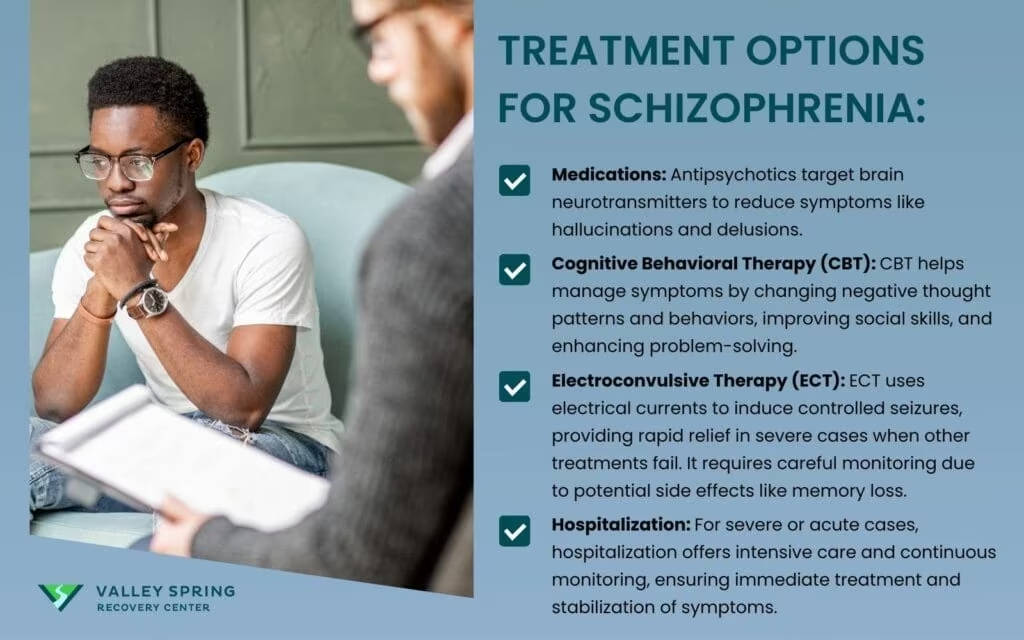
The numbers set expectations honestly. Approximately one-third of patients meet treatment-resistance criteria, and clozapine benefits about 40% of those with treatment-resistant schizophrenia, per the StatPearls review. Coordinated specialty care, the team-based model NIMH describes for first-episode psychosis, combines medication, psychotherapy, family education, and school or work support with shared decision-making. Psychosocial treatment, including cognitive behavioral therapy for psychosis and supported employment, targets the negative and cognitive symptoms medication reaches least. The physical-health side is part of treatment, not an afterthought: the estimated average potential life lost for individuals with schizophrenia in the U.S. is 28.5 years, per NIMH, driven heavily by cardiovascular and metabolic disease, so routine medical care carries clinical weight. Ongoing psychiatric care at the IOP and outpatient levels runs through schizophrenia treatment in New Jersey.
What Are the Most Common Questions About Schizophrenia?
Common questions: genetics, cannabis, split personality, independent living, stress, and untreated illness.
Is Schizophrenia Genetic?
Genetics carry most of the documented risk: twin studies attribute approximately 80% of risk to genetic factors, and identical-twin concordance is approximately 60%, per StatPearls. The 40% discordance shows environment still decides outcomes.
Does Cannabis Cause Schizophrenia?
Heavy cannabis users face 6 times the risk of a schizophrenia diagnosis compared with nonusers, per StatPearls. Cannabis acts as a documented risk factor and symptom trigger in vulnerable people rather than a sole cause.
Is Schizophrenia the Same as Split Personality?
No. Schizophrenia is a psychotic disorder of perception and thought. Dissociative identity disorder, the condition involving distinct identity states, is a separate diagnosis in a separate DSM-5-TR chapter. The two are unrelated conditions.
Can People With Schizophrenia Live and Work Independently?
Yes, with sustained treatment. Antipsychotic medication, coordinated specialty care, and supported employment are the documented tools, and early treatment of a first episode improves the long-term course, per NIMH.
Can Stress Trigger Psychosis?
Severe stress precipitates episodes in people who carry the underlying vulnerability, and it worsens symptom control in diagnosed schizophrenia. Stress alone, without that vulnerability, is not a documented cause of the disorder.
What Happens if Schizophrenia Goes Untreated?
Untreated psychosis lengthens episodes, deepens functional decline, and raises the risk of self-harm and suicide, which claims an estimated 4.9% of people with schizophrenia per NIMH. Earlier treatment produces measurably better outcomes.
Sources & References5ShowHide
- NIMH — Schizophrenia Statistics — U.S. prevalence estimates of schizophrenia and related psychotic disorders range between 0.25% and 0.64%; international estimates 0.33% to 0.75%. Approximately 4.9% die by suicide. Estimated average potential life lost is 28.5 years in the U.S. Among the top 15 leading causes of disability worldwide. Underlying studies 2001-2016, including the National Comorbidity Survey Replication and Global Burden of Disease Study 2016.
- Hany M, Rizvi A. Schizophrenia. StatPearls, NCBI Bookshelf (updated February 23, 2024) — DSM-5-TR criteria: two or more of five symptoms for a significant portion of 1 month, continuous signs for at least 6 months including at least 1 month of active-phase symptoms. Twin studies attribute approximately 80% of risk to genetic factors; monozygotic concordance approximately 60%; 22q11.2 deletion raises lifetime risk 25-fold; heavy cannabis users face 6 times greater risk than nonusers. Approximately one-third of patients are treatment-resistant, with about 40% of those responding to clozapine.
- NIMH — Understanding Psychosis — Between 15 and 100 people out of 100,000 develop psychosis each year; onset concentrated in the late teens to mid-20s; coordinated specialty care improves the course of a first episode.
- Waters F, Fernyhough C. Hallucinations: A Systematic Review of Points of Similarity and Difference Across Diagnostic Classes. Schizophrenia Bulletin, 2017 (PMC) — Auditory verbal hallucinations in 75% of people with schizophrenia and visual hallucinations in 30%; 60% report hallucinations in 3 or more sensory modalities; auditory hallucinations in 46% to 57% of people with bipolar disorder.
- American Psychiatric Association. Diagnostic and Statistical Manual of Mental Disorders, Fifth Edition, Text Revision (DSM-5-TR). Washington, DC: American Psychiatric Publishing, 2022 — The five criterion symptoms and the 6-month duration requirement; retirement of the DSM-IV subtypes in DSM-5 (2013); catatonia as a cross-cutting specifier; course specifiers including in partial remission. Print reference.