


Mental health guide
Mental Health Screening Tests: Types, Accuracy, and Next Steps
Mental health screening tests detect depression, anxiety, bipolar disorder, PTSD, and alcohol risk early. The instruments, their accuracy, and next steps.
By Paul James Roeser·Reviewed by Dr. Michael Olla, MD·Last reviewed September 6, 2026·10 min read
Published ·Updated
A mental health screening test is a brief, validated questionnaire that detects probable cases of a specific mental health condition before a full clinical evaluation. Screening instruments exist per condition: the PHQ-9 for depression, the GAD-7 for anxiety, the Mood Disorder Questionnaire for bipolar spectrum disorder, the PCL-5 for PTSD, the AUDIT for alcohol risk, and the Columbia-Suicide Severity Rating Scale for suicide risk.
Several common instruments take only a few minutes, and their accuracy is measured: the PHQ-9 detects major depression with 88% sensitivity and 88% specificity at a score of 10 or higher, per Kroenke, Spitzer, and Williams' 2001 validation study in 6,000 patients. A screening result is a first step rather than a diagnosis; a positive result requires professional evaluation to confirm or rule out the condition.
What Are Mental Health Screening Tests?
Mental health screening tests are standardized self-report or clinician-administered instruments that measure the frequency and severity of a condition's symptoms against a validated cutoff score. A score above a cutoff raises the probability that further evaluation is needed, while a score below it does not rule out a condition when symptoms or safety concerns persist. Substance-use screening tests apply the same probability-based process to alcohol and drug risk without substituting for a diagnosis.
Screening differs from diagnosis in one structural way: a screen measures symptom report, while a diagnosis applies DSM-5-TR criteria through clinical interview, history, and differential diagnosis. The screen's job is to decide, cheaply and early, who needs that fuller evaluation.

Clinical perspective
Screening tools have their place — they're a fast, structured way to flag a pattern worth a closer look. But a checklist score was never meant to be the whole assessment. It's where the questions start, not where the diagnosis ends — the actual diagnosis comes from the biopsychosocial picture, not the score.
Narcissistic personality disorder requires a longitudinal clinical interview, evidence of a stable pattern across contexts, and confirmation of at least five DSM-5-TR criteria; a general symptom screen does not establish the diagnosis.
Why Does Early Detection of Mental Health Conditions Matter?
Early detection matters because identification precedes treatment, and untreated conditions accumulate impairment. Screening shortens the untreated interval in 3 ways: it catches conditions before they escalate, it routes people to intervention while intervention is most effective, and it gives clinicians a measured severity baseline, the PHQ-9's 5-point severity bands, for example, against which treatment response is tracked.
Screening also establishes a repeatable baseline. Clinicians can administer the same instrument during care to measure whether symptom severity is improving, unchanged, or worsening and then interpret that score alongside function, safety, and the clinical interview.
What Are the Types of Mental Health Screening Tests?
The 8 widely used mental health screening tests are the Beck Depression Inventory (BDI), Patient Health Questionnaire (PHQ-9), Generalized Anxiety Disorder scale (GAD-7), Hamilton Anxiety Rating Scale (HAM-A), Mood Disorder Questionnaire (MDQ), Adult ADHD Self-Report Scale (ASRS), PTSD Checklist for DSM-5 (PCL-5), and Alcohol Use Disorders Identification Test (AUDIT). Each targets one condition, and none is diagnostic on its own.
Each test, its target condition, how it is conducted, and what completing it involves:
| Test Type | Target Disorder | Conduct Method | Typical Questions/Assessments | Experience |
|---|---|---|---|---|
| Beck Depression Inventory (BDI) | Depression | Self-administered questionnaire | Questions about mood, pessimism, sense of failure, self-dissatisfaction, guilt, punishment feelings, suicidal thoughts, crying, agitation, loss of interest, indecisiveness, worthlessness, loss of energy, changes in sleeping pattern, irritability, changes in appetite, concentration difficulty, tiredness or fatigue, loss of interest in sex | Individuals rate their feelings over the past week, including today, on a scale of 0-3 for each category. |
| Patient Health Questionnaire (PHQ-9) | Depression | Self-administered or clinician-guided questionnaire | 9 items based on the DSM depression criteria such as little interest or pleasure in doing things, feeling down, trouble sleeping, feeling tired, poor appetite or overeating, feeling bad about yourself, trouble concentrating, moving or speaking slowly or too fast, thoughts of hurting yourself | Individuals reflect on the frequency of these issues over the past two weeks. |
| Generalized Anxiety Disorder (GAD-7) | Anxiety | Self-administered questionnaire | 7 items assessing symptoms of anxiety such as feeling nervous, not being able to stop or control worrying, worrying too much about different things, trouble relaxing, being so restless that it's hard to sit still, becoming easily annoyed or irritable, feeling afraid as if something awful might happen | Responses are based on the frequency of these symptoms over the last two weeks. |
| Hamilton Anxiety Rating Scale (HAM-A) | Anxiety | Clinician-administered interview | 14 items including anxious mood, tension, fears, insomnia, cognitive, somatic (muscular, sensory, cardiovascular, respiratory, gastrointestinal, genitourinary, autonomic, behavior at interview) | The clinician rates the severity of each symptom based on the interview, observations, and patient's report. |
| Mood Disorder Questionnaire (MDQ) | Bipolar Disorder | Self-administered questionnaire | Questions focus on symptoms of mania or hypomania, such as periods of elevated mood, increased activity or energy, risky behavior, spending sprees, hypersexuality, racing thoughts, less need for sleep | Individuals answer yes or no to experiencing symptoms, and if yes, whether these occurred at the same time, causing significant problems. |
| Adult ADHD Self-Report Scale (ASRS) | ADHD | Self-administered questionnaire | 18 items based on the DSM criteria for ADHD, covering inattention and hyperactivity-impulsivity symptoms such as making careless mistakes, difficulty keeping attention, not following through on instructions, difficulty organizing tasks, losing things necessary for tasks, being easily distracted, forgetfulness in daily activities, fidgeting, talking excessively, interrupting or intruding on others | Individuals rate the frequency of these symptoms in their lives. |
| PTSD Checklist for DSM-5 (PCL-5) | PTSD | Self-administered or clinician-guided questionnaire | 20 items assessing PTSD symptoms related to a stressful experience, including intrusive thoughts, nightmares, flashbacks, emotional distress, physical reactivity after exposure to traumatic reminders, avoidance of thoughts or reminders about the trauma, negative thoughts or feelings that began or worsened after the trauma, hyperarousal | Responses indicate how bothered the individual has been by each symptom over the past month. |
| Alcohol Use Disorders Identification Test (AUDIT) | Alcohol Use Disorder | Self-administered | A 10-item screening tool developed by the World Health Organization to identify persons with hazardous and harmful alcohol consumption (Saunders et al., 1993). | The responses are scored, and the total AUDIT score indicates the level of risk. A score of 8 or more indicates hazardous or harmful drinking behavior. The test takes less than 5 minutes to complete. |
The Alcohol Use Disorders Identification Test (AUDIT) uses 10 alcohol-specific questions and a separate scoring interpretation; it does not diagnose alcohol use disorder.
How Are Mental Health Screening Tests Conducted?
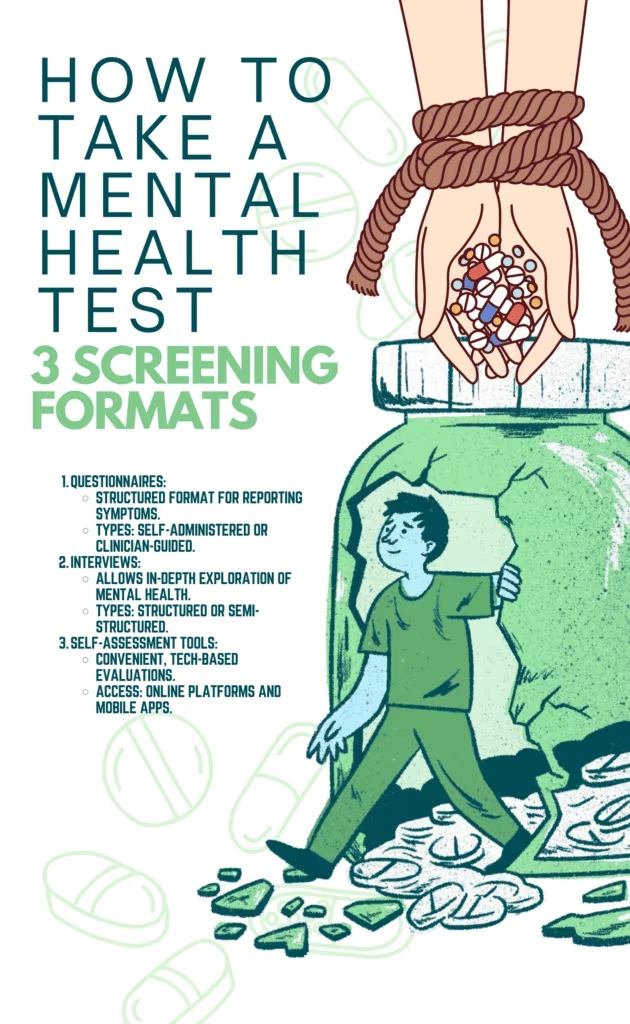
Mental health screening tests are conducted through 3 formats: self-administered questionnaires, clinician-led structured interviews, and digital self-assessment tools, and the format determines where the screen happens and who interprets it.
In integrated behavioral-health settings, SBIRT adds brief intervention and referral to substance-use screening, while condition-specific psychiatric questionnaires remain separate inputs to mental-health evaluation.
Each format with an example and its function:
| Method | Format | Example | Functionality |
|---|---|---|---|
| Questionnaires | Self-administered or clinician-guided | "Over the past two weeks, how often have you been bothered by feeling down, depressed, or hopeless?" | Allows individuals to reflect on their symptoms and experiences, providing a structured format for reporting. |
| Interviews | Structured or semi-structured | "Can you describe your current mood and how it affects your daily life?" | Enables clinicians to assess symptoms and behaviors in depth through direct conversation, as in the HAM-A and the C-SSRS. |
| Self-assessment tools | Online platforms and mobile applications | A mobile app tracking mood patterns over time. | Offers a convenient, private way to evaluate symptoms, with mood tracking, symptom logging, and feedback. |
Format changes access and interpretation, not the test's diagnostic status: every format still requires follow-up when symptoms, impairment, or safety concerns remain.
A screening result is most useful when it starts a conversation: bring the instrument name, score, date, and the symptoms or safety concerns that prompted it to the evaluating clinician. Do not compare scores across different instruments as if they use one scale; a PHQ-9 score is not interchangeable with a GAD-7 or PCL-5 score.
How Accurate Are Mental Health Screening Tests?
The accuracy of the major screening tests is measured in published validation studies: the PHQ-9 carries 88% sensitivity and 88% specificity for major depression at a score of 10 or higher, the GAD-7 carries 89% sensitivity and 82% specificity at its optimized cut point, and the MDQ carries 73% sensitivity and 90% specificity when all three positive-screen requirements are met. For the MDQ, that means 7 or more endorsed symptoms, symptoms occurring during the same period, and moderate or serious impairment.

Each figure has a study behind it. The PHQ-9 numbers come from Kroenke, Spitzer, and Williams' 2001 validation in 6,000 primary care and obstetrics-gynecology patients, which also established the severity bands: scores of 5, 10, 15, and 20 mark mild, moderate, moderately severe, and severe depression. The GAD-7 numbers come from Spitzer and colleagues' 2006 study of 2,740 primary care patients, where rising scores tracked functional impairment across all six health-survey domains. The MDQ numbers come from Hirschfeld and colleagues' 2000 validation in psychiatric outpatient clinics and apply to the full three-part positive rule, not the symptom count by itself. Setting matters because screening instruments perform differently in general-population samples than in the clinical populations where they were validated.
The limitations are structural. Screens rely on self-report, so results bend with self-awareness, recall, and willingness to disclose. False positives and false negatives both occur, which is why a positive screen leads to clinical assessment rather than straight to a diagnosis or a prescription.
How Is Suicide Risk Screened?
Suicide risk is screened with the Columbia-Suicide Severity Rating Scale (C-SSRS), which grades both suicidal ideation and suicidal behavior, and with item 9 of the PHQ-9, which asks about thoughts of self-harm. Anyone whose screening, or whose own judgment, surfaces thoughts of suicide or self-harm contacts the 988 Suicide & Crisis Lifeline now, by calling 988, texting 988, or chatting at 988lifeline.org, free and confidential, 24 hours a day; call 911 when someone is in immediate danger.
The C-SSRS evidence base is multisite: across three studies of adolescent suicide attempters, depressed adolescents, and adults presenting to an emergency department, the scale showed good convergent and divergent validity, and worst-point lifetime ideation predicted attempts during follow-up where the older Scale for Suicide Ideation did not, per Posner and colleagues' 2011 report in the American Journal of Psychiatry. That predictive power is why the C-SSRS runs in emergency departments, clinical trials, and intake assessments.
How Can Individuals Access Mental Health Screening Tests?
Individuals access mental health screening tests through 3 channels: healthcare providers, validated online tools, and community screening programs.
- Healthcare providers: Primary care physicians administer the PHQ-9 and GAD-7 routinely, and mental health professionals add condition-specific instruments with professional interpretation and follow-up.
- Online self-assessment tools: Validated instruments are available free online; reliability depends on the source, so instruments published by government health agencies and academic medical centers beat unattributed quizzes.
- Community health organizations: Screening events and awareness programs bring instruments to schools, workplaces, and community centers, and connect positive screens to local resources.
What Is the Next Step After Completing a Mental Health Screening Test?
The next step after a positive screen is a clinical evaluation with a mental health professional, who confirms or rules out the condition and builds the treatment plan.

For a positive PHQ-9 followed by persistent depressive symptoms, the next step is diagnostic assessment and a treatment plan; outpatient depression treatment is the relevant care pathway when major depression is confirmed.
A mental health intensive outpatient program supplies multiple therapy sessions each week when confirmed symptoms cause substantial functional impairment but the person remains medically and psychiatrically stable enough for outpatient care.
Three professional groups carry that evaluation: psychiatrists diagnose conditions and manage medication; psychologists conduct testing, evaluation, and therapy; and licensed clinical social workers and licensed professional counselors provide assessment and psychotherapy within their scopes of practice. The evaluation interprets the screening result, applies diagnostic criteria, and selects appropriate care, including individual or group therapy, psychiatric medication management, and behavioral changes. Repeating the same validated scale helps measure response over time. A negative screen with persistent symptoms also warrants evaluation because no instrument detects every case.
Sources & References6ShowHide
- Kroenke K, Spitzer RL, Williams JB. The PHQ-9: validity of a brief depression severity measure. Journal of General Internal Medicine, 2001 (PMC) — 6,000 patients across 8 primary care and 7 OB-GYN clinics: PHQ-9 score of 10 or higher carried 88% sensitivity and 88% specificity for major depression; 5, 10, 15, and 20 mark mild, moderate, moderately severe, and severe depression.
- Spitzer RL, Kroenke K, Williams JB, Löwe B. A brief measure for assessing generalized anxiety disorder: the GAD-7. Archives of Internal Medicine, 2006 — 2,740 adult primary care patients, 15 clinics: the 7-item scale's optimized cut point yielded 89% sensitivity and 82% specificity for GAD; rising scores tracked functional impairment across all 6 SF-20 domains.
- Hirschfeld RM, Williams JB, Spitzer RL, et al. Development and validation of a screening instrument for bipolar spectrum disorder: the Mood Disorder Questionnaire. American Journal of Psychiatry, 2000 — 198 psychiatric outpatients: the full positive rule required 7 or more endorsed symptoms, symptoms occurring during the same period, and moderate or serious impairment; that rule yielded sensitivity 0.73 and specificity 0.90 against SCID diagnosis.
- Posner K, Brown GK, Stanley B, et al. The Columbia-Suicide Severity Rating Scale: initial validity and internal consistency findings from three multisite studies with adolescents and adults. American Journal of Psychiatry, 2011 (PMC) — Three multisite studies (N=124 adolescent attempters, N=312 depressed adolescents, N=237 ED adults): good convergent and divergent validity; worst-point lifetime ideation predicted attempts during follow-up where the Scale for Suicide Ideation did not.
- Saunders JB, Aasland OG, Babor TF, de la Fuente JR, Grant M. Development of the Alcohol Use Disorders Identification Test (AUDIT): WHO Collaborative Project on Early Detection of Persons with Harmful Alcohol Consumption. Addiction, 1993 — The 10-item WHO screening instrument for hazardous and harmful alcohol consumption, developed and validated in a six-country collaborative project.
- Blevins CA, Weathers FW, Davis MT, Witte TK, Domino JL. The Posttraumatic Stress Disorder Checklist for DSM-5 (PCL-5): Development and Initial Psychometric Evaluation. Journal of Traumatic Stress, 2015 — The 20-item self-report measure mapping the DSM-5 PTSD symptom clusters, with strong initial reliability and validity evidence.