Acceptance and Commitment Therapy

Acceptance and Commitment Therapy (ACT) is a type of therapy that helps people accept their thoughts and feelings and take positive actions based on what matters most to them. ACT is commonly used for treating anxiety, depression, stress, chronic pain, and addiction. ACT teaches psychological flexibility, the ability to stay present, open up to unpleasant experiences, and take meaningful steps aligned with what really matters to you. A meta-analysis of 60 randomized controlled trials involving 4,234 participants by Lars-Göran Ost (2014) found a moderate effect size of 0.42 in favor of ACT versus control conditions.
Acceptance and Commitment Therapy (ACT) helps with addiction by teaching individuals to accept cravings and difficult emotions without acting on them, reducing the urge to escape through substance use. It uses techniques like mindfulness, cognitive defusion, values clarification, and committed action to build healthier coping habits. By focusing on what truly matters, ACT supports long-term recovery and stronger self-control.
What is Acceptance and Commitment Therapy?
Acceptance and Commitment Therapy (ACT) is a psychotherapy approach that teaches people to accept difficult thoughts and feelings while taking meaningful actions guided by their core values. It teaches individuals to stay present, manage challenging thoughts and emotions, and focus on meaningful life goals rather than avoiding discomfort. A recent meta-analysis by Qinghuan Kong, et al., focusing on depression, found that ACT significantly reduced depressive symptoms (SMD = ‒0.69) and boosted psychological flexibility (SMD = 0.35). These findings underline ACT’s credibility as a flexible, values-driven therapeutic approach.
What Does Acceptance and Commitment Therapy Treat?
Acceptance and Commitment Therapy treats a wide range of psychological and behavioral challenges by helping individuals accept difficult thoughts and emotions while committing to value-driven actions. It is commonly used for anxiety, depression, stress, and chronic pain, providing strategies to manage symptoms without avoidance. ACT is also effective for addiction, helping people cope with cravings and reduce relapse by fostering healthier coping habits. By combining mindfulness, cognitive defusion, values clarification, and committed action, ACT empowers individuals to improve mental well-being and lead more meaningful, fulfilling lives.
What are the Technique Used in Acceptance and Commitment Therapy (ACT)?
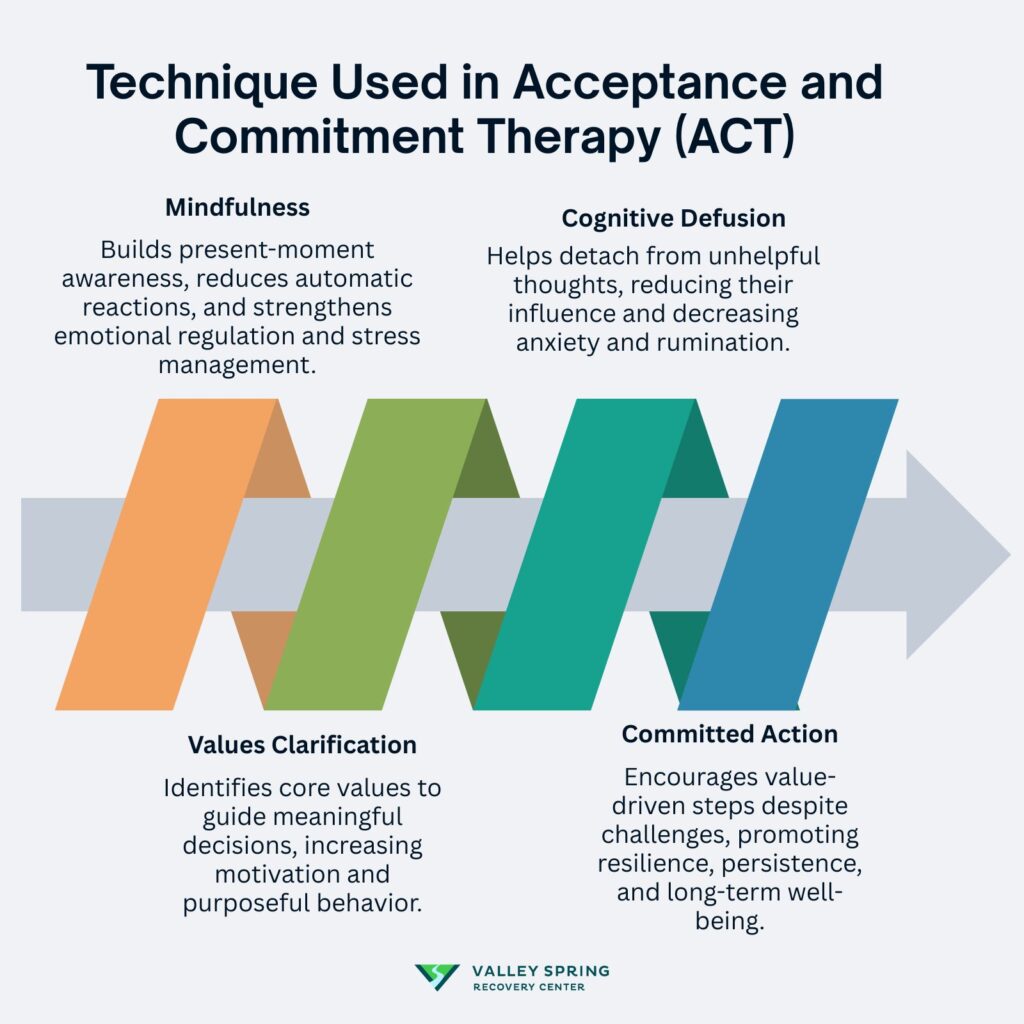
The techniques used in Acceptance and Commitment Therapy (ACT) include a combination of mindfulness, cognitive, and behavioral strategies designed to increase psychological flexibility. It helps individuals live according to their values. These techniques encourage acceptance of difficult thoughts and feelings while promoting meaningful action, improving coping skills, and enhancing overall well-being. ACT techniques are adaptable for a range of mental health issues, including anxiety, depression, chronic pain, and addiction.
Here are the techniques used in ACT;
- Mindfulness: This technique helps individuals stay present and fully engage in the current moment without judgment. People learn to reduce automatic reactions and increase awareness of their experiences by observing thoughts and emotions as they arise. Mindfulness supports better emotional regulation and stress management.
- Cognitive Defusion: Cognitive defusion teaches people to separate themselves from unhelpful or intrusive thoughts. Instead of taking thoughts literally, they learn to see them as transient mental events, reducing their impact on behavior. This helps minimize anxiety, rumination, and negative self-talk.
- Values Clarification: This process helps individuals identify and prioritize what truly matters to them in life. By understanding core values, people make more intentional decisions and align actions with meaningful goals. Values clarification motivates sustained behavioral change.
- Committed Action: Taking concrete steps guided by personal values, even in the presence of difficult emotions or thoughts. This technique encourages persistence and goal-directed behavior. It helps build resilience and long-term well-being.
What are the 6 Steps of Acceptance and Commitment Therapy?
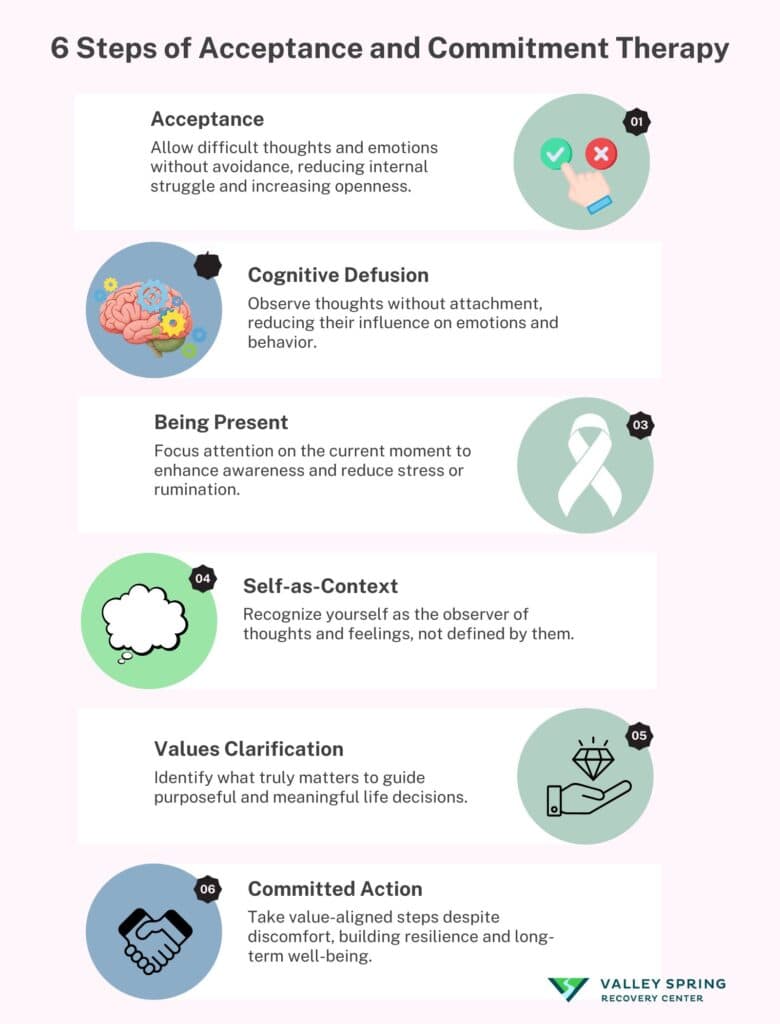
The 6 steps of Acceptance and Commitment Therapy (ACT) include a structured approach to building psychological flexibility, helping individuals accept difficult experiences and take meaningful action guided by their values. These steps work together to reduce avoidance, increase mindfulness, and promote behaviors that align with what truly matters in life. By practicing these steps, individuals better manage stress, anxiety, depression, addiction, and other challenges while living a more purposeful and fulfilling life.
The six core steps of ACT are:
- Acceptance: Involves allowing unpleasant thoughts, emotions, and sensations to exist without trying to control or avoid them. Acceptance reduces struggle with internal experiences and creates space for mindful action.
- Cognitive Defusion: Teaches individuals to detach from unhelpful thoughts by observing them without being dominated by them. This reduces the power of negative thinking and prevents it from dictating behavior.
- Being Present: Encourages full awareness of the present moment, focusing attention on current experiences rather than past regrets or future worries. This enhances mindfulness and reduces stress.
- Self-as-Context: Helps individuals recognize that they are more than their thoughts, feelings, or experiences. This perspective promotes a stable sense of self and reduces over-identification with negative experiences.
- Values Clarification: Guides people in identifying what truly matters to them, providing direction and motivation for behavior. Clarifying values helps align actions with meaningful life goals.
- Committed Action: Involves taking concrete, value-driven steps even in the presence of challenges or uncomfortable emotions. Committed action fosters resilience, goal achievement, and long-term psychological well-being.
What are the 4 A’s of Acceptance and Commitment Therapy?

The 4 A’s of Acceptance and Commitment Therapy (ACT) are practical strategies: accept, acknowledge, allow, and act. It is designed to help individuals manage difficult thoughts and emotions while staying committed to meaningful actions. These four principles provide a simple framework for increasing psychological flexibility and improving mental well-being. By practicing the 4 A’s, people reduce avoidance, enhance mindfulness, and make choices aligned with their core values, even in the face of challenging experiences.
The 4 A’s of ACT are:
- Accept: Involves embracing uncomfortable thoughts, feelings, and sensations without trying to suppress or fight them. Acceptance allows individuals to reduce struggle and create space for healthier coping.
- Acknowledge: Encourages recognizing and observing internal experiences objectively. By acknowledging thoughts and emotions, individuals gain clarity and prevent being overwhelmed by them.
- Allow: Focuses on permitting experiences to exist without resistance, even if they are unpleasant. Allowing thoughts and feelings reduces avoidance and promotes psychological flexibility.
- Act: Involves taking deliberate, value-driven actions despite difficult emotions or thoughts. Acting in alignment with personal values fosters meaningful progress and long-term well-being.
How Does Acceptance and Commitment Therapy (ACT) Work for Addiction?
ACT works for addiction by helping individuals accept cravings and uncomfortable emotions without acting on them. It also guides behavior toward meaningful, value-driven goals. Instead of trying to suppress urges or avoid difficult feelings, ACT teaches skills to observe these experiences mindfully, reduce their impact, and take deliberate action aligned with recovery. ACT improves coping, reduces relapse risk, and supports long-term behavioral change in people struggling with substance use disorders.
The key ways ACT supports addiction recovery include:
Understanding Experiential Avoidance in Substance Use
Experiential avoidance occurs when individuals try to escape or suppress unpleasant thoughts, feelings, or cravings through substance use. ACT helps clients recognize these patterns and develop healthier strategies to tolerate discomfort without resorting to addictive behaviors.
Psychological Flexibility and Craving Management
ACT enhances psychological flexibility, enabling individuals to experience cravings without being controlled by them. Mindfulness and cognitive defusion techniques allow people to observe urges without acting impulsively, reducing the power of cravings over time.
Values-Based Recovery
ACT encourages identifying and clarifying personal values, which guide recovery goals and meaningful life choices. By focusing on what truly matters, individuals are motivated to maintain sobriety and engage in purposeful behaviors.
Managing Urges and Triggers
ACT provides practical strategies for handling triggers and high-risk situations, including mindfulness, urge surfing, and acceptance exercises. These tools reduce the likelihood of relapse and strengthen self-control in challenging moments.
Treating Co-Occurring Mental Health Conditions
Many individuals with addiction also face anxiety, depression, or trauma. ACT addresses co-occurring mental health conditions by promoting acceptance, emotional regulation, and adaptive coping, improving overall treatment outcomes.
How is ACT Different From Cognitive Behavior Therapy (CBT)?
ACT is different from Cognitive Behavior Therapy (CBT) in its approach to thoughts and emotions. While CBT focuses on identifying, challenging, and changing negative thought patterns, ACT emphasizes accepting thoughts and feelings without judgment and committing to value-driven actions. ACT promotes psychological flexibility, mindfulness, and living in alignment with personal values instead of trying to eliminate or control unwanted mental experiences. This makes ACT particularly effective for chronic conditions, stress, and situations where changing thoughts alone, as done in CBT, is not sufficient.
Can ACT Be Combined with Other Addiction Treatments?
Yes, ACT can be combined with other addiction treatments to enhance recovery outcomes. Integrating ACT with approaches like cognitive-behavioral therapy (CBT), medication-assisted treatment (MAT), group therapy, or specialized alcohol addiction treatment. allows individuals to benefit from multiple strategies simultaneously. While ACT focuses on acceptance, mindfulness, and values-based action, other treatments target specific behaviors, cravings, or physiological aspects of addiction, including alcohol dependence. Combining these approaches provides a more comprehensive, personalized plan, improving coping skills, reducing relapse risk, and supporting long-term sobriety for individuals struggling with alcohol use disorder.
Is Acceptance and Commitment Therapy Evidence-Based?
Yes, Acceptance and Commitment Therapy is evidence-based and supported by a growing body of research. Multiple meta-analyses and randomized controlled trials have demonstrated its effectiveness in treating anxiety, depression, stress, chronic pain, and addiction. For example, a meta-analysis of 60 studies involving over 4,000 participants found a moderate effect size of 0.42 in favor of ACT compared to control conditions. Its focus on psychological flexibility, mindfulness, and values-based action provides a scientifically validated framework for improving mental health and overall well-being.
Is Acceptance and Commitment Therapy Trauma-Informed?
Yes, Acceptance and Commitment Therapy is trauma-informed, as it emphasizes safety, empowerment, and self-awareness when addressing difficult emotions and experiences. ACT helps individuals acknowledge and accept traumatic thoughts and feelings without judgment, reducing avoidance and reactivity. Promoting mindfulness, psychological flexibility, and values-based action, it allows clients to regain a sense of control and purpose in their lives. This trauma-informed approach makes ACT suitable for supporting recovery from trauma alongside other mental health challenges.
Share This Post

Valley Spring Editorial Team
All author posts
Our Therapuetic Recovery Programs
Are you covered for treatment?






Valley Spring Recovery Center is an approved provider for Blue Shield of California and Cigna, while also accepting many other major insurance carriers.
Check Coverage Now!