


Addiction therapy guide
Motivational Interviewing: Definition, types, effectiveness and application in addiction treatment
Motivational interviewing (MI) resolves ambivalence about change through OARS skills and four guided processes. Evidence, effect sizes, and NJ delivery.
By Paul James Roeser·Reviewed by Noelle Mathew, LCSW, LCADC, CASAC-M·Last reviewed August 8, 2026·8 min read
Published ·Updated
Motivational interviewing (MI) is a collaborative counseling method that strengthens a person's own motivation for change by exploring and resolving ambivalence, rather than by confrontation or advice-giving. Psychologist William R. Miller introduced motivational interviewing in a 1983 article on problem drinking, and Miller and Stephen Rollnick have refined the method across four editions of their text "Motivational Interviewing." The Substance Abuse and Mental Health Services Administration (SAMHSA) codifies the approach for addiction counselors in Treatment Improvement Protocol (TIP) 35, "Enhancing Motivation for Change in Substance Use Disorder Treatment."
The evidence base for motivational interviewing is large and precisely bounded. A 2023 Cochrane review spanning 93 randomized controlled trials with 22,776 participants found MI reduces substance use compared with no intervention, with effects that shrink over follow-up; the post-intervention estimate (standardized mean difference 0.48) rests on 6 studies with 471 participants and is graded low-certainty. In Project MATCH, the 1,726-participant alcohol treatment trial, four-session motivational enhancement therapy produced outcomes nearly identical to twelve-session comparison treatments.
Valley Spring Recovery Center in Norwood, New Jersey uses motivational interviewing through trained counselors for clients in pre-contemplative stages of change — the people least ready to name their substance use a problem.
What Is Motivational Interviewing?
Motivational interviewing is a client-centered, directive counseling method that resolves ambivalence about change by drawing out the client's own reasons for changing. The method treats motivation as something evoked, not installed: the counselor guides the conversation so the client — not the counselor — voices the argument for change.
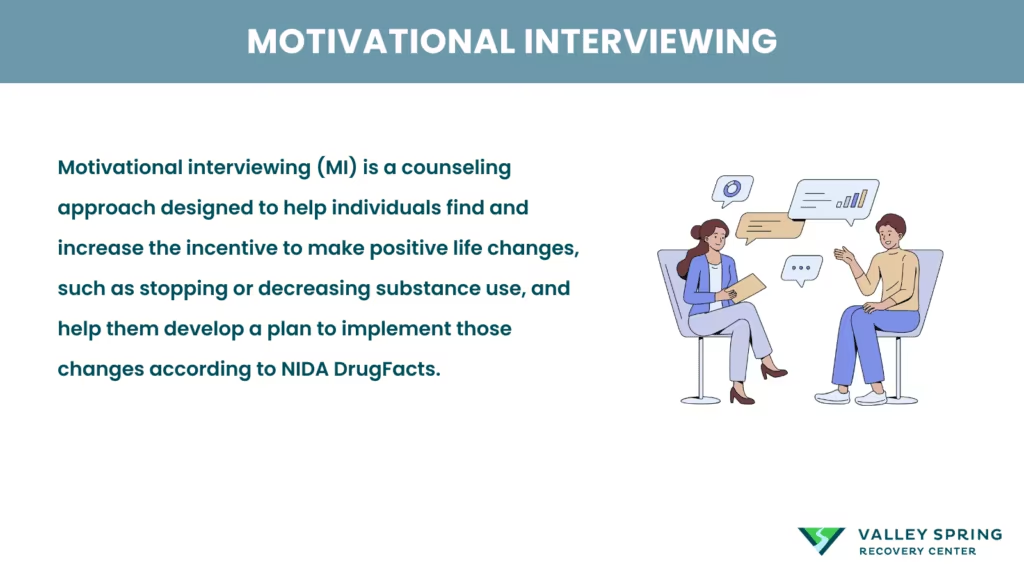
The working distinction is between change talk and sustain talk. Change talk is client speech that favors movement — "I'm tired of feeling sick every morning" — and sustain talk favors the status quo — "drinking is the only way I unwind." Motivational interviewing counselors recognize both, respond to sustain talk without argument, and selectively reinforce change talk, because the client's own stated reasons predict behavior better than any reason a counselor supplies. Underneath those techniques sits a defined relational stance the method calls its spirit.
What Is the Spirit of Motivational Interviewing?
The spirit of motivational interviewing consists of 4 elements — partnership, acceptance, compassion, and evocation — that define the counselor's stance before any technique is applied, per SAMHSA's TIP 35.
- Partnership: the counselor and client collaborate as equals, and the client drives the conversation — the counselor is not the expert delivering a verdict.
- Acceptance: the counselor communicates the client's absolute worth, accurate empathy, support for autonomy, and affirmation of strengths.
- Compassion: the counselor actively promotes the client's welfare and puts the client's needs first.
- Evocation: the counselor draws out motivations and strengths the client already holds, rather than supplying reasons from outside.
Spirit sets the stance; a set of 4 named communication skills carries it into the conversation.
What Are the OARS Skills in Motivational Interviewing?
The OARS skills are the 4 core motivational interviewing techniques: open questions, affirming, reflective listening, and summarizing, as SAMHSA's TIP 35 defines them. Open questions invite the client's own perspective ("What worries you about your drinking?"), affirmations name real strengths and past successes, reflections mirror the client's meaning back with precision, and summaries collect the client's change talk into one coherent statement.
Reflective listening carries the heaviest load. A skilled reflection of "I know I should quit, but I don't think I can" is "Quitting matters to you, and you doubt your ability to do it alone" — the counselor names both sides of the ambivalence without arguing either. OARS skills run continuously through the method's 4 sequential processes.
What Are the Four Processes of Motivational Interviewing?
The 4 processes of motivational interviewing are engaging, focusing, evoking, and planning, per SAMHSA's TIP 35. The task of each process:
| Process | Counselor task | Marker of completion |
| Engaging | Establish a mutually trusting and respectful helping relationship | The client talks openly rather than defensively |
| Focusing | Develop a mutually agreed-on agenda and identify a target behavior | One change goal is named and shared |
| Evoking | Elicit the client's own motivations for change through change talk | The client, not the counselor, argues for change |
| Planning | Develop a change plan that is acceptable, accessible, and appropriate | The client commits to concrete first steps |
Process describes the method's flow; three decades of randomized trials describe what the flow achieves.
How Effective Is Motivational Interviewing?
Motivational interviewing reduces substance use compared with no intervention — standardized mean difference 0.48 at post-intervention (6 studies, 471 participants, low-certainty evidence) and 0.20 at short-term follow-up — within a review spanning 93 randomized controlled trials and 22,776 participants, per Schwenker and colleagues' 2023 Cochrane review, published in the Cochrane Database of Systematic Reviews.
The same review sets the boundaries: against treatment as usual the review found no consistent benefit — a small post-intervention effect favored usual care (standardized mean difference -0.14, 95% CI -0.27 to -0.02), and a very small MI advantage appeared only at medium-term follow-up — while against assessment-and-feedback controls MI holds a small advantage at medium- and long-term follow-up (SMD 0.24). Lundahl, Brad and colleagues' 2010 meta-analysis of 119 studies in Research on Social Work Practice measured the same shape — durable small effects against weak comparisons (g = 0.28), nonsignificant against specific treatments (g = 0.09). Rubak, Sune and colleagues' 2005 meta-analysis of 72 randomized trials in the British Journal of General Practice found a significant effect in 74 percent of studies, and an effect in 64 percent of studies using brief 15-minute encounters.
The efficiency finding is the practical headline. In Project MATCH, the National Institute on Alcohol Abuse and Alcoholism's 1,726-participant trial, four sessions of motivational enhancement therapy — MI plus structured feedback — produced drinking outcomes nearly identical to twelve sessions of cognitive behavioral therapy or twelve-step facilitation. MI is a brief treatment that earns its place at a specific point in care, and that placement question is where clinical use begins.
When Is Motivational Interviewing Used in Addiction Treatment?
Motivational interviewing is used at the front of addiction treatment, when readiness to change is low — SAMHSA's TIP 35 names the precontemplation and contemplation stages of change as the point where MI is most helpful. A person in precontemplation does not identify their substance use as a problem; arguing with that person produces resistance, while evoking their own goals produces movement.
Valley Spring Recovery Center applies exactly that placement: trained counselors use motivational interviewing with clients in pre-contemplative stages of change. Addiction intervention services apply the same evocative, non-confrontational stance when a family member refuses treatment. Once a client commits to change, MI hands off to the therapies that build the skills change requires.
How Does Motivational Interviewing Combine With Other Therapies?
Motivational interviewing combines with other therapies as a sequenced front end: MI builds the commitment, then skill-based treatment builds the capability. The manualized combination of MI with normed assessment feedback is called motivational enhancement therapy (MET), the four-session format tested in Project MATCH.
The most common pairing sequences MI into cognitive behavioral therapy: MI resolves ambivalence, and CBT restructures the triggers and beliefs that maintain use. Acceptance and commitment therapy connects willingness to chosen values, so values supply the direction after MI establishes a reason to change. MI's communication style also threads through group treatment and case management as a default stance rather than a separate session type. Where MI sits among all 14 modalities is mapped in the Addiction Therapy Modalities Library.
What Are the Most Common Questions About Motivational Interviewing?
Common questions about motivational interviewing: the definitions, evidence figures, and practical facts.
Who Developed Motivational Interviewing?
Psychologist William R. Miller introduced motivational interviewing in a 1983 article on problem drinking. Miller and Stephen Rollnick then codified the method in their text "Motivational Interviewing," now in its fourth edition.
What Does OARS Stand For?
OARS stands for open questions, affirming, reflective listening, and summarizing — the 4 core communication skills of motivational interviewing, as defined in SAMHSA's Treatment Improvement Protocol 35.
What Is Change Talk?
Change talk is client speech that favors change — statements of desire, ability, reasons, need, or commitment. Motivational interviewing counselors selectively evoke and reinforce change talk because the client's own arguments predict behavior change.
How Many Sessions Does Motivational Interviewing Take?
Motivational interviewing itself has no fixed session count — it is a counseling style used throughout care. Motivational enhancement therapy, the manualized format tested in Project MATCH, ran 4 sessions over 12 weeks and matched twelve-session comparison treatments.
What Is the Difference Between MI and MET?
Motivational enhancement therapy (MET) is motivational interviewing plus structured, normed feedback from an intake assessment, delivered in a manualized 4-session format. Project MATCH tested MET, and its outcomes matched twelve-session comparison treatments.
Who Is Motivational Interviewing Best Suited For?
People in the precontemplation and contemplation stages of change — those not yet ready to name substance use a problem. SAMHSA's TIP 35 identifies low readiness to change as the point where MI helps most.
Sources & References5ShowHide
- SAMHSA — TIP 35: Enhancing Motivation for Change in Substance Use Disorder Treatment (updated 2019), NCBI Bookshelf — OARS skills (open questions, affirming, reflective listening, summarizing); spirit of MI (partnership, acceptance, compassion, evocation); four processes (engaging, focusing, evoking, planning) with task definitions; MI identified as particularly helpful in the Precontemplation and Contemplation stages when readiness to change is low.
- Schwenker R, et al. Motivational interviewing for substance use reduction. Cochrane Database of Systematic Reviews, 2023, CD008063 (PubMed) — 93 RCTs, 22,776 participants; vs no intervention: SMD 0.48 (95% CI 0.07-0.89) post-intervention, 0.20 (0.12-0.28) short-term, 0.12 medium-term, no difference long-term; vs treatment as usual: no consistent benefit — small post-intervention effect favoring usual care (SMD -0.14, 95% CI -0.27 to -0.02), very small MI advantage at medium term (SMD 0.12); vs assessment and feedback: SMD 0.24 at medium- and long-term follow-up; authors report moderate to no confidence in the evidence.
- Lundahl B, Kunz C, Brownell C, Tollefson D, Burke BL. A Meta-Analysis of Motivational Interviewing: Twenty-Five Years of Empirical Studies. Research on Social Work Practice, 2010 — 119 studies; durable, statistically significant small effects against weak comparison groups (g = 0.28); nonsignificant against specific treatments (g = 0.09).
- Rubak S, Sandbaek A, Lauritzen T, Christensen B. Motivational interviewing: a systematic review and meta-analysis. British Journal of General Practice, 2005 (PMC) — 72 randomized controlled trials; significant effect in approximately 74% (53/72) of studies; MI outperformed traditional advice-giving in approximately 80% of investigations; 64% of studies using brief 15-minute encounters showed an effect.
- Project MATCH Research Group. Matching Alcoholism Treatments to Client Heterogeneity: Project MATCH posttreatment drinking outcomes. Journal of Studies on Alcohol, 1997 (PubMed) — 952 outpatient and 774 aftercare participants (1,726 total) randomized to three 12-week treatments — 4-session motivational enhancement therapy, 12-session cognitive behavioral therapy, and 12-session twelve-step facilitation — with little difference in outcomes by type of treatment.