


Addiction therapy guide
Acceptance and Commitment Therapy (ACT): Core Processes and Addiction Evidence
Acceptance and commitment therapy (ACT) builds psychological flexibility through six hexaflex processes. Meta-analytic effects and addiction applications.
By Paul James Roeser·Reviewed by Noelle Mathew, LCSW, LCADC, CASAC-M·Last reviewed August 8, 2026·8 min read
Published ·Updated
Acceptance and commitment therapy (ACT) is a behavioral psychotherapy that treats substance use and mental health disorders by building psychological flexibility — the capacity to stay present with difficult thoughts, feelings, and cravings without obeying them, while acting on chosen values. Psychologist Steven C. Hayes and colleagues formalized the model, grounding it in relational frame theory, a behavioral account of human language and cognition, in the account published in Behaviour Research and Therapy in 2006.
The evidence base for ACT is quantified — and contested at the margins. A-Tjak, Jacqueline G., and colleagues' 2015 meta-analysis of 39 randomized controlled trials covering 1,821 patients, published in Psychotherapy and Psychosomatics, found ACT outperformed control conditions with a Hedges' g of 0.57. Ost, Lars-Goran's 2014 meta-analysis of 60 randomized controlled trials covering 4,234 participants, published in Behaviour Research and Therapy, found a smaller mean effect size of 0.42 and judged the therapy not yet well-established for any disorder.
What Is Acceptance and Commitment Therapy?
Acceptance and commitment therapy is a behavioral psychotherapy that changes a person's relationship to unwanted thoughts and feelings — accepting them as passing internal events — while directing behavior toward chosen values. The model belongs to the behavioral tradition's third wave: where earlier behavioral therapy targeted conditioned behavior and cognitive therapy targeted thought content, ACT targets the function thoughts serve.
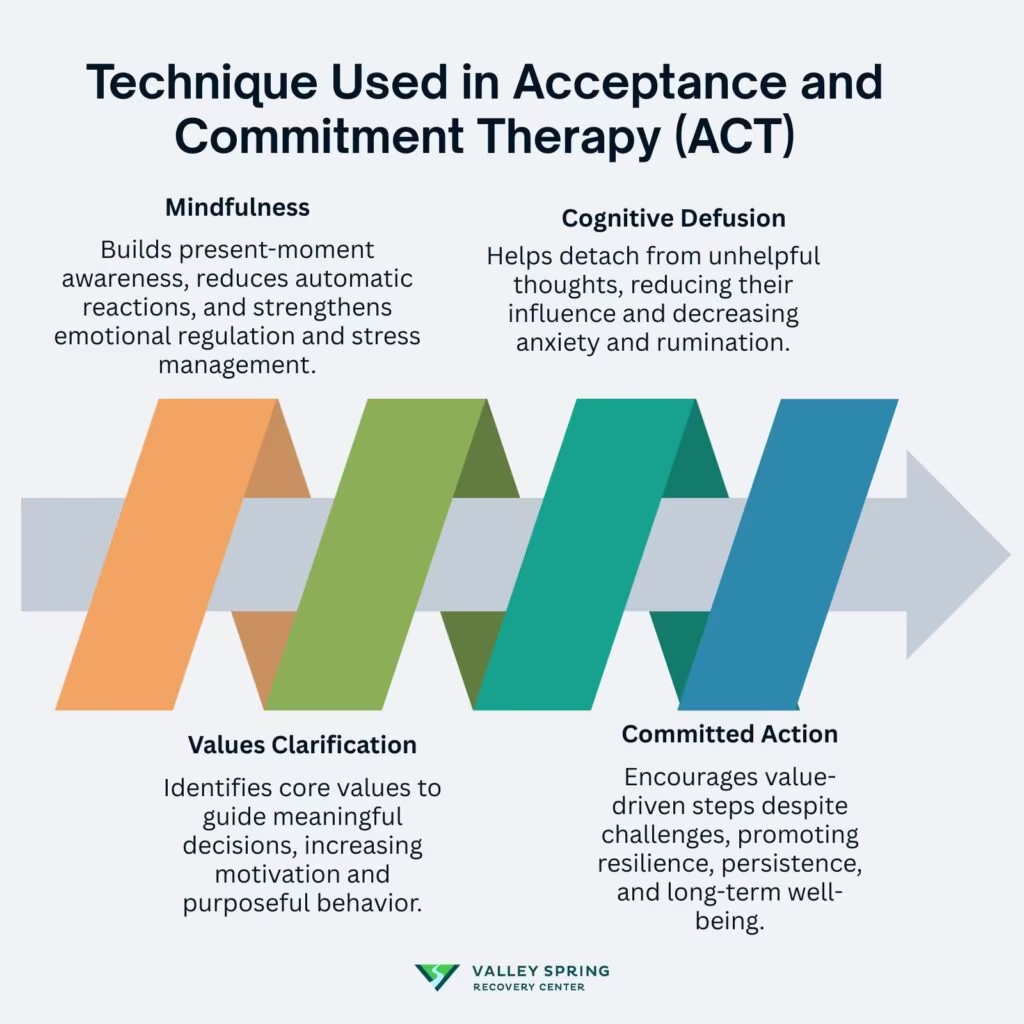
The therapy's stated target is psychological flexibility: contacting the present moment fully and, depending on what the situation affords, persisting or changing behavior in the service of chosen values. Everything ACT does in session — metaphors, mindfulness exercises, values work — trains one or more of six defined processes.
What Are the Six Core Processes of ACT?
The 6 core processes of ACT are acceptance, cognitive defusion, contact with the present moment, self-as-context, values, and committed action — together forming the psychological flexibility model that Hayes and colleagues' 2006 account defines, a hexagon of processes practitioners call the hexaflex.
The 6 processes and what each trains:
- Acceptance: allowing unwanted thoughts, emotions, and sensations to exist without fighting or suppressing them, which removes the struggle that amplifies them.
- Cognitive defusion: observing thoughts as passing mental events — words, not verdicts — so a thought like "one drink won't matter" loses behavioral authority.
- Contact with the present moment: attending to what is happening now rather than to remembered failures or feared futures.
- Self-as-context: locating identity in the observing self rather than in any thought or feeling — the person is the sky, not the weather.
- Values: naming what the person wants their life to be about — family, health, work, honesty — as the compass for behavior.
- Committed action: taking concrete, values-aligned steps while difficult internal experiences are still present.
In addiction treatment, those six processes are aimed at one specific mechanism.
What Does ACT for Addiction Look Like in Practice?
ACT practice links the trigger, internal experience, chosen value, and next observable action. A clinician first identifies what the substance use accomplishes, such as escaping anxiety; the client then notices the craving without treating it as a command, names a value such as health or family reliability, and chooses a small committed action consistent with that value. The goal is a more flexible response to cravings, not a promise that cravings disappear.
How Does ACT Work for Addiction?
ACT works for addiction by treating substance use as experiential avoidance — the attempt to escape unwanted internal experience — and training the person to tolerate cravings and difficult emotions without using, while building a life aligned with chosen values.
The functional analysis is direct: a substance reliably switches off discomfort, so discomfort becomes the trigger and use becomes the escape. ACT interrupts the escape rather than the discomfort. Acceptance and defusion skills let a craving rise, peak, and pass without a behavioral response — the practice clinicians call urge surfing — and values work supplies the reason to endure the wave: a person clear on what they are staying abstinent for tolerates more discomfort than a person merely told to stop. Whether that mechanism translates into measured outcomes is a question three meta-analyses answer with different emphases.
How Effective Is Acceptance and Commitment Therapy?
ACT outperformed control conditions with a Hedges' g of 0.57 across 39 randomized controlled trials and 1,821 patients in A-Tjak and colleagues' 2015 meta-analysis, while Ost's 2014 meta-analysis of 60 trials and 4,234 participants found a smaller mean effect of 0.42 and judged ACT not yet well-established for any disorder. Both reviews agree on the comparison that matters clinically: ACT and cognitive behavioral therapy perform without significant difference.
The 3 meta-analytic findings that define ACT's evidence base, from the reviews by A-Tjak and colleagues and Ost, plus the substance-specific analysis by Lee and colleagues:
| Meta-analysis | Scope | Finding |
| A-Tjak et al., 2015 (Psychotherapy and Psychosomatics) | 39 RCTs, 1,821 patients, mental and physical health conditions | ACT vs controls: g = 0.57 overall (waitlist g = 0.82, psychological placebo g = 0.51, treatment as usual g = 0.64); no significant difference vs CBT (p = 0.140) |
| Ost, 2014 (Behaviour Research and Therapy) | 60 RCTs, 4,234 participants, psychiatric and somatic disorders and workplace stress | Mean effect size 0.42 across all comparisons; vs cognitive and behavioral treatments 0.16, non-significant; verdict: not yet well-established for any disorder |
| Lee et al., 2015 (Drug and Alcohol Dependence) | 10 RCTs on substance use disorders | Significant small-to-medium effect favoring ACT over active treatments (CBT, pharmacotherapy, 12-step, treatment as usual) on substance use outcomes |
The two headline numbers diverge because the reviews pooled different trials against different comparators under different quality standards — a divergence worth reading as a lesson in how the evidence-based label is earned, not as a contradiction to resolve by picking the friendlier figure. For substance use specifically, the record is narrower and more consistent.
How Effective Is ACT for Substance Use Disorders?
For substance use disorders, ACT produced a significant small-to-medium effect over active treatment comparisons — including CBT, pharmacotherapy, and 12-step approaches — across 10 randomized controlled trials in Lee, Eric B., An, Woolee, Levin, Michael E., and Twohig, Michael P.'s 2015 meta-analysis in Drug and Alcohol Dependence.
The effect held with equal consistency across the review's 5 smoking-cessation trials and its 5 trials on other substance use disorders, and the authors' verdict was measured: ACT appears to be a promising intervention for substance use disorders. Ost's stricter 2014 grading reached a compatible conclusion, rating ACT possibly efficacious for substance use — the review's term is drug abuse — alongside depression, psychotic symptoms, obsessive-compulsive disorder, and mixed anxiety. A promising-but-unsettled record raises the practical question of how ACT differs from the settled default.
How Does ACT Differ From Cognitive Behavioral Therapy?
ACT differs from cognitive behavioral therapy in its target: CBT identifies and restructures the content of distorted thoughts, while ACT leaves content alone and changes the person's relationship to thoughts through acceptance and defusion. A person in CBT tests "I cannot cope without alcohol" against evidence; a person in ACT notices it as a thought, thanks the mind, and pours coffee anyway.
The distinction is functional, not adversarial — both meta-analytic records show the two performing without significant difference, and clinicians sequence them by presentation. Cognitive behavioral therapy remains the default skill-building framework; dialectical behavior therapy already blends the two traditions, pairing cognitive-behavioral change strategies with the same acceptance and mindfulness processes ACT trains. Which conditions each framework has evidence for is a matter of record.
What Conditions Does ACT Treat?
Ost's 2014 review grades ACT probably efficacious for chronic pain and tinnitus, and possibly efficacious for depression, psychotic symptoms, obsessive-compulsive disorder, mixed anxiety, substance use, and workplace stress — with remaining conditions rated experimental. A-Tjak's 2015 review pooled trials across anxiety, depression, addiction, and somatic health problems and found ACT superior to control conditions across that span.
The breadth matters in addiction treatment because substance use disorders commonly overlap with psychiatric symptoms. Acceptance-based skills also appear in dialectical behavior therapy, which combines acceptance and mindfulness with explicit behavior-change strategies. Valley Spring Recovery Center documents its group and individual formats in the Group & Individual Therapy Program; this informational page does not claim that the center delivers a standalone ACT protocol. The full modality set is compared in the Addiction Therapy Modalities Library.
What Are the Most Common Questions About Acceptance and Commitment Therapy?
Common questions about acceptance and commitment therapy: the definitions, evidence figures, and practical facts.
Who Developed Acceptance and Commitment Therapy?
Psychologist Steven C. Hayes and colleagues formalized ACT, publishing the definitive account of its model, processes, and outcomes in Behaviour Research and Therapy in 2006 and grounding it in relational frame theory.
What Is Psychological Flexibility?
Psychological flexibility is ACT's treatment target: contacting the present moment fully and persisting or changing behavior in the service of chosen values. The six hexaflex processes — acceptance through committed action — each train one facet of it.
What Is Cognitive Defusion?
Cognitive defusion is the ACT skill of observing thoughts as passing mental events rather than literal truths. A defused thought — "I am noticing the thought that I need a drink" — loses its authority over behavior.
Is ACT Better Than CBT?
No. Both major meta-analyses found no significant difference between ACT and cognitive behavioral therapy — A-Tjak reported p = 0.140, and Ost reported a non-significant 0.16 effect versus cognitive and behavioral treatments. The two are alternatives, not rivals.
Is ACT Evidence-Based?
ACT carries 39 randomized trials showing g = 0.57 over controls (A-Tjak, 2015), while Ost's stricter 2014 review rated it possibly efficacious for substance use and not yet well-established overall — a real, still-contested evidence base.
Where Are Acceptance-Based Skills Taught in Addiction Treatment?
Acceptance-based skills appear in ACT protocols and in dialectical behavior therapy curricula, which train mindfulness, distress tolerance, and emotion regulation. Delivery format depends on the clinician, treatment plan, and program.
Sources & References6ShowHide
- Hayes SC, Luoma JB, Bond FW, Masuda A, Lillis J. Acceptance and commitment therapy: model, processes and outcomes. Behaviour Research and Therapy, 2006;44(1):1-25 (PubMed) — The definitive account of ACT's psychological flexibility model and its connection to relational frame theory; basis for the six-process (hexaflex) framework.
- A-Tjak JG, Davis ML, Morina N, Powers MB, Smits JA, Emmelkamp PMG. A meta-analysis of the efficacy of acceptance and commitment therapy for clinically relevant mental and physical health problems. Psychotherapy and Psychosomatics, 2015;84(1):30-36 (PubMed) — 39 RCTs, 1,821 patients; ACT vs controls Hedges' g = 0.57 (waitlist 0.82, psychological placebo 0.51, TAU 0.64); no significant difference vs established treatments/CBT (p = 0.140).
- Ost LG. The efficacy of Acceptance and Commitment Therapy: an updated systematic review and meta-analysis. Behaviour Research and Therapy, 2014;61:105-121 (PubMed) — 60 RCTs, 4,234 participants; mean ES 0.42 across all comparisons; 0.16 non-significant vs cognitive/behavioral treatments; verdict: not yet well-established for any disorder; possibly efficacious for depression, psychotic symptoms, OCD, mixed anxiety, drug abuse, and stress at work; probably efficacious for chronic pain and tinnitus.
- Lee EB, An W, Levin ME, Twohig MP. An initial meta-analysis of Acceptance and Commitment Therapy for treating substance use disorders. Drug and Alcohol Dependence, 2015;155:1-7 (PubMed) — 10 RCTs; significant small-to-medium effect favoring ACT vs active treatments (CBT, pharmacotherapy, 12-step, TAU) on substance use outcomes; consistent across 5 smoking-cessation and 5 other drug trials; ACT judged a promising intervention.
- Dindo L, Van Liew JR, Arch JJ. Acceptance and Commitment Therapy: A Transdiagnostic Behavioral Intervention for Mental Health and Medical Conditions. Neurotherapeutics, 2017;14(3):546-553 (PMC) — Describes the six psychological-flexibility skills (differently labeled) and summarizes the meta-analytic pattern: medium effects vs treatment as usual, large vs waitlist, variable vs established treatments.
- Twohig MP, Shoenberger D, Hayes SC. A preliminary investigation of acceptance and commitment therapy as a treatment for marijuana dependence in adults. Journal of Applied Behavior Analysis, 2007;40(4):619-632 (PMC) — Demonstrates how functional assessment, acceptance, values, and committed action are applied in practice to substance use.