Does Medicaid Cover Addiction Treatment in New Jersey?

Yes, Medicaid covers addiction treatment in New Jersey. Common Medicaid plan types available in New Jersey include MCOs for most enrollees, limited FFS coverage for certain populations, and specialized programs like MLTSS and PACE for individuals with long-term care needs.
Medicaid in New Jersey covers addiction treatment services like inpatient rehab, outpatient counseling, detox, medication-assisted treatment, and dual diagnosis care.
Other available insurance plans for addiction treatment in New Jersey include those from Medicare, Humana, and Tricare, covering services such as inpatient and outpatient rehab, detox, counseling, and medication-assisted treatment.
What Medicaid Plan Types Are Available In New Jersey for Addiction Treatment?
Medicaid plan types include Managed Care Organizations (MCOs), Fee-For-Service (FFS), Managed Long-Term Services and Supports (MLTSS), and the Program of All-Inclusive Care for the Elderly (PACE).
Here are the Medicaid plan types available in New Jersey:
Did you know most health insurance plans cover substance use disorder treatment? Check your coverage online now.
1. Managed Care Organizations (MCOs)
NJ FamilyCare primarily operates through MCOs that coordinate care for enrollees. Medicaid benefits—including those for addiction treatment—are delivered through these plans:
- Aetna Better Health of New Jersey
- Fidelis Care
- Horizon NJ Health
- UnitedHealthcare Community Plan
- WellPoint (formerly Amerigroup New Jersey)
2. Fee-For-Service (FFS)
Before the full integration into MCOs, many behavioral health services—including addiction treatment—were managed via traditional fee-for-service. Providers billed the state directly for these services.
- FFS still applies in limited cases (e.g., members with presumptive eligibility or populations not yet transitioned into the managed care model).
3. Managed Long-Term Services & Supports (MLTSS) & PACE
For certain populations (e.g., elderly, dual-eligible recipients), Medicaid offers additional managed care options:
- MLTSS: Provides coordinated health, prescription, and long-term supports through a selected MCO.
- PACE (Program of All-Inclusive Care for the Elderly): Combines Medicare and Medicaid service
Contact us today to schedule an initial assessment or to learn more about our services. Whether you are seeking intensive outpatient care or simply need guidance on your drug addiction journey, we are here to help.
What Types of Addiction Treatment Programs Does Medicaid Insurance Cover In New Jersey?
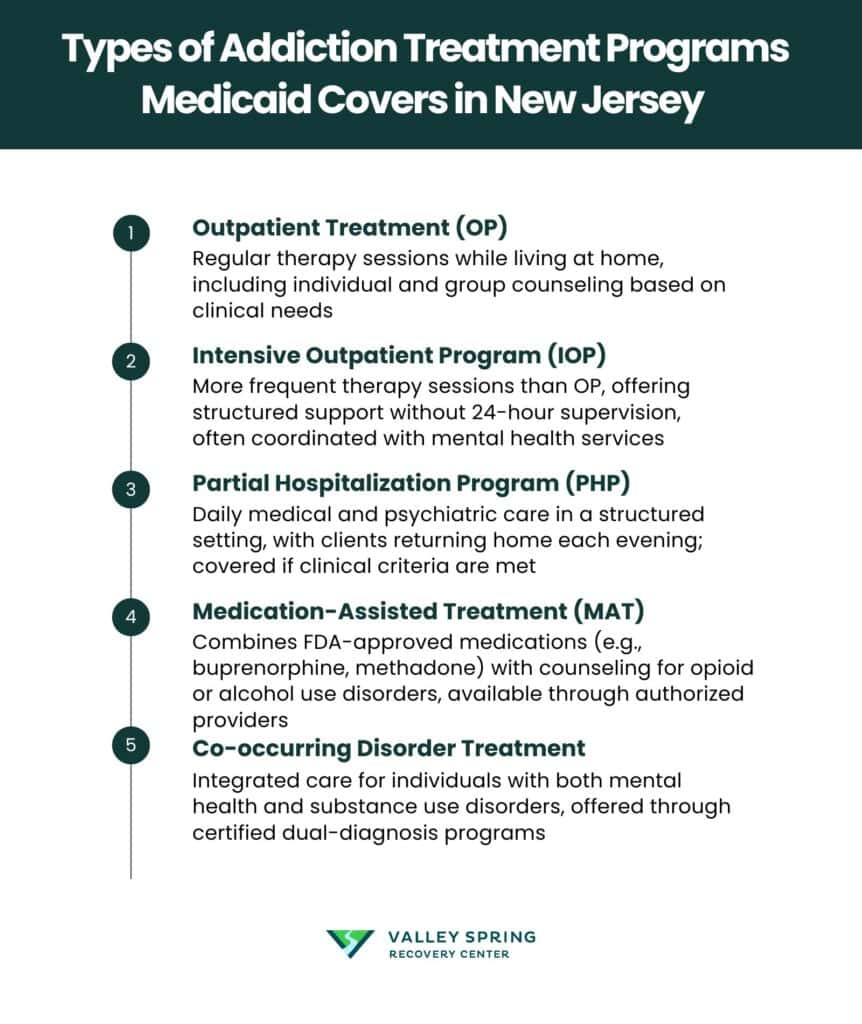
The types of addiction treatment programs Medicaid insurance covers in New Jersey include Outpatient Treatment Programs, Intensive Outpatient Programs, Partial Hospitalization Programs, Medication-Assisted Treatment, and Co-occurring Mental Health and SUD Treatment.
The common types of addiction treatment programs Medicaid covers in New Jersey are explained below.
- Outpatient Treatment Programs (OP): Structured therapy sessions that allow individuals to live at home while regularly attending treatment. Services include individual and group counseling sessions based on clinical needs.
- Intensive Outpatient Programs (IOP): Higher-frequency outpatient care for individuals who require more structured support but do not need 24-hour supervision. IOP includes multiple therapy sessions per week and involves coordination with mental health services.
- Partial Hospitalization Programs (PHP): Comprehensive day programs where clients receive medical and psychiatric services daily but return home each evening. Medicaid covers PHP when clients meet clinical criteria indicating this level of care.
- Medication-Assisted Treatment (MAT): Use of FDA-approved medications (such as buprenorphine, methadone, or naltrexone) combined with counseling. Medicaid supports MAT for opioid and alcohol use disorders through authorized providers.
- Co-occurring Mental Health and SUD Treatment: Integrated services that simultaneously address both mental health disorders and addiction. Medicaid supports dual-diagnosis treatment within certified programs that meet state requirements.
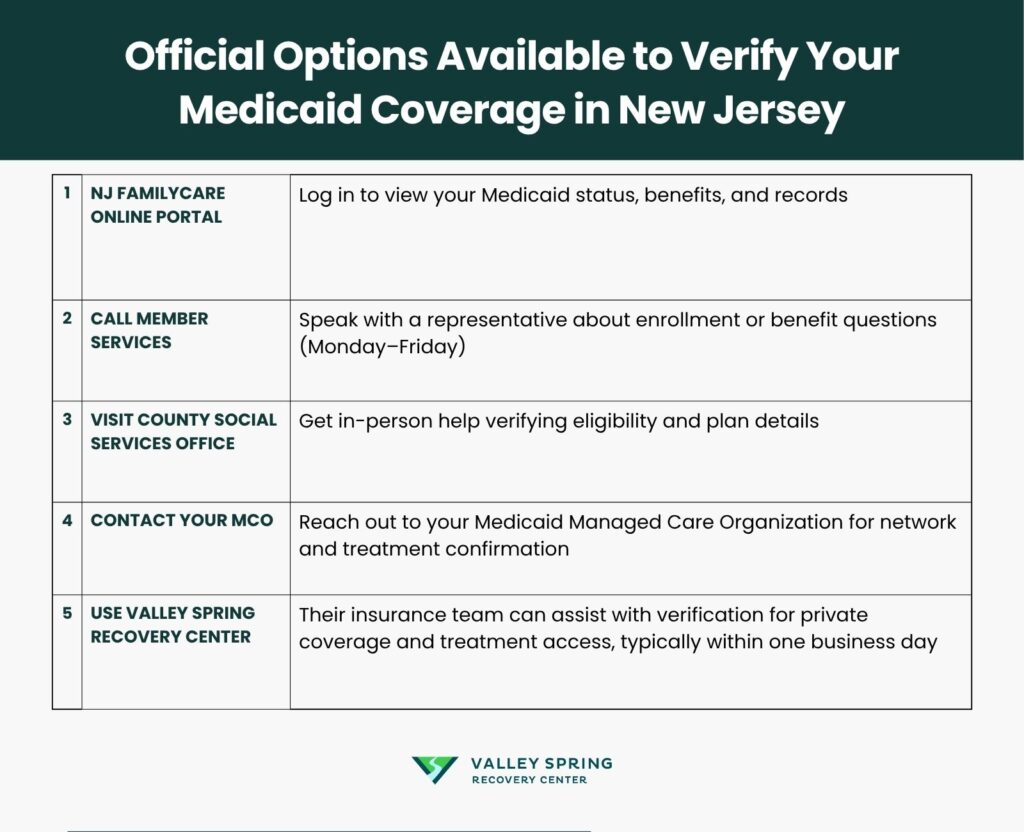
Does Medicaid Require Pre-approval for Rehab in New Jersey?
Yes, Medicaid requires pre-approval for rehab in New Jersey. Before individuals access many substance use disorder (SUD) treatment services under Medicaid, prior authorization is required to confirm medical necessity. This includes higher-intensity levels of care such as residential treatment, Partial Hospitalization Program (PHP), and in some cases, intensive outpatient programs (IOP). Pre-approval ensures that services align with state guidelines and the individual’s clinical needs as reviewed by the managed care organization (MCO) overseeing their Medicaid plan.
Does Medicaid cover Dual Diagnosis and Mental Health Treatment in New Jersey?
Yes, Medicaid covers Dual Diagnosis and Mental Health treatment in New Jersey. Individuals with co-occurring substance use and mental health disorders access integrated behavioral healthcare services through Medicaid-approved programs when clinically indicated. Medicaid supports comprehensive dual-diagnosis treatment under state guidelines, offering coverage for therapy, psychiatric evaluation, and medication management as part of coordinated care.
Rediscover Life at Valley Spring Recovery Center
Get the compassionate support you deserve. We're here to help you reclaim joy, wellness, and a brighter future.
Verify Benefits
Are There Out-of-pocket Payments With Medicaid Addiction Treatment Coverage In New Jersey?
No, there are no out-of-pocket payments for addiction treatment when covered under Medicaid in New Jersey. Medicaid insurance is structured to fully or largely cover the costs of substance use disorder (SUD) treatment for eligible individuals when care is provided by in-network services and meets medical necessity criteria. Covered services include outpatient, residential, medication-assisted treatment, and co-occurring mental health care, without direct charges to the individual beyond minimal co-pays, if applicable and authorized by the state.
What Are Some Other Common Insurance Providers For Addiction Treatment In New Jersey?
Some other common types of insurance plans for addiction treatment in New Jersey include plans from Medicare, Humana, and TRICARE.
Here are some of the common insurance providers for addiction treatment in detail:
Medicare
Medicare provides federal health insurance for adults aged 65 and older as well as certain younger individuals with qualifying disabilities, covering addiction treatment such as screenings, outpatient counseling and therapy, intensive outpatient programs, inpatient hospitalization when medically necessary, opioid treatment program services with approved medication-assisted treatment, and select telehealth services.
Cost-sharing for services under Medicare varies depending on whether you have Original Medicare or a Medicare Advantage plan, the part of coverage used, and whether your providers accept Medicare.
Are you covered for treatment?


Valley Spring Recovery Center is an approved provider for Blue Cross Blue Shield and Cigna, while also accepting many other major insurance carriers.
Check Coverage Now!Humana
Humana is a national insurer offering commercial and Medicare plans with behavioral health benefits in New Jersey, covering addiction services including medical detox, inpatient/residential rehab, outpatient therapy, intensive outpatient (IOP), partial hospitalization (PHP), medication-assisted treatment, and related supports through networked providers, with coverage details set by the specific Humana plan.
Prior authorization and network participation determine the scope of benefits and out-of-pocket costs, and members should verify facilities are in network before starting treatment with Humana.
TRICARE
TRICARE is the Department of Defense health program for service members, retirees, and families, covering substance use disorder care such as withdrawal management/detox, inpatient and residential treatment, partial hospitalization, intensive outpatient programs, office-based and opioid treatment programs, medication-assisted treatment, psychotherapy, and related behavioral services when medically necessary.
In New Jersey, access to treatment services through TRICARE depends on meeting network participation and medical necessity criteria. Eligible beneficiaries can receive the full range of covered care at participating TRICARE treatment centers.
Share This Post

Valley Spring Editorial Team
All author posts
Our Therapuetic Recovery Programs
Are you covered for treatment?


Valley Spring Recovery Center is an approved provider for Blue Shield of California and Cigna, while also accepting many other major insurance carriers.
Check Coverage Now!