Motivational Interviewing: Definition, types, effectiveness and application in addiction treatment
Motivational Interviewing (MI) is a counseling method that helps people find their own motivation to change. MI focuses on guiding conversations with empathy and understanding. It plays an important role in helping individuals overcome ambivalence and make lasting changes. It is especially useful in addiction treatment because it encourages people to take responsibility for their recovery. MI makes change more meaningful and effective by supporting personal choice.
There are different types of MI, including directive, client-centered, and group approaches. The effectiveness of MI shows that it works well to reduce substance use, improve treatment participation, and increase readiness for change. MI is applicable in addiction treatment. Counselors use MI to address resistance, build confidence, and strengthen commitment to recovery. MI helps people change their behavior in a positive and lasting way by focusing on internal motivation.
What is Motivational Interviewing
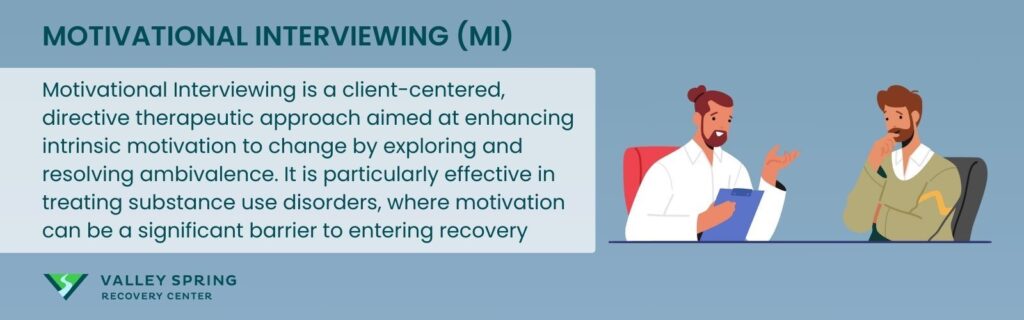
Motivational Interviewing (MI) is a counseling method designed to enhance a person’s internal motivation to change behavior. It works by exploring and resolving ambivalence, focusing on the client’s reasons for change rather than imposing external pressure. MI is collaborative, with the therapist and client working together in a supportive, compassionate atmosphere. Key techniques include expressing empathy through reflective listening, developing discrepancy between current behaviors and goals, rolling with resistance, and supporting self-efficacy.
MI has proven effective in addiction treatment, healthcare, and counseling, especially for clients struggling with ambivalence. MI empowers individuals to make meaningful, lasting changes by emphasizing personal values and goals. This makes it a practical, goal-oriented approach for fostering internal motivation.
What Are The Types of Motivational Interviewing?
The types of Motivational Interviewing (MI) include the Directive/Client-Centered Approach, Elicit-Provide-Elicit Technique, and the Decisional Balance. Motivational Interviewing (MI) aims to strengthen a client’s motivation for change while respecting their autonomy. These methods allow therapists to adapt MI techniques to the unique needs of each individual, making the process more effective in addressing ambivalence and supporting long-term recovery.

Here are the types of Motivational Interviewing (MI):
Directive/Client-Centered Approach
This approach combines gentle guidance with a focus on the client’s own perspective and experiences. The therapist helps clients explore their ambivalence toward change and supports them in identifying personal goals. It is particularly effective in addiction treatment. It creates a safe and supportive environment where individuals feel understood and encouraged to move toward recovery.
Elicit-Provide-Elicit Technique
This technique begins with eliciting the client’s knowledge and views. It further provides new information when needed and elicits the client’s reaction. It ensures the client remains an active participant in the process, respecting their autonomy and perspective. By engaging the client in this cycle, practitioners encourage deeper reflection and foster motivation to make informed, self-directed changes.
Decisional Balance
The decisional balance approach involves exploring the pros and cons of both current behaviors and potential changes. It helps clients clarify their values, priorities, and long-term goals by weighing benefits against drawbacks. This technique is especially useful for those struggling with ambivalence, as it makes the costs of harmful behaviors and the benefits of change more concrete and motivating.
By weighing the positive and negative aspects, clients gain a clearer perspective on their motivation for change. Each type of MI is designed to engage the client’s own motivation for change, addressing ambivalence and enhancing self-efficacy.
What Are The Core Elements of Motivational Interviewing (MI)?
The core elements of Motivational Interviewing (MI) include foundational principles, skills, and processes that guide how practitioners engage with clients. These elements emphasize collaboration, respect, and evoking motivation for change, making MI both empathetic and effective. Together, they provide a framework that can be applied across diverse settings and populations.
Here are some core elements of MI;
Spirit of MI
The spirit of MI reflects the way practitioners connect with clients. It is built on partnership, evocation, acceptance, and compassion. Partnership includes working collaboratively while respecting the client’s expertise, while evocation draws out the client’s own reasons for change. Acceptance involves offering empathy, affirming strengths, and honoring autonomy, and compassion includes prioritizing the client’s well-being. These principles create a supportive environment that fosters trust and openness.
Core Skills (OARS)
MI relies on four core communication skills known as OARS:
- Open Questions: Invite clients to share experiences and perspectives, encouraging reflection.
- Affirmations: Highlight strengths and past successes to build confidence in change.
- Reflections: Mirror the client’s words and feelings to show empathy and deepen understanding.
- Summarizing: Bring together key points to reinforce progress and shared understanding.
Attending to the Language of Change
Language plays a central role in MI. Practitioners distinguish between change talk (supporting movement toward change) and sustain talk (favoring the status quo). They guide conversations to encourage more change talk while respecting ambivalence. Information is shared through a two-way exchange, recognizing both the client’s lived experience and the practitioner’s expertise.
Four Fundamental Processes
MI follows four key processes: engaging (building a strong, respectful relationship), focusing (agreeing on shared goals), evoking (eliciting the client’s own motivations for change), and planning (helping the client design a practical plan). These stages ensure that change emerges from the client’s own readiness and commitment.
MI as a Communication Method
MI functions as a communication method that blends easily with other treatments. It has proven effective in healthcare, addiction recovery, corrections, education, and mental health across different ages, cultures, and delivery formats, including individual sessions, groups, and telemedicine. This versatility makes MI a widely applicable and impactful tool for fostering meaningful change.
What Are The Benefits Of Motivational Interviewing?
The benefits of Motivational Interviewing (MI) include its ability to engage clients, enhance motivation, and promote lasting behavioral change. MI offers flexibility, cultural sensitivity, and practical tools as a client-centered and evidence-based approach. It empowers individuals while strengthening the therapeutic relationship. Its effectiveness makes it valuable across diverse settings and populations.
Here are the benefits of MI;
- Enhanced Client Engagement: Builds trust through collaboration and respect for client autonomy.
- Increased Motivation and Commitment: Encourages clients to voice their own reasons for change, reducing ambivalence.
- Improved Treatment Outcomes: Demonstrates effectiveness in addiction, mental health, and chronic care with lasting results.
- Flexibility and Adaptability: Works across multiple fields, populations, and alongside other therapies.
- Empathy and Understanding: Uses empathic listening and a nonjudgmental stance to create a safe space for clients.
- Empowerment and Self-Efficacy: Strengthens confidence by affirming personal values, strengths, and goals.
- Observable Practice Behaviors: Provides measurable techniques that support ongoing practitioner development.
- Cultural Sensitivity: Respects diversity and integrates clients’ cultural values into the process.
- Practical and Intuitive: Offers simple, common-sense principles that are easy to apply in practice.
- Positive Research Findings: Backed by a broad evidence base proving its success in fostering change.
What Are The Downsides and Limitations of Motivational Interviewing (MI)?
The downsides and limitations of Motivational Interviewing (MI) include challenges related to training, applicability, and practitioner readiness. While MI is widely effective, its success depends heavily on practitioner skill, client readiness, and context. Understanding these limitations helps in deciding when MI is the right approach and where alternative methods are more suitable.
Here are some downsides and limitations of motivational interviewing;
- Time-Intensive Training: Mastering MI requires extensive learning, practice, and ongoing feedback.
- Complex Skill Set: The full framework is difficult to apply effectively without advanced training.
- Variable Effectiveness: Outcomes depend on practitioner skill and vary across clients.
- Limited Applicability: Less suitable for severe mental health issues, cognitive impairments, or acute crises.
- Resistance from Practitioners: Some find the collaborative style incompatible with their professional habits.
- Initial Costs: Training and supervision expenses are high for individuals and organizations.
- Dependence on Client’s Readiness: Progress stalls if clients are highly resistant or ambivalent.
- Measurement Challenges: Success relies on subjective outcomes, making evaluation difficult.
What Is The Effectiveness of Motivational Interviewing?
The effectiveness of Motivational Interviewing (MI) is well-documented across various settings, particularly in addiction treatment, health behavior changes, and chronic condition management. Its client-centered, empathetic approach significantly increases the likelihood of positive behavioral change.
Below is a detailed table showcasing the effectiveness of MI in different contexts:
| Context | Effectiveness Measure | Source of Data |
|---|---|---|
| Substance Abuse | Reduction in substance use by up to 25% | Cochrane Database of Systematic Reviews, 2018 |
| Reducing Alcohol Consumption | 20% increase in clients maintaining sobriety over 6 months | Journal of Consulting and Clinical Psychology, 2019 |
| Enhancing Drug Abstinence Rates | 35% improvement in abstinence rates at 1-year follow-up | Addiction Science & Clinical Practice, 2020 |
| Behavioral Change for Chronic Conditions | 30% of patients showed improved adherence to treatment plans | Patient Education and Counseling, 2021 |
| Improving Diet and Exercise | 40% of participants adopted healthier diet and exercise routines | American Journal of Lifestyle Medicine, 2022 |
| Managing Diabetes and Hypertension | 25% better management and outcomes in diabetic and hypertensive patients | Diabetes Care, 2023 |
In Substance Abuse
MI has been a cornerstone in substance abuse treatment, offering a supportive and empathetic methodology that encourages recovery and change. For instance, a systematic review in the Cochrane Database of Systematic Reviews (2018) found that MI contributed to a significant reduction in substance use among adults.
Reducing Alcohol Consumption
Research in the Journal of Consulting and Clinical Psychology (2019) highlighted MI’s success in reducing alcohol consumption, with a notable 20% increase in clients maintaining sobriety over six months.
Enhancing Drug Abstinence Rates
A study published in Addiction Science & Clinical Practice (2020) demonstrated MI’s efficacy in enhancing drug abstinence rates, showing a 35% improvement at a 1-year follow-up.
In Behavioral Change for Chronic Conditions
MI’s application extends beyond addiction, proving instrumental in behavioral changes for chronic conditions. According to Patient Education and Counseling (2021), 30% of patients showed improved adherence to treatment plans.
Improving Diet and Exercise
The American Journal of Lifestyle Medicine (2022) reported that MI effectively motivated 40% of participants to adopt healthier diets and exercise routines, showcasing its benefit in fostering durable commitments to healthier living practices.
Managing Diabetes and Hypertension
Diabetes Care (2023) highlighted MI’s considerable effectiveness in the management of diabetes and hypertension, with 25% better management and outcomes reported in patients. This detailed breakdown underscores MI’s versatile and effective role in promoting well-being and self-efficacy, highlighting its critical importance in contemporary therapeutic practices.
How is Motivational Interviewing applied in Addiction Treatment?
Motivational Interviewing is applied in addiction treatment through a client-centered approach that addresses the complexities of substance use and behavioral change. It provides a structured yet empathetic method to resolve ambivalence, strengthen internal motivation, and guide individuals toward recovery.
MI fosters collaboration and empowers clients to identify their own reasons for change. MI becomes a highly effective tool in supporting lasting sobriety and healthier life choices.
| Step in Application | Description | Specific Example |
|---|---|---|
| Building Motivation for Change | MI lays the groundwork by fostering an environment where individuals feel empowered to initiate change. | A practitioner uses open-ended questions to help a client articulate their desire to quit smoking, highlighting personal health and family as key motivators. |
| Exploring Personal Reasons for Change | Encourages clients to delve into their own motivations for wanting to overcome addiction. | In a session, a client identifies their children’s future and their role as a parent as a primary reason for seeking sobriety. |
| Resolving Ambivalence | Addresses ambivalence, often a significant hurdle in the path to recovery. | Through reflective listening, a therapist helps a client navigate mixed feelings about giving up alcohol, emphasizing the discrepancy between current behavior and future goals. |
| Strengthening Commitment to Change | Systematically reinforcing the client’s resolve to enhance the likelihood of sustained commitment to recovery. | After identifying a client’s reasons for change, the therapist asks for a commitment to a small, achievable goal, such as attending a support group meeting. |
| Setting Goals | Collaborative goal setting to establish clear, attainable objectives that guide the recovery process. | A therapist and client use a SMART goals framework to set a 30-day abstinence goal, with specific, measurable, achievable, relevant, and time-bound criteria. |
| Developing a Plan of Action | Formulating a concrete plan of action provides a structured approach to achieving recovery milestones. | The plan includes daily check-ins with a peer support partner, weekly therapy sessions, and strategies to manage cravings. |
| Addressing Ambivalence and Reflective Listening | Utilizes techniques like reflective listening to ensure clients feel genuinely heard and understood. | A therapist reflects a client’s statement, “I know I should quit, but I don’t think I can,” with, “It sounds like you recognize the importance of quitting, yet you doubt your ability to do so.” |
| Summarizing Client’s Dilemmas | Summarization helps to clarify and reinforce the client’s own arguments for change. | At the end of a session, the therapist summarizes the client’s expressed desires to change, their fears, and the discussed plan, reinforcing the client’s commitment. |
This detailed approach to Motivational Interviewing addresses the immediate challenges associated with substance use disorder, like alcohol use disorder. It also cultivates a supportive environment conducive to long-term recovery and well-being. Through these specific examples and methodologies, the application of MI in addiction treatment is demonstrated to be both strategic and empathetic, offering a clear pathway towards positive behavioral change.
Share This Post

Valley Spring Editorial Team
All author posts
Our Therapuetic Recovery Programs
Are you covered for treatment?




Valley Spring Recovery Center is an approved provider for Blue Shield of California and Cigna, while also accepting many other major insurance carriers.
Check Coverage Now!