


Clinical guide
Does Suboxone Make You High?
Suboxone combines buprenorphine and naloxone to ease opioid withdrawal: its mechanism and whether the medication produces a high.
By Paul James Roeser·Reviewed by Noelle Mathew, LCSW, LCADC, CASAC-M·10 min read
Published ·Updated
Suboxone is a sublingual film prescribed for opioid use disorder, and buprenorphine, the opioid inside it, is a partial agonist, which is why the question of euphoria attaches to Suboxone at all.
Treitler, Nowels, Samples and Crystal (2023), "Buprenorphine Utilization and Prescribing Among New Jersey Medicaid Beneficiaries After Adoption of Initiatives Designed to Improve Treatment Access", JAMA Network Open 6(5):e2312030, measured buprenorphine receipt among New Jersey Medicaid beneficiaries with opioid use disorder rising from 1.29 to 1.76 prescriptions per 1000 beneficiaries per month after the state's April 2019 Medicaid reforms, a 36 percent increase in the monthly rate.
What Is Suboxone?
Suboxone is a fixed-dose combination of buprenorphine and naloxone that treats opioid use disorder by suppressing withdrawal and craving. Sublingual administration lets buprenorphine partially activate mu-opioid receptors, which reduces withdrawal discomfort without producing a full opioid effect. Naloxone stays largely inactive when the film dissolves under the tongue and becomes systemically active on injection. The FDA classifies Suboxone as Schedule III, indicating moderate abuse potential.
Does Suboxone Get You High?
No, Suboxone does not get you high. Suboxone taken as prescribed relieves withdrawal and craving, which is a therapeutic effect rather than intoxication.
The agonist ceiling, the plateau at which added milligrams add receptor occupancy and no further subjective effect, limits respiratory depression relative to full agonist opioids, meaning a fall in respiratory rate and tidal volume.
Why Do Some People Feel High On Suboxone?
Suboxone produces mild euphoria in an opioid-naive person, because buprenorphine's partial agonism activates mu-opioid receptors that have never adapted to an opioid and therefore respond fully to submaximal signaling. Opioid-naive names the absence of tolerance, the reduced effect a fixed dose produces after repeated exposure.
Injection triggers precipitated withdrawal, the abrupt withdrawal that follows when an antagonist displaces an opioid already seated on the receptor. Nausea and drowsiness follow receptor activation in a person with no opioid tolerance, and repeated use without a prescription produces dependence on buprenorphine itself.
How Many Opioid Receptors Does Suboxone Occupy?
Sublingual buprenorphine leaves 9 to 20 percent of mu-opioid receptors available at 16 mg and 2 to 12 percent at 32 mg, measured by PET imaging 4 hours post-dose, the range that blunts euphoria from typical doses of abused opioids. Greenwald, Johanson, Moody and colleagues (2003), "Effects of buprenorphine maintenance dose on mu-opioid receptor availability, plasma concentrations, and antagonist blockade in heroin-dependent volunteers", Neuropsychopharmacology 28(11):2000-9, produced those scans with the tracer [11C]carfentanil. Greenwald, Comer and Fiellin (2014), "Buprenorphine maintenance and mu-opioid receptor availability in the treatment of opioid use disorder", Drug and Alcohol Dependence 144:1-11, review that imaging and attach the clinical thresholds to it.
Greenwald and colleagues scanned four daily dose conditions in 2003: 0 mg, 2 mg, 16 mg and 32 mg. Receptor availability across the four sublingual doses a person in treatment encounters runs as follows.
- 2 mg: leaves 53 to 72 percent of mu-opioid receptors available, sitting above the 50 percent threshold for withdrawal suppression.
- 8 mg: leaves 36 to 55 percent available, a figure Greenwald, Comer and Fiellin estimated from curve fits rather than from a scanned dose arm.
- 16 mg: leaves 9 to 20 percent available, straddling the 20 percent blockade threshold.
- 32 mg: leaves 2 to 12 percent available, the deepest blockade in the scanned series.
Two clinical thresholds sit inside those numbers, both set by Greenwald, Comer and Fiellin (2014). Withdrawal suppression requires 50 percent receptor availability or less, pairs with a buprenorphine trough plasma concentration at or above 1 ng/mL, and arrives for most patients on a single daily dose of 4 mg. Blockade of the reinforcing and subjective effects of typical doses of abused opioids requires under 20 percent availability, paired with a trough concentration at or above 3 ng/mL. Greenwald, Comer and Fiellin conclude that most individuals reach blockade on single daily doses above 16 mg or on lower divided doses.
Deep receptor occupancy lowers the reinforcing effect of an added opioid without making that combination safe. The Suboxone label warns that taking buprenorphine alongside benzodiazepines or other central nervous system depressants risks profound sedation, respiratory depression, coma and death.
Buprenorphine's partial agonism at the mu receptor produces the ceiling, not the naloxone. That same label records that in opioid-experienced subjects who were not physically dependent, acute sublingual doses of buprenorphine and naloxone tablets produced agonist effects reaching a maximum between 8 mg/2 mg and 16 mg/4 mg, so increases past that band add receptor occupancy without adding euphoria. Methadone is a full agonist and carries no such ceiling, a difference Comparing Suboxone and Methadone sets out. Naloxone on its own reverses an opioid overdose rather than capping a high, a separate use explained in Naloxone usages in addiction.
What Are The Effects Of Suboxone On Opioids?
Suboxone affects other opioids by blocking their euphoria, suppressing craving, and precipitating withdrawal in a person who is opioid dependent. Buprenorphine occupies the mu-opioid receptors that heroin, oxycodone and fentanyl would otherwise reach.
Mattick, Breen, Kimber and Davoli (2014), "Buprenorphine maintenance versus placebo or methadone maintenance for opioid dependence", Cochrane Database of Systematic Reviews 2014(2):CD002207, pooled 5 trials with 1,001 participants and found buprenorphine at 16 mg or more retained people in treatment better than placebo, with a risk ratio of 1.82 and a 95 percent confidence interval of 1.15 to 2.90.
What Happens If You Take Suboxone Without A Prescription In NJ?
Possession of Suboxone without a prescription in New Jersey carries a third-degree criminal charge, the medical risk of unsupervised dosing, and exposure to an unverified illicit supply.
The three consequences of possessing Suboxone without a prescription in New Jersey are:
- Legal penalties: N.J.S.A. 2C:35-10(a)(1) makes possession of a Schedule III controlled dangerous substance without a valid prescription a crime of the third degree, carrying 3 to 5 years and a fine of up to $35,000. That conviction records a felony that follows a person into employment and housing applications.
- Health dangers: Unsupervised use removes the dose adjustment a prescriber makes against a person's tolerance, and abrupt discontinuation produces withdrawal.
- Street-related risks: Suboxone bought outside a pharmacy carries an unverified formulation and an unverified dose.
Is Suboxone A Safe Treatment For Opioid Addiction?
Yes, Suboxone is a safe treatment for opioid addiction. Safety here means a lower overdose risk than a full agonist carries and a documented adverse event profile, not an absence of risk.
The American Society of Addiction Medicine's National Practice Guideline for the Treatment of Opioid Use Disorder, 2020 focused update, names buprenorphine one of three recommended medications for opioid use disorder alongside methadone and naltrexone, and directs clinicians to choose among them on patient preference, past treatment history, current state of illness and treatment setting.
How Long Do The Effects Of Suboxone Last?
Suboxone's effects last 24 to 36 hours at a therapeutic dose. Onset occurs within 30 to 60 minutes as buprenorphine begins activating mu-opioid receptors, and peak effects arrive at 1 to 4 hours.
Onset still begins in 30 to 60 minutes under misuse. Crushing or injecting the film changes the absorption route rather than intensifying a peak. Buprenorphine's mean elimination half-life of 24 to 42 hours, recorded in the Suboxone label, is what carries effects past the 36 hour mark.
How To Prevent Suboxone Misuse?
Three controls prevent Suboxone misuse: prescribing guidelines, drug monitoring, and MAT program safeguards. These controls reduce diversion, the transfer of a prescribed medication to a person for whom it was not prescribed.
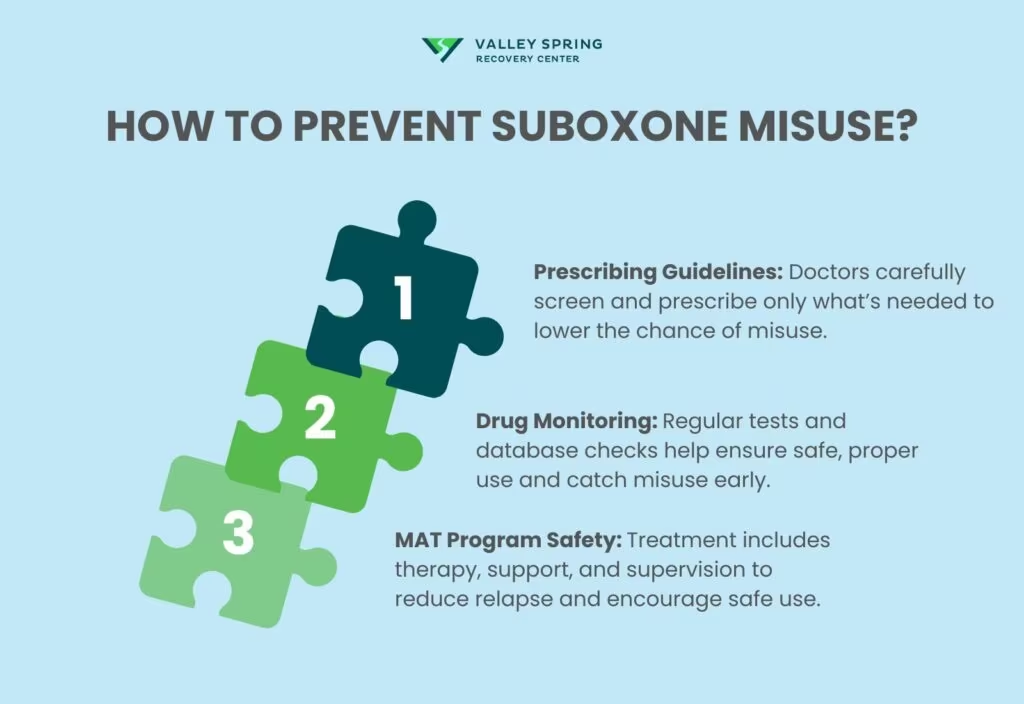
The three ways to prevent Suboxone misuse are:
- Prescribing guidelines: Providers follow strict criteria before initiating Suboxone, ensuring you meet opioid use disorder diagnosis requirements. They prescribe the lowest effective dose and adjust over time based on your response. This approach limits the surplus supply available for diversion.
- Drug monitoring: You submit to regular urine screenings and prescription database checks to confirm adherence. These checks detect diversion early and allow intervention when patterns of misuse emerge.
- MAT program safeguards: You enroll in a medication-assisted treatment (MAT) program that integrates counseling, peer support, and medical supervision. A MAT program pairs the prescription with behavioral treatment, which is the treatment setting the ASAM guideline above directs clinicians to weigh.
Where Can You Get Suboxone Treatment In New Jersey?
Suboxone treatment in New Jersey comes from community health centers, hospital-based clinics, and telehealth providers. Each of these three settings prescribes buprenorphine under the same federal authority. Section 1262 of the Consolidated Appropriations Act, 2023 removed the DATA-Waiver requirement, so any clinician holding a DEA registration with Schedule III authority treats opioid use disorder with Suboxone and faces no federal patient cap, if state law permits.

The three settings that prescribe Suboxone in New Jersey are:
- Community health centers: You can find federally qualified health centers offering sliding-scale fees and integrated care. Staff provide medication management, counseling, and peer support under one roof, as Valley Spring Recovery Center does through medication assisted treatment. Sliding-scale billing keeps buprenorphine reachable without private insurance.
- Hospital-based clinics: You visit outpatient clinics affiliated with hospitals, where an intensive outpatient program combines medical oversight with therapy and peer groups. These clinics coordinate care between addiction specialists and your primary care provider.
- Telehealth providers: You connect with licensed prescribers online for medication management and virtual counseling sessions. You complete initial assessments, receive prescriptions, and attend follow-ups without traveling.
What Are The Most Common Side Effects Of Suboxone?
The Suboxone prescribing information records 12 adverse events commonly observed with sublingual and buccal use of the film: oral hypoesthesia, glossodynia, oral mucosal erythema, headache, nausea, vomiting, hyperhidrosis, constipation, withdrawal signs and symptoms, insomnia, pain and peripheral edema.
Three of those 12 name the mouth, because the film dissolves there rather than in the stomach: oral hypoesthesia is numbness of the mouth lining, glossodynia is tongue pain, and oral mucosal erythema is reddening of that lining. Hyperhidrosis is sweating beyond what ambient temperature requires. The label records insomnia rather than somnolence, so wakefulness rather than drowsiness is its documented sleep effect.
The FDA required a dental warning on every buprenorphine medicine dissolved in the mouth on January 12, 2022, after its drug safety communication counted 305 reported cases of dental problems, 131 of them serious and 26 in people with no prior dental history. Tooth decay, cavities, oral infection and tooth loss are the named risks, and the label's mitigation is a sip of water swished around the teeth and gums once the film has dissolved, then an hour before brushing.
How Long Does Suboxone Block Opiates?
A single 16 mg dose of Suboxone blunts an added opioid for roughly 28 hours, the point at which measured mu-opioid receptor availability has climbed back from 30 percent to 54 percent and blockade of a hydromorphone challenge starts to weaken. Blockade measures how long buprenorphine keeps another opioid from producing an effect, which is not the 24 to 36 hour therapeutic window, and that window measures freedom from withdrawal and craving.
Greenwald, Johanson, Bueller and colleagues (2007), "Buprenorphine duration of action: mu-opioid receptor availability and pharmacokinetic and behavioral indices", Biological Psychiatry 61(1):101-110, scanned 10 volunteers with heroin dependence at 4, 28, 52 and 76 hours after a 16 mg daily dose was withheld. Whole-brain receptor availability measured 30, 54, 67 and 82 percent across those four time points, and the subjective effects of a hydromorphone challenge were significantly less attenuated at 52 and 76 hours.
Overdose risk rises as buprenorphine clears, because a full agonist dose that produced nothing under blockade produces its whole effect once receptor availability has recovered.