Drug Tolerance: Definition, Causes, Signs & Symptoms, Risks, Treatment
Drug tolerance is a physiological adaptation in which the body becomes less responsive to a drug’s effects after repeated exposure, necessitating higher doses to achieve the same result. Drug tolerance develops through complex pharmacokinetic, pharmacodynamic, and behavioral mechanisms that alter drug metabolism, receptor sensitivity, and brain chemistry.
The body’s adaptation to a certain drug reduces its therapeutic benefit, increases dependence risk, and elevates overdose potential if unmanaged. According to the National Survey on Drug Use and Health (NSDUH, 2022), about 3.1% of U.S. adults aged 12 or older misused prescription pain relievers in the past year, a key driver of tolerance and dependence.
The clinical teams at professional drug rehabs in New Jersey address drug tolerance through medical monitoring, behavioral therapy, and individualized treatment planning to restore balanced neurochemical function and prevent progression to addiction. Understanding drug tolerance helps patients and providers manage medication efficacy safely and support long-term recovery outcomes.
What Is Drug Tolerance?
Drug tolerance is the process by which a patient’s response to a given dose of a drug diminishes over time. A person with a tolerance to a specific drug requires higher doses to achieve the same effect.
The body adapts to repeated exposure to the drug, altering its pharmacologic responses. Data from the 2022 National Survey on Drug Use and Health (NSDUH) showed that 3.1% of people aged 12 or older in the U.S. misused prescription pain relievers in the past year, resulting in drug tolerance.
Drug tolerance develops when the body undergoes neurobiological and metabolic adaptations that reduce the drug’s effectiveness over time, as studied by Altman et al. (1996. These changes alter how the brain’s receptors respond or how the liver metabolizes the substance, eventually requiring higher doses and increasing the risk of overdose and addiction.
Did you know most health insurance plans cover substance use disorder treatment? Check your coverage online now.
What Are the Different Types of Drug Tolerance?
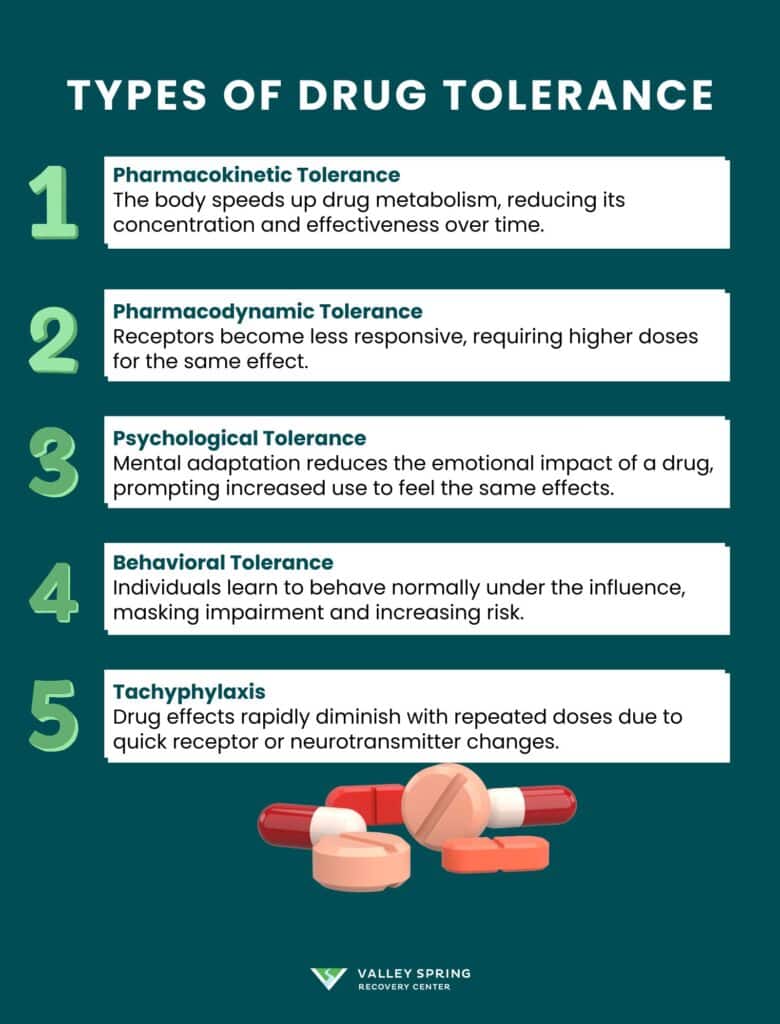
The main types of drug tolerance include Pharmacokinetic tolerance, Pharmacodynamic tolerance, and Tachyphylaxis. These types of drug tolerance are classified based on physiological, psychological, and behavioral adaptations that alter how the body and brain respond to repeated drug exposure.
The main types of drug tolerance are as follows:
- Pharmacokinetic tolerance: Pharmacokinetic tolerance occurs when the body accelerates the metabolism or clearance of a drug, lowering its concentration at the receptor site and diminishing its effect. Studies published in Frontiers in Pharmacology (2022) suggest that repeated drug exposure stimulates enzyme activity in the liver, leading to faster drug elimination and reduced potency.
- Pharmacodynamic tolerance: This form of drug tolerance develops when receptors or neural signal pathways become less sensitive to a drug’s presence. According to Osmosis (2023), chronic exposure alters receptor density or function, requiring higher doses to achieve the same therapeutic outcome.
- Psychological tolerance: Psychological tolerance occurs when mental or emotional responses to a drug weaken over time, driving individuals to use more to reach the initial level of euphoria or calm. It reflects the brain’s learned adaptation to altered neurotransmitter activity.
- Behavioral tolerance: This type of drug tolerance happens when a person learns to function under the influence, appearing less impaired despite equivalent drug levels in the body. Such learned adjustments mask true intoxication, raising the risk of unsafe behaviors and dependence.
- Tachyphylaxis: Tachyphylaxis is a rapid-onset form of tolerance in which drug effects decline sharply with successive doses or continuous exposure. AccessAnesthesiology (2022) identifies tachyphylaxis as a pharmacologic phenomenon resulting from receptor desensitization or neurotransmitter depletion.
What Are the Important Facts About Drug Tolerance?
The important facts about drug tolerance highlight how repeated drug exposure alters the body’s pharmacological and behavioral response over time.
Key statistics and facts about drug tolerance are as follows:
- Tolerance can develop with nearly any substance. Both prescription medications and recreational drugs trigger tolerance when used repeatedly. According to Healthline (2023), this adaptation occurs with opioids, benzodiazepines, alcohol, and even caffeine, as the body adjusts to sustained chemical exposure.
- ADHD medications frequently show tolerance development. A PubMed Central (PMC, 2021) analysis found that approximately 24.7% of patients on stimulant therapy such as Adderall or Ritalin developed measurable tolerance within several weeks, and up to 66% experienced reduced clinical benefit over long-term use.
- Cross-tolerance extends effects between related drugs. Healthline (2023) reports that tolerance to one drug, such as morphine, produces tolerance to another drug from the same pharmacologic class, like codeine, because of shared receptor activity in the brain.
- Tolerance increases the risk of dependence but is not addiction itself. A study by Szalavitz, M, Rigg, KK, Wakeman, SE. et al. 2021, titled “Drug dependence is not addiction-and it matters,” clarifies that while tolerance means the body needs more of a drug for the same result, addiction involves compulsive use and loss of control. However, both conditions overlap and heighten overdose risk.
- Ongoing medical supervision is crucial for managing tolerance. Vadivelu N, et al. 2014, in their study titled “Practical guide to the management of acute and chronic pain in the presence of drug tolerance for the healthcare practitioner,” emphasize that clinicians regularly reassess dosage levels, introduce drug holidays, or rotate medications to maintain therapeutic efficacy while minimizing adverse outcomes and dependence.
What Are the Causes of Drug Tolerance?
The main causes of drug tolerance include biological, behavioral, and genetic mechanisms that collectively reduce drug effectiveness over time.
Repeated drug exposure activates the body’s metabolic enzyme systems, particularly the cytochrome P450 (CYP450) family, which accelerates drug metabolism and clearance, resulting in lower plasma concentrations. This pharmacokinetic adaptation causes diminished drug availability at receptor sites.
At the cellular level, receptor desensitization and downregulation occur when continuous stimulation leads neurons to reduce receptor sensitivity or number. This pharmacodynamic shift weakens the body’s response to the same dosage, necessitating increased doses to achieve the original effect.
Behavioral adaptations also contribute. Individuals learn compensatory behaviors, such as functioning normally under intoxication, masking drug effects, and promoting higher use.
Lastly, genetic predisposition influences the rate at which tolerance develops. A study by Dumas EO and Pollack GM (2014), titled “Opioid Tolerance Development: A Pharmacokinetic/Pharmacodynamic Perspective,” found that genetic variations in receptor genes and metabolic enzymes determine individual susceptibility to tolerance.
Contact us today to schedule an initial assessment or to learn more about our services. Whether you are seeking intensive outpatient care or simply need guidance on your drug addiction journey, we are here to help.
What Are the Signs and Symptoms of Drug Tolerance?
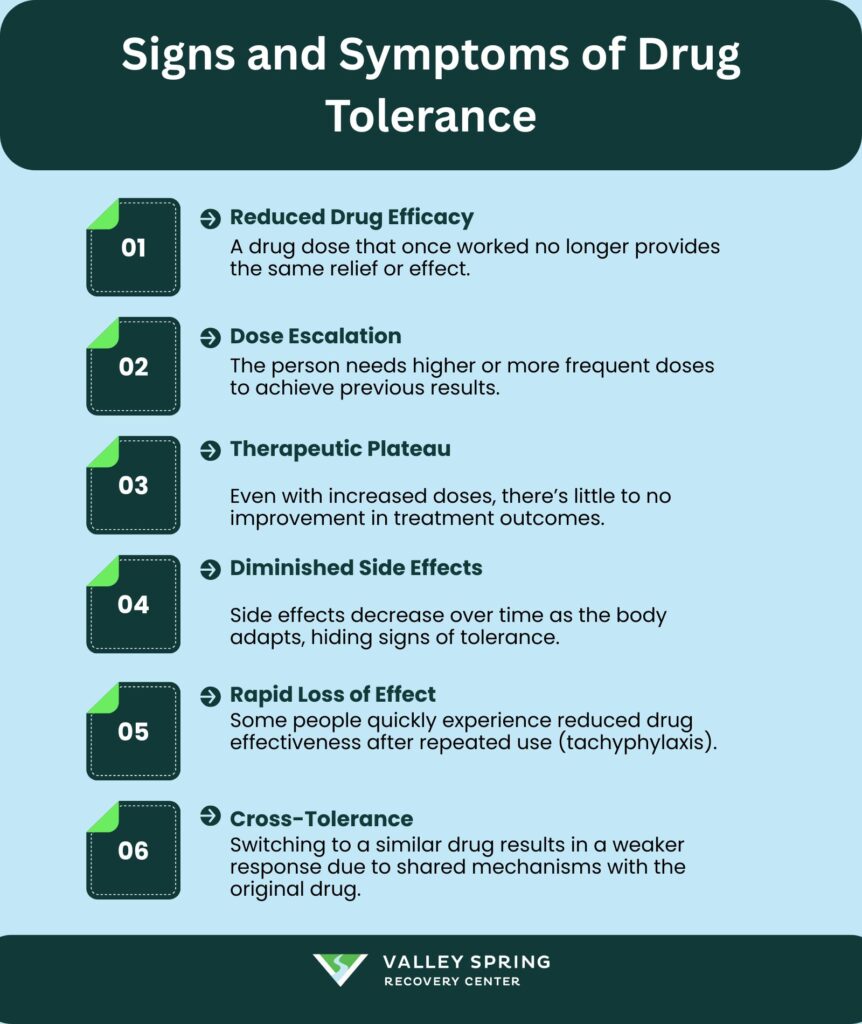
The common signs and symptoms of drug tolerance are reduced drug efficacy, dose escalation, and therapeutic plateau. These signs and symptoms of drug tolerance reflect the body’s adaptation to repeated drug exposure, resulting in diminished effectiveness of the same dosage. These changes occur gradually and are observed both clinically and behaviorally.
The following are the signs and symptoms of drug tolerance:
- Reduced drug efficacy: A previously effective dose no longer produces the same therapeutic or euphoric effect, indicating receptor or metabolic adaptation.
- Dose escalation: Individuals need to increase the dosage or frequency of administration to achieve the same symptom relief or desired effect as before.
- Diminished side effects: In some cases, side effects lessen over time as the body adjusts to the drug, masking the warning signs of physiological adaptation.
- Therapeutic plateau: Despite higher doses, patients experience stagnation in clinical improvement, signaling the development of pharmacodynamic tolerance.
- Rapid loss of effect: Some individuals experience an early onset of reduced efficacy shortly after repeated use, a hallmark of tachyphylaxis.
- Cross-tolerance manifestation: When switching to a related drug class, users notice a weaker response due to shared receptor pathways or similar mechanisms of action.
What Are the Risks of Drug Tolerance?
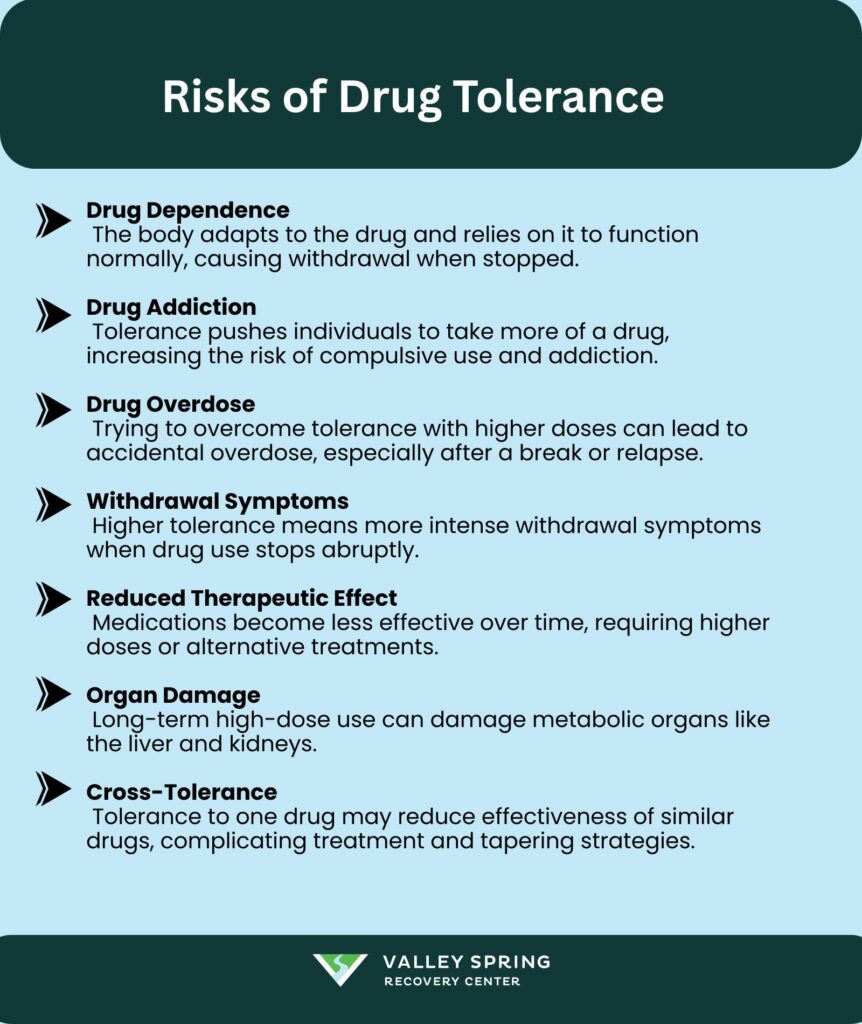
The common risks of drug tolerance include drug dependence, drug addiction, drug overdose, and withdrawal symptoms. These risks of drug tolerance involve the progressive adaptation of the body to the drug’s effects, resulting in increased vulnerability to dependence, addiction, and overdose.
The risks of drug tolerance are as follows:
Drug Dependence
Drug dependence occurs when the body physiologically adapts to the continued presence of a substance, leading to withdrawal symptoms upon cessation. According to the National Institute on Drug Abuse (NIDA, 2022), tolerance and drug dependence are interlinked stages in the neuroadaptive process where homeostasis shifts toward requiring the drug for normal function.
Rediscover Life at Valley Spring Recovery Center
Get the compassionate support you deserve. We're here to help you reclaim joy, wellness, and a brighter future.
Verify Benefits
Drug Addiction
Drug addiction is a chronic relapsing disorder marked by compulsive drug seeking despite harmful consequences. Tolerance accelerates the transition to addiction by raising the dose threshold that activates reward pathways.
A longitudinal study by Koob and Volkow (2016) in Neuropsychopharmacology demonstrated that repeated high-dose exposure alters the mesolimbic dopamine system, reinforcing drug-taking behavior and reducing natural reward sensitivity.
Drug Overdose
The risk of overdose increases when individuals attempt to overcome tolerance by taking larger doses. As shown in CDC data (2023), the majority of opioid overdose fatalities involve patients who had developed tolerance but misjudged lethal thresholds after dose escalation or relapse.
Withdrawal Symptoms
Withdrawal symptoms become more severe with tolerance, as neurochemical balance depends on sustained drug input. When intake stops abruptly, symptoms such as anxiety, tremors, and nausea occur due to sudden neurotransmitter dysregulation (Mayo Clinic Proceedings, 2021).
Are you covered for treatment?


Valley Spring Recovery Center is an approved provider for Blue Cross Blue Shield and Cigna, while also accepting many other major insurance carriers.
Check Coverage Now!Reduced Therapeutic Effect
In medical treatments, tolerance lowers drug efficacy, forcing clinicians to adjust doses or switch medications. For example, chronic opioid therapy shows diminished analgesic response over time as studied by Ballantyne et al. (2019, complicating pain management and increasing risk of misuse.
Organ Damage
Continuous exposure to high doses of radiation taxes the metabolic organs. The liver and kidneys, responsible for drug metabolism and clearance, exhibit signs of enzyme induction and oxidative stress.
A study by Li et al. (2020) in Toxicology Reports found that repeated exposure to psychostimulants and opioids causes hepatocellular damage and renal impairment due to bioaccumulation.
Cross-Tolerance
Cross-tolerance occurs when tolerance to one drug extends to another within the same pharmacological class. For example, tolerance to morphine reduces response to other opioids such as oxycodone or fentanyl (Healthline, 2023).
Cross-tolerance complicates treatment, as switching medications does not always restore full therapeutic benefit.
Did you know most health insurance plans cover substance use disorder treatment? Check your coverage online now.
How Is Drug Tolerance Treated?
Drug tolerance is treated by dose adjustment, drug holidays, and behavioral therapy. Treatment of drug tolerance requires multi-modal strategies.
The following are the treatment options for drug tolerance:
- Dose adjustment: Dose adjustment involves modifying the amount or frequency of drug administration to reestablish therapeutic efficacy. Under medical supervision, clinicians gradually lower doses to reduce receptor desensitization or slightly increase them to regain control over symptoms. A study in Clinical Pharmacology & Therapeutics (2020) found that individualized dose recalibration slows tolerance progression by maintaining optimal plasma drug concentrations without overactivating metabolic enzymes.
- Drug holidays: Drug holidays are structured breaks in medication use that allow receptor systems to reset and recover. This practice helps reverse receptor downregulation and restore normal sensitivity, particularly in ADHD or Parkinson’s treatment contexts. According to Frontiers in Pharmacology (2022), periodic discontinuation helps normalize the activity of dopamine and serotonin receptors, thereby enhancing future drug responses.
- Switching medications: Switching to a different drug class or formulation targets alternate pathways or receptor subtypes, bypassing tolerance mechanisms. For instance, opioid rotation from morphine to methadone improves analgesic efficacy while lowering cumulative exposure, as studied by Pain Medicine, 2021. This approach ensures continued symptom management without dose escalation.
- Behavioral therapy: Behavioral therapy addresses psychological dependence and maladaptive coping patterns that reinforce tolerance-related drug use. Cognitive Behavioral Therapy (CBT) helps modify reward-related behavior and reduce reliance on pharmacologic interventions. The National Institute on Drug Abuse (NIDA, 2023) identifies CBT and motivational interviewing as evidence-based approaches that enhance self-regulation and reduce substance reinforcement.
- Medical supervision: Medical supervision ensures that adjustments to drug regimens occur safely and effectively. Clinicians track tolerance progression through patient feedback, biomarker analysis, and pharmacokinetic assessment. Under the FDA’s 2022 Clinical Guidance for Chronic Drug Therapy, continuous monitoring reduces overdose risk and prevents under- or over-medication.
- Lifestyle changes: Lifestyle modification enhances the body’s natural capacity to respond to medications. Adequate sleep, nutrition, exercise, and stress control improve neurochemical stability and metabolic efficiency. Research from Harvard Health (2021) indicates that physical activity increases dopamine receptor availability, which counteracts drug-induced desensitization.
- Detoxification: Detoxification involves a structured medical process to eliminate substances from the body while managing withdrawal symptoms. The goal is to restore homeostasis and reduce tolerance by gradually tapering use under the guidance of a professional. According to the Substance Abuse and Mental Health Services Administration (SAMHSA, 2023), medically supervised detox reduces relapse risk and stabilizes brain receptor function for post-detox therapy.
- Support programs: Support programs such as Narcotics Anonymous or SMART Recovery provide community-based reinforcement that lowers relapse rates. Peer accountability helps patients maintain abstinence during periods of adjustment or medication change. A Journal of Substance Abuse Treatment (2020) review found that participation in structured support networks improved long-term recovery outcomes by 35%.
What Is The Difference Between Drug Tolerance and Drug Addiction?
The main difference between drug tolerance and drug addiction lies in their physiological and behavioral mechanisms. Drug tolerance is the body’s adaptive response to repeated drug exposure that leads to a reduced pharmacological effect at the same dose. In contrast, addiction is a chronic neurobehavioral disorder marked by compulsive drug-seeking and continued use despite harmful consequences.
According to Healthline and the National Institute on Drug Abuse (NIDA, 2023), tolerance develops as the brain and body adjust to the presence of a substance, requiring higher doses for the same effect, but does not necessarily cause psychological craving or loss of control. Addiction, however, involves both tolerance and a dysfunctional reward system that drives compulsive behavior.
What Is the Difference Between Drug Tolerance and Drug Withdrawal?
The main difference between drug tolerance and drug withdrawal lies in physiological adaptation versus response to absence. Drug tolerance is the body’s reduced reaction to a drug after repeated exposure, resulting in the need for higher doses to achieve the same effect.
Drug withdrawal occurs when a drug-dependent individual suddenly stops use and experiences physical or psychological symptoms due to a neurochemical imbalance. According to NIDA (2023), tolerance exists without dependence, but withdrawal only follows physical dependence.
Contact us today to schedule an initial assessment or to learn more about our services. Whether you are seeking intensive outpatient care or simply need guidance on your drug addiction journey, we are here to help.
What Is the Difference Between Drug Tolerance and Drug Dependence?
The main difference between drug tolerance and drug dependence lies in physiological adaptation versus necessity. Drug tolerance is a pharmacological change reducing a drug’s effect over time, while drug dependence is a state where the body requires the drug to function normally, leading to withdrawal when discontinued.
As Healthline notes, dependence results from tolerance, but it also involves disruptions in biochemical homeostasis in the brain and other organ systems.
What Is the Difference Between Drug Tolerance and Reverse Tolerance?
The main difference between drug tolerance and reverse tolerance is the directionally opposite response. Drug tolerance leads to decreased sensitivity with repeated use, whereas reverse tolerance, also known as sensitization, involves increased sensitivity to the same dose over time.
Studies cited by Frontiers in Pharmacology (2020) show that reverse tolerance occurs with certain psychostimulants or alcohol after liver damage, leading to amplified drug effects.
What Is the Difference Between Drug Tolerance and Drug Tolerability?
The main difference between drug tolerance and drug tolerability concerns efficacy versus side-effect endurance. Drug tolerance refers to the diminished therapeutic response that occurs due to repeated dosing, whereas drug tolerability measures how well a patient can endure a drug’s side effects.
According to Clinical Pharmacology & Therapeutics (2019), tolerability affects adherence, while tolerance affects dose-response relationships.
Rediscover Life at Valley Spring Recovery Center
Get the compassionate support you deserve. We're here to help you reclaim joy, wellness, and a brighter future.
Verify BenefitsWhat Is the Difference Between Drug Tolerance and Drug Resistance?
The main difference between drug tolerance and drug resistance lies in the biological target. Drug tolerance occurs in humans when the nervous system adapts to a drug’s continuous presence.
Drug resistance occurs in microorganisms, viruses, or cancer cells that mutate or evolve to survive therapeutic agents. As the World Health Organization (WHO, 2022) explains, tolerance affects host pharmacodynamics, while resistance affects pathogen survivability.
What Is the Difference Between Drug Tolerance and Drug Intolerance?
The main difference between drug tolerance and drug intolerance lies in dose response versus side-effect sensitivity. Drug intolerance is an exaggerated adverse reaction to normal doses, while drug tolerance is a reduced response after repeated doses.
Mayo Clinic (2023) clarifies that intolerance reflects hypersensitivity or metabolic variation, whereas tolerance reflects adaptation and desensitization mechanisms.
Can drug tolerance be reversed?
Yes, drug tolerance sometimes can be reversed through strategies such as drug holidays, switching medications, or dose adjustment, allowing receptor systems to recover sensitivity.
Are you covered for treatment?
Valley Spring Recovery Center is an approved provider for Blue Cross Blue Shield and Cigna, while also accepting many other major insurance carriers.
Check Coverage Now!Can drug tolerance be genetic?
Yes, tolerance can be genetic. Genetic factors such as enzyme polymorphisms and receptor variants influence how quickly and severely tolerance develops in different individuals.
Does drug tolerance lead to dependence?
Yes, drug tolerance may increase the risk of dependence because higher doses and longer use predispose the body to adaptation; however, tolerance alone does not guarantee dependence.
What is a drug tolerance test?
A drug tolerance test is a clinical or laboratory assessment of how a patient’s response to a drug changes over time, involving measurement of dose–response curves, biomarkers, or clinical endpoints to gauge reduced drug sensitivity.
Share This Post

Valley Spring Editorial Team
All author posts
Our Therapuetic Recovery Programs
Are you covered for treatment?





Valley Spring Recovery Center is an approved provider for Blue Shield of California and Cigna, while also accepting many other major insurance carriers.
Check Coverage Now!