New Jersey Population & Demographics: Effect on Urban Vs. Rural Rehab Centers Distribution and Access
New Jersey’s population reached approximately 9.5 million in 2024, reinforcing its status as the most densely populated state in the U.S. The distribution and accessibility of rehabilitation centers in New Jersey are closely tied to the state’s population density and geographic makeup. Urban regions are better served, while rural communities often lack adequate facilities and face logistical and financial barriers to care.
Key takeaways on the impact of New Jersey’s population and demographics on rehab center distribution:
- Urban areas concentrate most of New Jersey’s population.
- Urban counties have greater access to addiction treatment centers.
- Rural areas face limited access to rehab due to fewer facilities.
- Transportation barriers worsen treatment access in rural zones.
- Rural regions experience addiction provider shortages.
- Stigma and financial constraints further affect rural treatment rates.
- Addressing rural disparities is critical to achieving statewide treatment equity.
Population Distribution and Demographics of New Jersey
The population distribution and demographics of New Jersey reveal a state characterized by significant urban concentration and notable diversity. As of July 1, 2024, New Jersey’s population was estimated at 9,500,851, reflecting a 2.3% increase since April 2020. This growth underscores New Jersey’s status as the most densely populated state in the U.S., with approximately 1,263 residents per square mile, as reported by Census.gov.
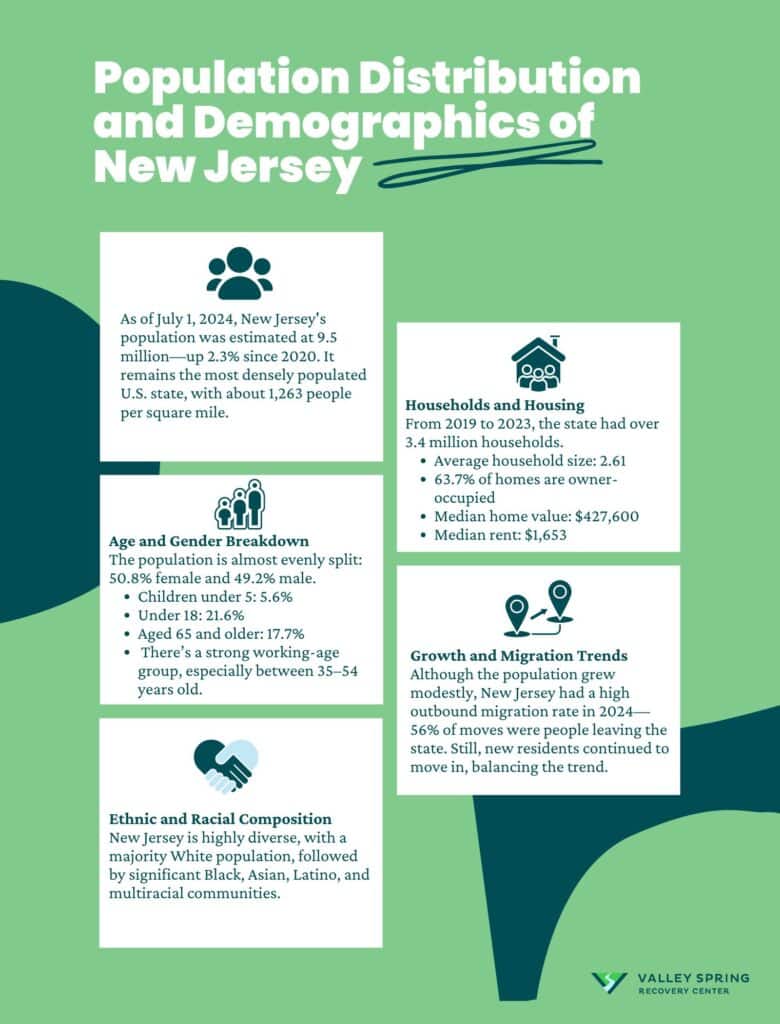
The population distribution and demographics of New Jersey are explained below:
- Age and Gender Breakdown of New Jersey Residents: The population is nearly evenly split by gender, with females making up 50.8% and males 49.2%. Children under 5 years comprise 5.6% of the population, those under 18 account for 21.6%, and individuals aged 65 and over represent 17.7%.
- Ethnic and Racial Composition in New Jersey:
| Race | Percentage |
| White | 56.93% |
| Black or African American | 12.96% |
| Asian | 9.91% |
| Other races | 9.15% |
| Two or more races | 10.56% |
| Native American | 0.45% |
| Native Hawaiian or Pacific Islander | 0.03% |
Source: World Population Review
- Household and Family Structure in New Jersey: Between 2019 and 2023, New Jersey recorded a total of 3,478,355 households, according to the U.S. Census Bureau. The average household size was approximately 2.61 persons. About 63.7% of these households were owner-occupied, reflecting a strong preference for homeownership across the state. The median value of owner-occupied housing units was $427,600, indicating relatively high property values consistent with New Jersey’s cost of living. The median gross rent stood at $1,653, underscoring the state’s competitive rental market.
- Population Growth Trends and Migration Patterns in New Jersey: From April 2020 to July 2024, New Jersey’s population grew by approximately 2.3%, reflecting modest but steady growth. Despite this increase, the state experienced a high outbound migration rate in 2024, with 56% of migration classified as outbound, placing New Jersey fourth in the nation for residents moving out, according to NJB Magazine and the New York Post. However, this trend was partially offset by inbound migration, as new residents continued to relocate to the state, contributing to its overall population growth.
- Age and Gender Breakdown of New Jersey Residents: In 2023, approximately 13.3% of New Jersey’s population was aged 35 to 44, and 12.8% were aged 45 to 54, according to Statista. This reflects a substantial working-age population alongside a growing segment nearing retirement, highlighting the importance of age-specific planning in areas like healthcare, employment, and senior services.
Did you know most health insurance plans cover substance use disorder treatment? Check your coverage online now.
Effect of Population Distribution on Urban vs. Rural Rehab Centers: Access and Availability
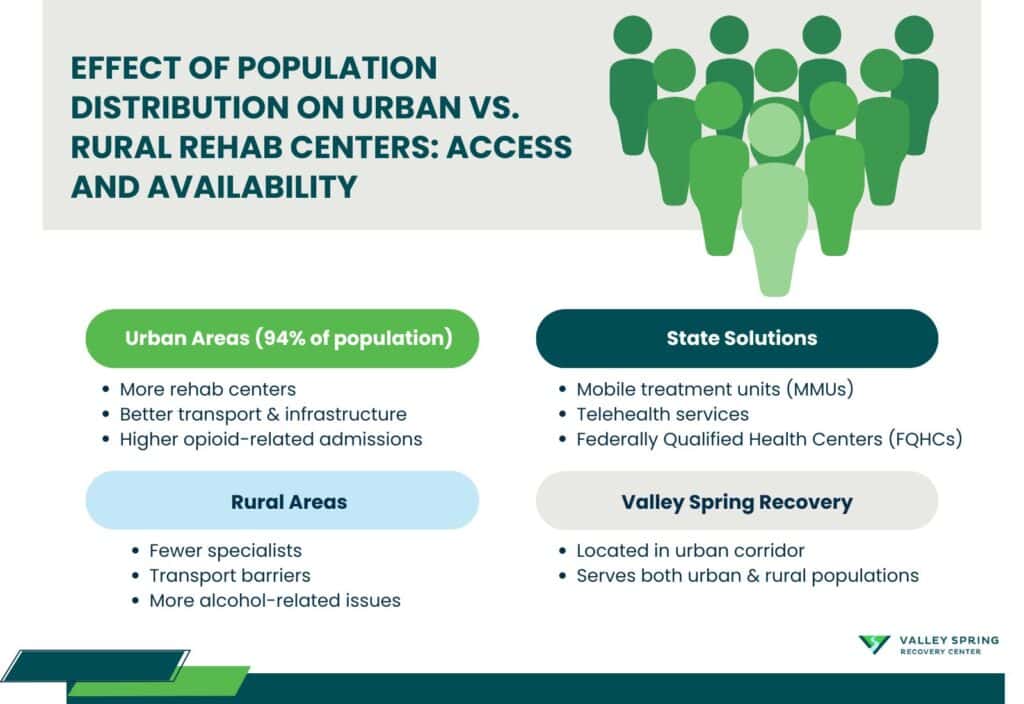
The demographic and geographic distribution in New Jersey directly impacts where rehabilitation centers are located and who can access them. With nearly 94% of the population residing in urban areas, addiction treatment services are heavily concentrated in counties like Bergen, Middlesex, and Essex. These regions benefit from well-developed healthcare infrastructure, diverse clinical programs, and transportation networks that make treatment more accessible and responsive to community needs.
In contrast, rural areas, particularly in the northwestern and southern parts of the state, face considerable access challenges. Geographic isolation, a limited healthcare workforce, and underfunded infrastructure make it difficult for residents to find and sustain treatment. Key barriers include the lack of public transportation, few addiction specialists, reduced Medicaid acceptance and heightened stigma around seeking help in small, tight-knit communities.
To address these disparities, New Jersey has implemented innovative solutions aimed at bridging the treatment gap. Mobile Medication Units (MMUs) now bring opioid treatment programs directly to underserved regions, reducing geographic barriers. The growth of telehealth services has also enabled rural residents to participate in therapy and counseling sessions from home. Federally Qualified Health Centers (FQHCs) provide affordable and comprehensive addiction care to low-income and rural populations, expanding the reach of support systems statewide.
Socioeconomic factors further influence substance abuse patterns and access. Urban centers report higher opioid-related admissions, driven by economic instability and drug availability, while rural regions see more alcohol-related issues, tied to social norms and limited recreational outlets. These disparities highlight the need for tailored interventions that consider both regional demographics and economic conditions.
How Do Population Demographics Affect Income Levels In New Jersey?
Population demographics significantly influence income levels in New Jersey by shaping the education, employment, and industry makeup of different regions. Counties with a higher share of residents holding bachelor’s degrees or above—such as Hunterdon and Somerset—tend to have larger concentrations of professional and managerial jobs, which drive up median household income. In contrast, areas with lower educational attainment and a higher reliance on lower-wage sectors, like agriculture or manufacturing, often report lower earnings.
Urban centers with diverse immigrant populations—for example, Hudson and Essex counties—can show a mix of high-earning professional enclaves alongside lower-income communities, reflecting both global talent inflows and economic inequality. Age distribution also matters: counties with larger working-age populations in high-demand industries typically generate higher per-capita income, while retirement-heavy coastal areas may see reduced average earnings due to fixed-income households. Over time, population shifts, commuting patterns, and industry clustering reinforce these regional disparities, creating a pronounced wealth gap across the Garden State.
Share This Post

Valley Spring Editorial Team
All author posts
Our Therapuetic Recovery Programs
Are you covered for treatment?







Valley Spring Recovery Center is an approved provider for Blue Shield of California and Cigna, while also accepting many other major insurance carriers.
Check Coverage Now!