


Clinical guide
Drug Rehab Center: Types, What to Expect, and Levels of Care
Drug rehab centers: facility types and labels, levels of care, the 5 admission steps, how long treatment runs, and how to verify a license.
By Paul James Roeser·Reviewed by Noelle Mathew, LCSW, LCADC, CASAC-M·12 min read
Published ·Updated
A drug rehab center is a licensed facility that treats substance use disorders through clinical assessment, behavioral therapy, medication where it applies, and a written plan for the care that follows discharge. The Substance Abuse and Mental Health Services Administration counted 20,681 eligible substance use and mental health treatment facilities across the United States and its territories for the 2023 National Substance Use and Mental Health Services Survey, at an overall response rate of 84.9 percent.
Facilities differ from one another on three attributes a license records: the level of care each is authorized to deliver, the setting it delivers that care in, and the ownership model that funds it. Amenity lists and program branding sit outside all three.
What Is A Drug Rehab Center?
A drug rehab center is a state-licensed facility that diagnoses substance use disorders, delivers behavioral therapy and medication under clinical supervision, and plans the continuing care that follows discharge. The license names the levels of care the facility is authorized to provide, and that authorization defines what the facility treats.
The diagnosis a rehab center works from is the substance use disorder defined in the DSM-5, scored against 11 criteria covering impaired control, social impairment, risky use, and pharmacological features such as tolerance and withdrawal. Two or three criteria meet the threshold for a mild disorder, four or five for moderate, and six or more for severe. Severity, medical history, and living situation together set the intensity of care a facility recommends. Severity is also what separates the categories of facility a family encounters when it starts searching, and it shapes whether two partners enter treatment together or separately.
What Types Of Drug Rehab Centers Are There?
Drug rehab centers sort into 4 categories that describe different things: the level of care a facility is licensed for, the setting it operates in, the ownership model behind it, and the curriculum or population it specializes in. Only the first is a clinical classification. The other three describe how treatment is packaged, priced, and staffed around it.
Curriculum and specialty labels are the ones a family meets first, because facilities market with them. The 6 labels each describe something real, and each has a verification question that converts the label back into a checkable fact.
| Rehab center label | What the label describes | The question that tests it |
| Holistic | Yoga, mindfulness practice, acupuncture, and nutrition counseling delivered alongside behavioral therapy | Which evidence-based therapies run alongside the holistic curriculum, and which licensed clinicians deliver them |
| Experiential | Action-based sessions such as psychodrama, role play, adventure and wilderness activity, and animal-assisted work | Whether the experiential work supplements individual and group therapy or replaces it |
| Luxury | Private rooms, resort settings, concierge services, and a higher price per day | Which level of care the license authorizes, since amenities carry no clinical rating |
| Specialty population | Programming built for veterans, licensed professionals, or people in the criminal justice system | What changes in the clinical protocol for that population beyond the composition of the group |
| Nonprofit or for-profit | The tax status that funds the facility and shapes its pricing and admission deposit | What the whole episode costs and how much is requested before admission |
| State-funded or Medicaid | Public funding that removes or reduces the cost to the person admitted | Whether the facility has capacity at the assessed level of care and how long the wait runs |
A luxury rehab center pairs a licensed level of care with hotel-grade accommodation, private suites, and a secluded setting. Price and privacy separate it from a standard program. The clinical instruments are identical: the same state license authorizes the level of care, the same accreditation standards apply, and the same evidence-based therapies carry the treatment. Two facilities holding the same license deliver the same authorized intensity of care whether or not one of them has a pool.
Every label still sits inside an older distinction, the one between what a program does and what a person does after the program ends.
What Is The Difference Between Rehabilitation and Recovery?
Rehabilitation is the set of clinical interventions delivered inside a program, and recovery is the ongoing process of change that continues after the program discharges the patient. The World Health Organization defines rehabilitation as a set of interventions designed to optimize functioning and reduce disability in individuals with health conditions in interaction with their environment.
SAMHSA published its working definition of recovery in 2012, and it names a different object: a process of change through which individuals improve their health and wellness, live self-directed lives, and strive to reach their full potential. That definition rests on 4 supporting dimensions.
- Health: management of the disorder and its symptoms, and informed choices that support physical and emotional well-being.
- Home: a stable and safe place to live.
- Purpose: meaningful daily activity such as a job, school, volunteering, family caretaking, or creative work, with the income and independence to participate in society.
- Community: relationships and social networks that supply support, friendship, love, and hope.
A rehab center is directly accountable for the first dimension and contributes to the other three through discharge planning. The route into that program starts with a phone call and an assessment.
What Are The Steps To Get Into Rehab?
Admission to a drug rehab center runs through 5 steps: an intake call, a clinical and financial assessment, a level-of-care determination, consent and admission paperwork, and the start of the treatment plan, whose progress is then tracked at review points and, in some programs, through remote patient monitoring. The assessment governs the other four, because the level of care it produces sets the schedule, the cost, and the length of the episode.
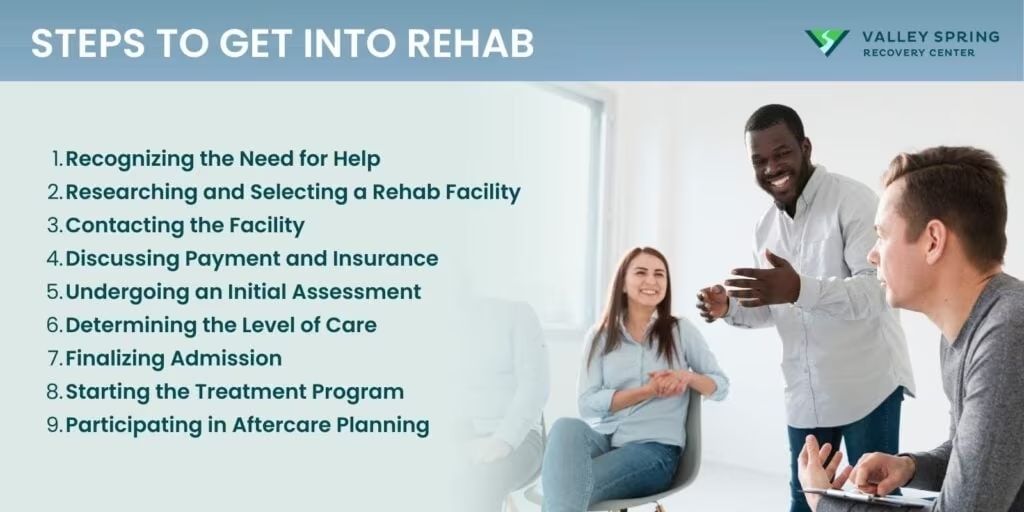
The 5 steps run in sequence at a licensed facility, and each one produces a record the next step depends on.
- Call the facility intake line and describe the substance, the pattern of use, and any history of withdrawal.
- Complete the clinical assessment, which covers medical history, psychiatric history, substance use history, and current living situation.
- Verify coverage with the facility benefits team before the level of care is finalized, and ask for the verification in writing.
- Sign the consent, release, and financial responsibility forms that authorize treatment and set what the facility shares with other providers.
- Begin the treatment plan at the assessed level of care, with a scheduled date for the first clinical review.
The rehab assessment and consent process includes clinical questions, required forms, privacy notices, and patient rights. The level-of-care recommendation comes from a published clinical standard rather than the facility's marketing label.
What Are The Drug Rehab Levels of Care and Intensity?
Drug rehab centers deliver levels of care defined by the American Society of Addiction Medicine, running from Level 1 outpatient care through Level 4 medically managed inpatient care. A facility holds a license for specific levels and refers to another provider for the rest. ASAM released the fourth edition of The ASAM Criteria in 2023.
Withdrawal management, known outside clinical settings as detox, is its own level of care rather than a stage inside the others. The National Institute on Drug Abuse states that detoxification alone without subsequent treatment generally leads to resumption of drug use. A facility licensed for outpatient care therefore refers a patient who needs medically supervised withdrawal to a detox provider and admits that patient after discharge, with provider-to-provider communication keeping the plan continuous across the handover. Addiction treatment levels of care include three residential sub-levels, while inpatient residential rehab provides 24-hour structure outside the outpatient continuum.
What Are The Different Types Of Therapies That Occur in A Rehab Center?
A rehab center runs a fixed weekly schedule of individual therapy, group process sessions, psychoeducation, psychiatric review where medication applies, and family work. The therapies are named and manualized rather than improvised, and the treatment plan is rewritten as the clinical picture changes.
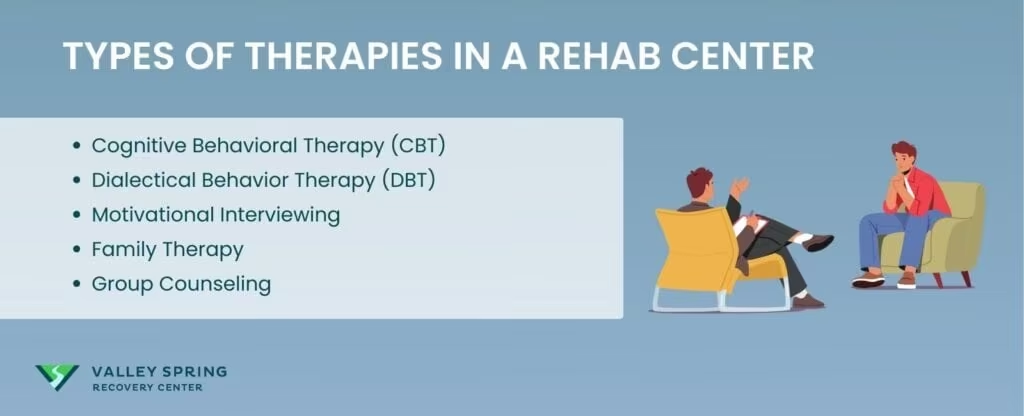
The 5 clinical methods account for the largest share of the treatment schedule at a licensed facility.
- Cognitive behavioral therapy identifies the thoughts and situations that precede use and rehearses a different response to them.
- Contingency management pays a tangible reward on a verified negative drug test, reinforcing abstinence on a fixed schedule.
- Motivational interviewing resolves ambivalence about change by drawing the reasons for it from the patient rather than supplying them.
- Dialectical behavior therapy teaches mindfulness, distress tolerance, emotion regulation, and interpersonal effectiveness as named skills.
- Medication for addiction treatment applies FDA-approved medicines, including buprenorphine, methadone, and naltrexone for opioid use disorder and naltrexone, acamprosate, and disulfiram for alcohol use disorder.
Pearson, Frank S. and colleagues measured the evidence behind those methods in their 2012 study "Meta-analyses of seven of NIDA's principles of drug addiction treatment," published in the Journal of Substance Abuse Treatment. Pooling published trials, they recorded the largest effect for therapeutic communities at g = 0.36, followed by reassessment of the treatment plan at g = 0.25, matching treatment to assessed need at g = 0.24, contingency management at g = 0.21, and cognitive behavioral therapy at g = 0.11. Those same methods run at every level of care, at the intensity the license sets. Valley Spring Recovery Center delivers behavioral therapies, counseling and recovery support through its intensive outpatient program in Norwood, New Jersey on an evening schedule built around a working week. Length of stay is the attribute families ask about next.
How Long Does Rehab Last?
Drug rehab lasts 3 months or longer. The National Institute on Drug Abuse states in its Principles of Drug Addiction Treatment that most people with an addiction need at least 3 months in treatment to significantly reduce or stop drug use, and that the strongest results come at longer durations. The assessed level of care sets the schedule inside those months.
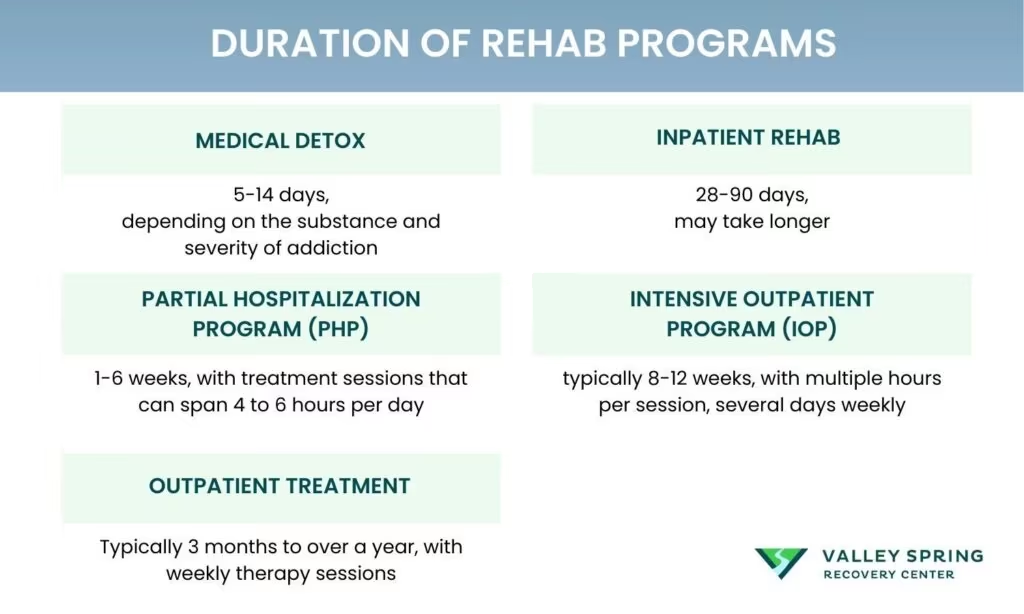
The evidence behind the duration principle is weaker than the principle itself, and saying so is more useful than repeating it. Pearson and colleagues found the treatment-duration principle unsupported across the trials they pooled, at an effect size of g = 0.02 with a confidence interval crossing zero, while matching treatment to assessed need and reassessing the plan both held. The practical reading is that time in treatment is a proxy for what happens during that time, and the facility that reassesses and adjusts a plan produces the result raw duration gets credited with. Cost tracks duration closely, and the breakdown of how much drug rehab costs gives the per-day and per-episode figures by level of care and tax status.
How Do You Check That A Drug Rehab Center Is Legitimate?
A drug rehab center is verified through 3 independent records: the state license authorizing it to operate at a named level of care, the accreditation it holds from a body such as CARF or The Joint Commission, and its listing in SAMHSA's national treatment locator. Each record is published by a third party, and none of them originates with the facility.
The 3 records answer different questions, and a facility that satisfies one but not the others is worth a direct question.
- State licensure is mandatory. The state agency issues a license number for each authorized level of care, publishes it, and inspects against it, so a facility that declines to give the number has answered the question.
- Accreditation is voluntary. CARF International accredits behavioral health programs through a consultative peer-review survey, and its Behavioral Health Standards Manual covers program types including outpatient treatment, residential treatment, and withdrawal management. A facility names the specific program types it holds.
- Federal listing is public. SAMHSA's national treatment locator carries the services and levels of care each facility reported to the National Substance Use and Mental Health Services Survey, which is the same survey that counts the facilities.
Licensure and accreditation describe a facility at the point of admission. The plan that follows discharge is separate, and it decides whether the episode holds.
What Happens After Rehab?
After discharge a patient continues in a stepped-down level of care, a housing arrangement that supports abstinence, and a written relapse-prevention plan naming specific triggers and scheduled follow-up. Discharge from the most intensive level is a transition inside one episode of care rather than the end of it.
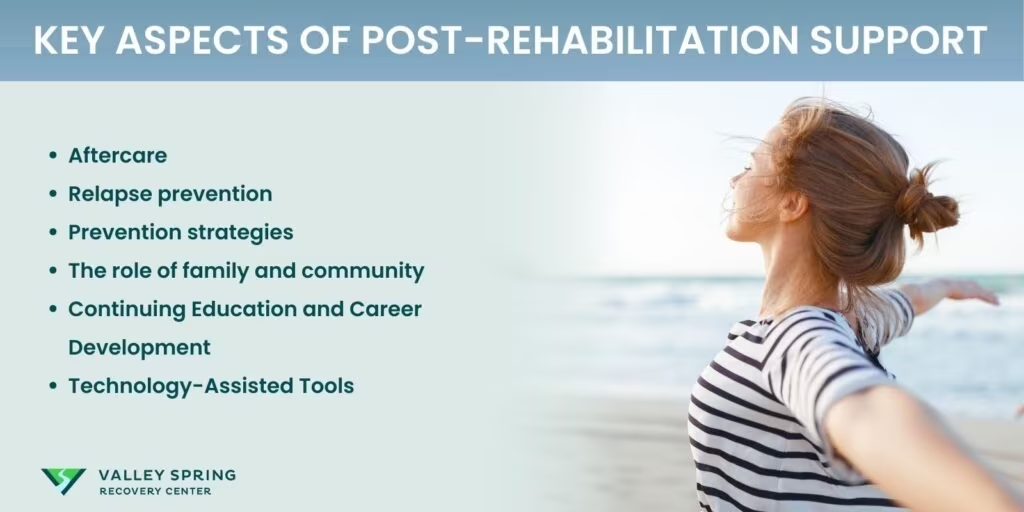
The step-down runs from residential care to partial care, then to intensive outpatient, then to standard outpatient, with contact frequency falling at each step. Housing carries the second dimension of SAMHSA's recovery definition, and the comparison of recovery residences and transitional housing covers sober living homes, halfway houses, and Oxford Houses. The relapse-prevention plan names the people, places, and emotional states that preceded use for that patient, and it schedules the therapy, peer support, and medication reviews that follow. A facility that hands over a plan naming all three, with dates attached, has done the part of the work that outlasts the building. Anyone comparing facilities now has a first question ready for the admissions line: the license number, and the level of care the assessment produced.
What Are The Most Common Questions About Drug Rehab Centers?
Common questions about drug rehab centers: cost, insurance, leaving early, the boundary between detox and rehab, luxury facilities, and how quickly admission happens.
How Much Does Drug Rehab Cost?
Cost varies by level of care, length of the episode, and the facility tax status. Residential care costs the most per day and standard outpatient the least. Commercial insurance, Medicaid, and state funding each reduce what the person admitted pays.
Can You Leave A Rehab Center Whenever You Want?
Yes. A voluntary admission allows discharge against medical advice at any point. The facility documents the discharge, records the risks it explained, and notifies the referring provider. Court-ordered admissions and civil commitments are the exceptions to that rule.
Do Rehab Centers Accept Insurance?
Licensed facilities bill commercial insurance, Medicaid, or both, and verify benefits before admission. Coverage turns on the authorized level of care, the network status of the facility, and the plan's own medical-necessity criteria. Ask for the verification in writing.
What Is The Difference Between Detox And Rehab?
Detox, clinically called withdrawal management, treats the physical process of stopping a substance. Rehab treats the disorder that produced the use. NIDA states that detoxification without subsequent treatment generally leads to resumption of drug use, which is why detox discharges into treatment.
Are Luxury Rehab Centers More Effective?
Amenity level carries no clinical rating. The state license, the accredited program types, the credentials of the clinicians, and the therapies delivered are what an accreditation survey assesses. Two facilities holding the same license deliver the same authorized level of care.
How Quickly Can Someone Be Admitted To Rehab?
Admission timing depends on the assessment, insurance authorization, and availability at the assessed level of care. Outpatient admission moves fastest because it requires no bed. A facility schedules the assessment first and sets the intake date from its result.
Sources & References8ShowHide
- SAMHSA. National Substance Use and Mental Health Services Survey (N-SUMHSS), 2023 annual release — Source of the 20,681 eligible substance use and mental health treatment facilities figure and the 84.9 percent overall response rate, covering the 50 states, the District of Columbia and the U.S. territories.
- World Health Organization. Rehabilitation (fact sheet) — Definition of rehabilitation as a set of interventions designed to optimize functioning and reduce disability in individuals with health conditions in interaction with their environment. Used to separate rehabilitation from recovery, correcting an earlier attribution that credited this definition to recovery.
- SAMHSA. SAMHSA's Working Definition of Recovery (PEP12-RECDEF, 2012) — The 2012 working definition of recovery and its 4 supporting dimensions: health, home, purpose, and community.
- NIDA. Drugs, Brains, and Behavior: The Science of Addiction, Treatment and Recovery — Statement that detoxification alone without subsequent treatment generally leads to resumption of drug use, and the 40 to 60 percent substance use disorder relapse comparison with hypertension and asthma.
- NIDA. Principles of Drug Addiction Treatment: A Research-Based Guide (Third Edition) — Source of the minimum-duration principle: research indicates most people with an addiction need at least 3 months in treatment to significantly reduce or stop drug use, with better outcomes at longer durations.
- Pearson FS, Prendergast ML, Podus D, Vazan P, Greenwell L, Hamilton Z. Meta-analyses of seven of NIDA's principles of drug addiction treatment. Journal of Substance Abuse Treatment, 2012;43(1):1-11 (PMC) — Effect sizes quoted on this page: therapeutic communities g = 0.36, treatment-plan reassessment g = 0.25, matching treatment to assessed need g = 0.24, contingency management g = 0.21, cognitive behavioral therapy g = 0.11, and the treatment-duration principle g = 0.02 with a confidence interval including zero.
- American Society of Addiction Medicine. About The ASAM Criteria — Confirms the Fourth Edition was released in 2023. That edition renumbered the continuum: Level 0.5 was removed, Level 4 became medically managed inpatient, and Level 3.3 was eliminated, leaving three residential sub-levels.
- CARF International. Behavioral Health accreditation — CARF accredits behavioral health programs including outpatient treatment, residential treatment and withdrawal management, through a consultative peer-review survey process. CARF publishes the list of program types but states no count.
Explore This Topic Further
How Long Does Drug Rehab Last? Treatment Length by Level of Care
→How to Know if You Need Drug or Alcohol Rehab: Addiction Assessment, Diagnosis, and Early Detection
→Outpatient Drug Rehab: Types, Cost, Duration, and Effectiveness
→FMLA for Going To Rehab: How To Go Without Losing Job
→How Much Does Drug Rehab Cost?
→Can You Leave Rehab Whenever You Want? AMA
→Does Drug Rehab Work? Effectiveness And Success Statistics
→Can You Get Fired for Going to Rehab? Protecting Your Job During Rehab.
→Insurance Coverage For Addiction Treatment: Plan Types, Authorization, and Payment
→Packing for Drug Rehab: What To Bring And Leave At Home
→Checking In To Drug Rehab: Assessment And Consent
→Addiction Treatment for Couples: Rehab for People in a Relationship
→Drug And Alcohol Rehab for Men: Benefits and Effectiveness
→6 Components Of Inpatient Residential Drug Rehab
→Telehealth Addiction Treatment And Online Rehab
→How to File a Complaint Against a Drug Rehab Facility
→Food And Snacks In Rehab Centers: Diet, Nutrition, and What to Expect
→Does Going to Rehab Go on Your Record?
→Can Going to Rehab Before Court Date Help Your Legal Case?
→RPM in Addiction Recovery: Remote Monitoring and Progress Measurement
→